
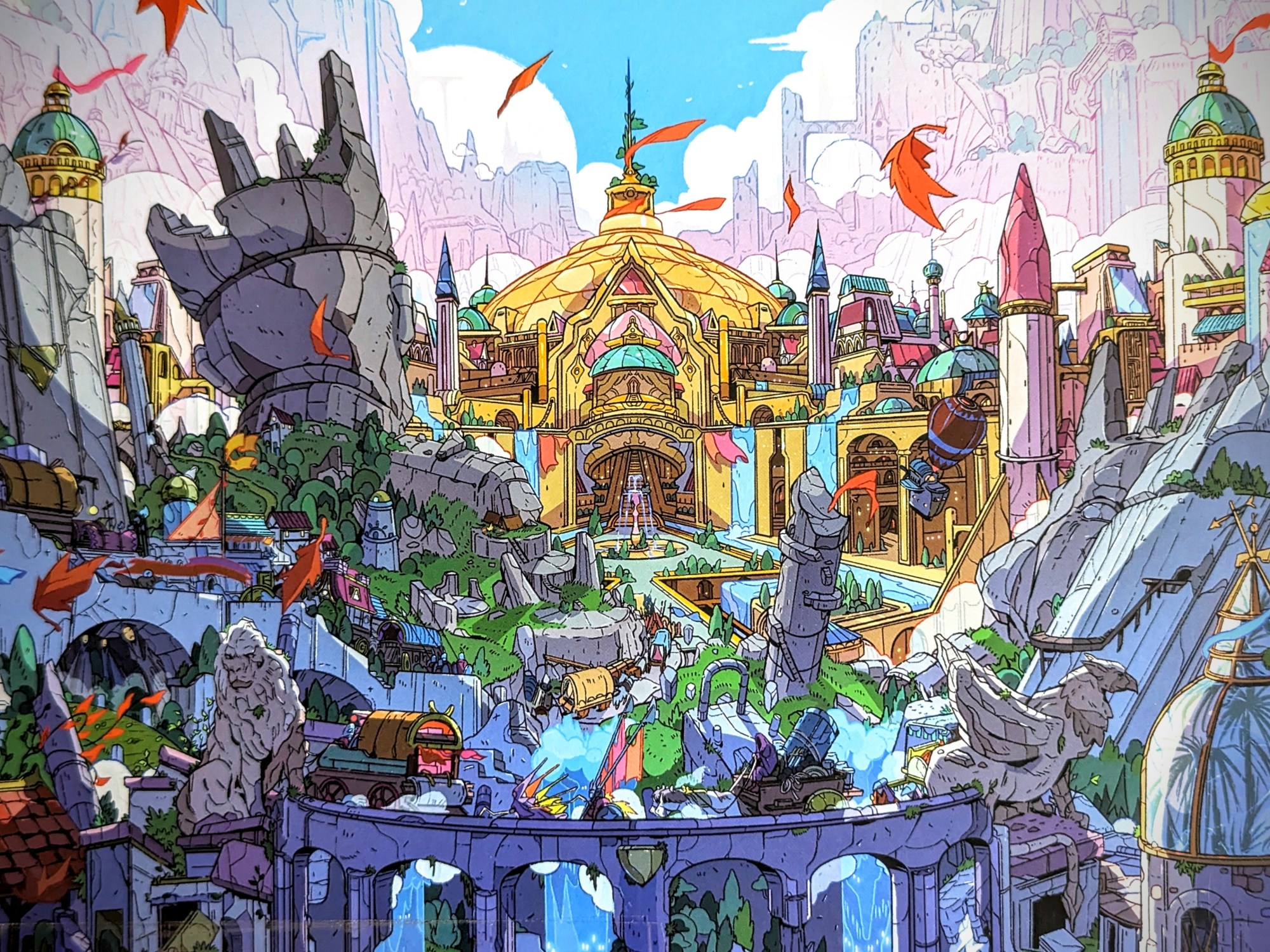
Ding dong the Old King is dead, or long gone…will you be the one to claim the crown of this forgotten Kingdom?
Let’s see if this game is worth the hype, shall we?
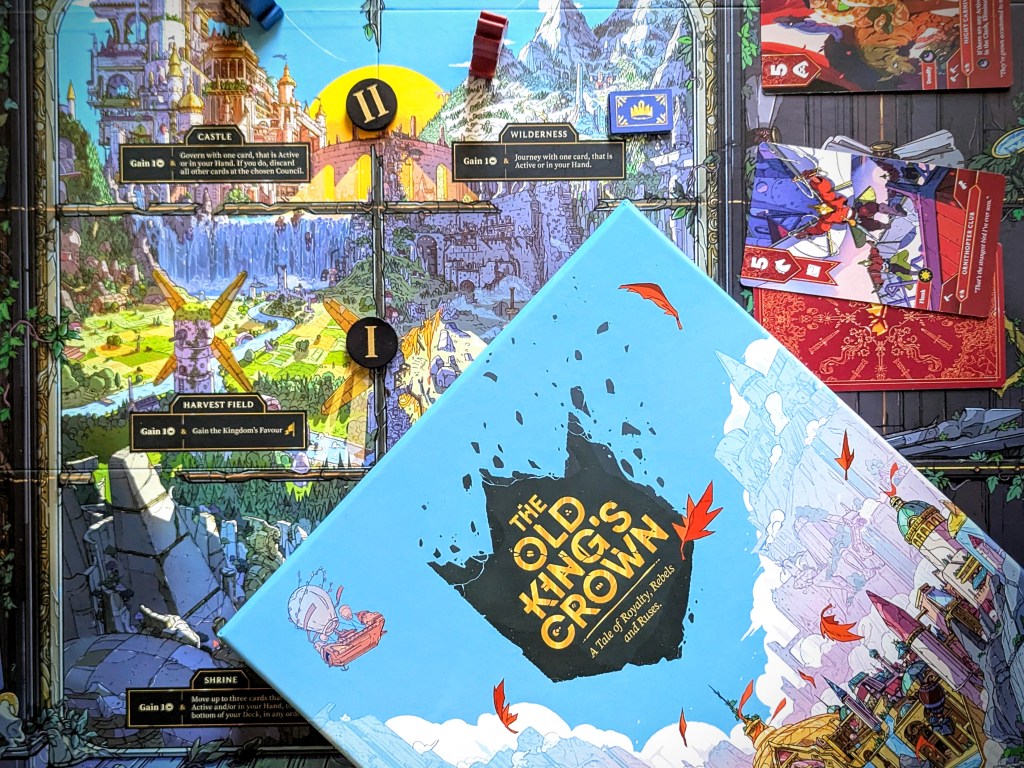
Key stats
1 to 4 players | 60-120 minutes | Age 12+
Publisher: Eerie Idol Games
Designer/Artist: Pablo Clark
Categories: Fantasy, Medieval, Card games
Key mechanics: Hand management, Variable player powers, Card play conflict resolution
Game overview
In The Old King’s Crown (which I’ll henceforth be calling OKC) players are warring Factions competing to rule a forgotten land. It actually has a relatively simple game loop where each round takes you through the seasons of the year. At the end of 5 years, the player with the most influence – gained from winning clashes, governing councils and exploiting card abilities – wins.
Before the year starts, each player draws up to their hand size, and player order is determined by whoever currently has the most influence (most influence is the first player, least influence is the last player, etc). Player hands start at 6, but whenever you need to reshuffle your discard to draw up, your hand limit gets decreased by 1 – so the more you cycle your deck, the more your options are reduced.
Spring – bidding & bluffing
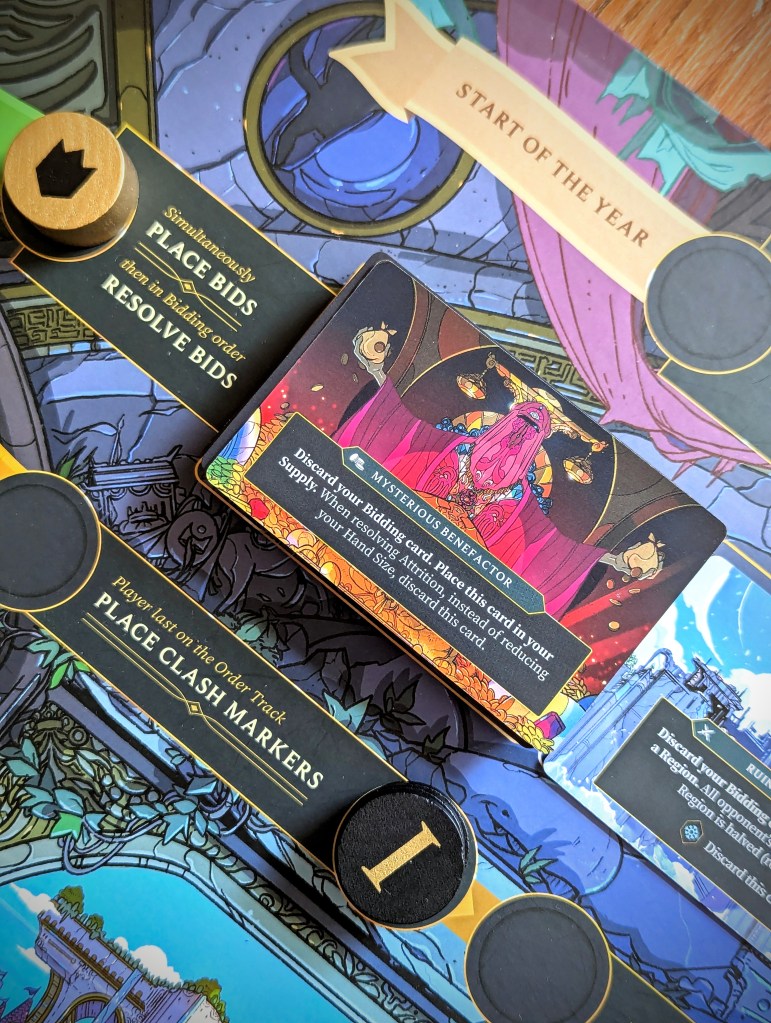
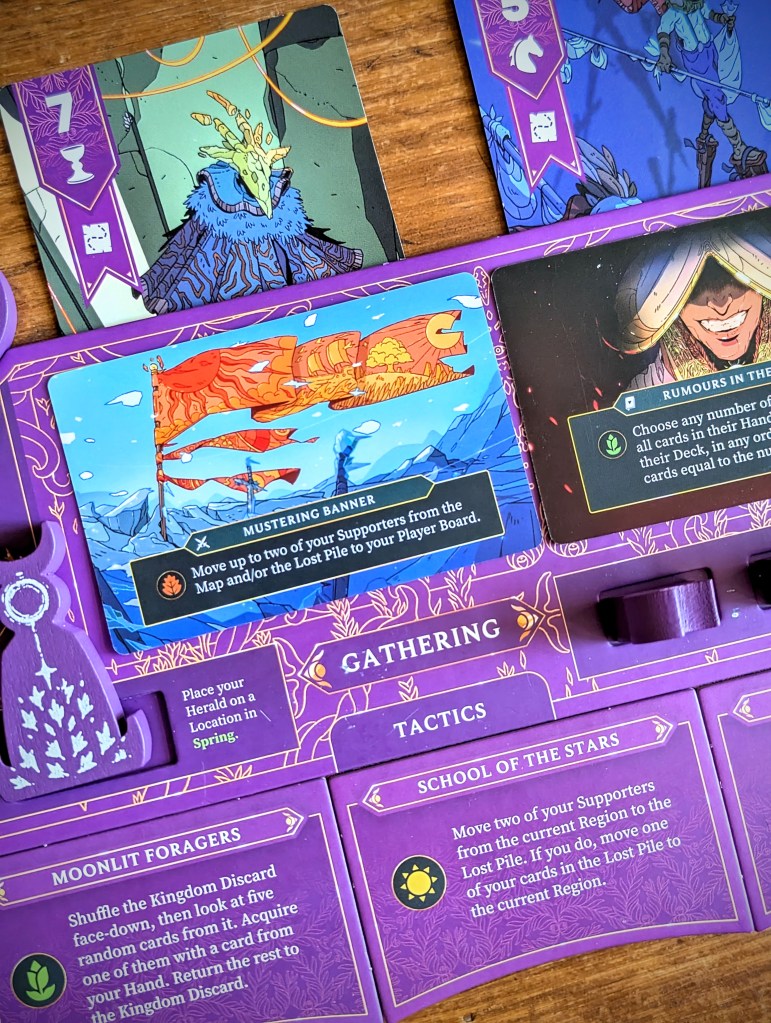
Spring is the season of bidding. First, you secretly bid a faction card from your hand to claim a Kingdom card. Whoever bids highest gets first pick of the Kingdom cards – cards that grant unique abilities for as long as you possess them. You can claim a Kingdom card from the board, tucking your bidding card behind to ‘occupy’ that Kingdom. Or, you can steal another player’s Kingdom card, if your bidding card is stronger than their occupying card. Or, claim no Kingdom card at all, and take your bidding card back in your hand.
Next players bid and bluff for battle. The central board is divided into 3 regions, each with 2 unique locations. Each player, in turn order, places their Herald marker on a location. This usually means they plan to win control and activate that location…unless they’re bluffing. Then each player simultaneously adds a face-down faction card to each region, and can add Supporters to each region if they so choose, adding public strength to their total.
Summer – all out war
It’s time to d-d-d-d-d-d-d-duel! Each region has a Clash (battle) to resolve, and the order they are resolved is decided by the player in last place. To resolve a clash, the faction cards at a region are revealed and, after any abilities and effects are resolved, whoever has the highest combined total strength (from their card and any Supporters) wins control of the region. They choose one of the 2 locations in that region, claim the related influence reward and (optionally) activate that location’s additional ability.
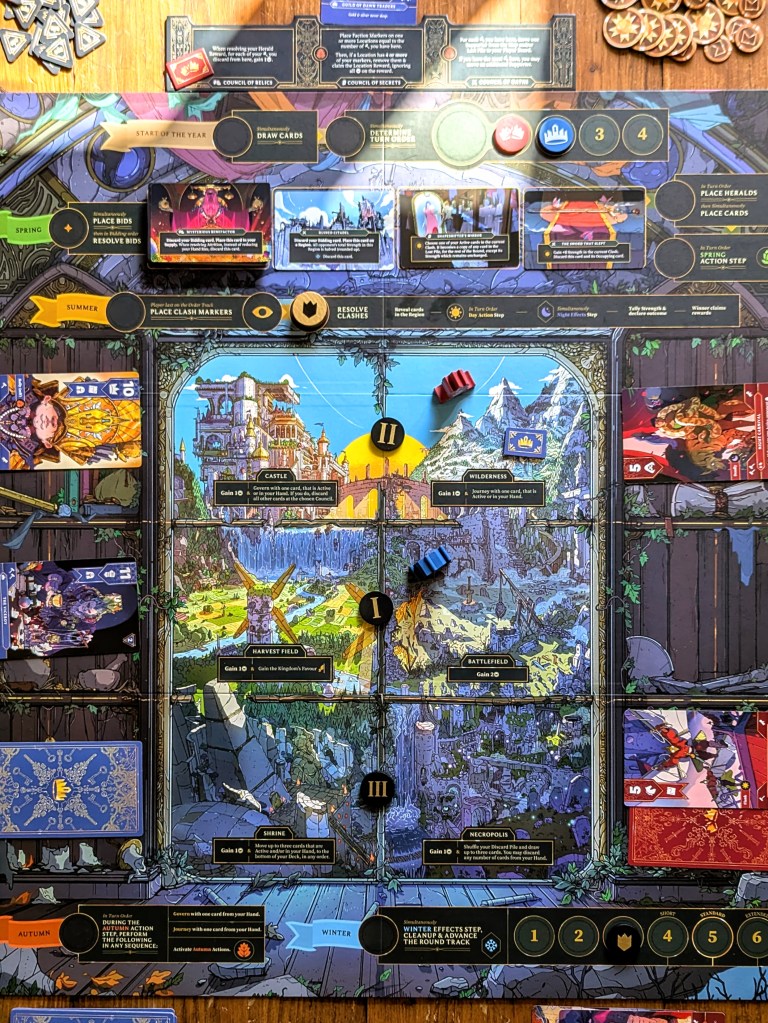
Autumn – adventure and politics
Players, in turn order, either use a Faction card from their hand to Journey or join a Council. Journeying gains lore tokens, which are used to ‘buy’ Advanced Faction-specific cards with cool abilities. Adding a Card to one of the three Councils lets you make use of its power, which is stronger if you have the most influence at that Council.
Winter – season of cleansing
The simplest season, because it’s the cleanup phase, preparing the board state for the next round.
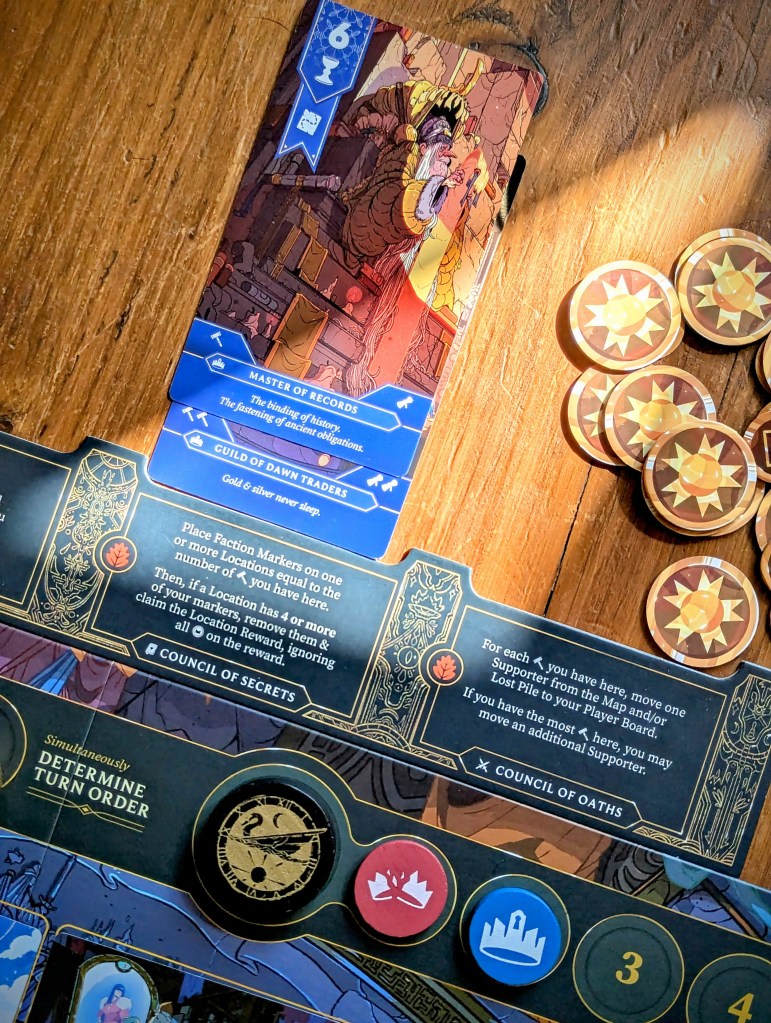
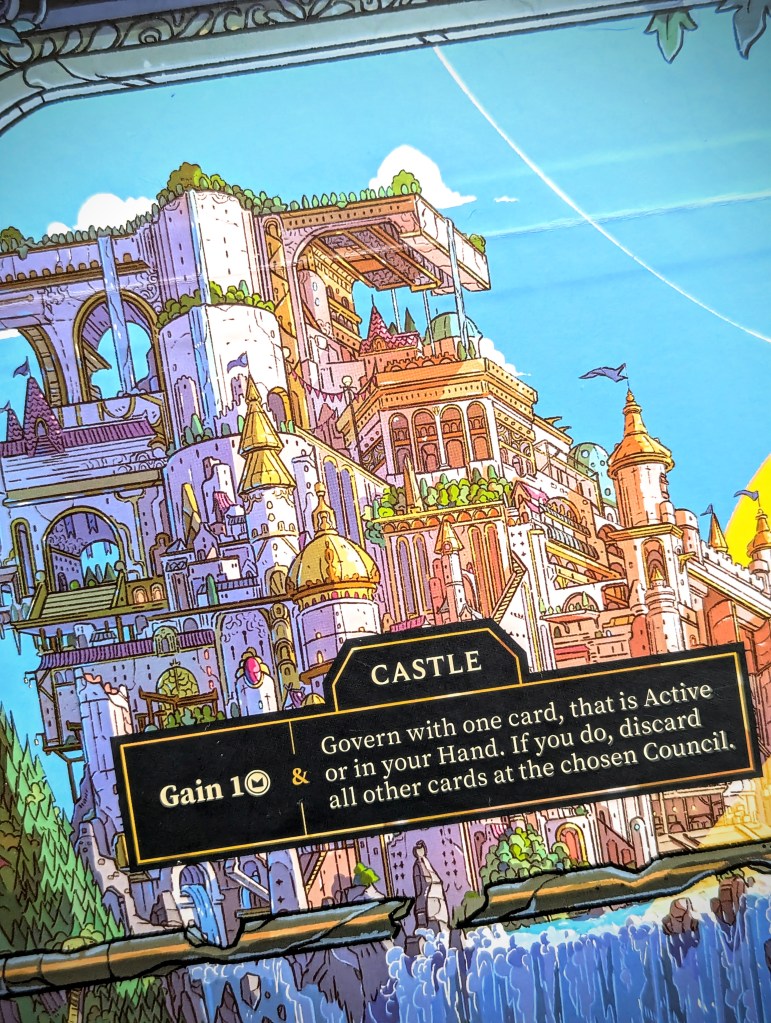
Now, there is a bit more to it than that! Each Faction starts with the same Faction cards, but their Faction specific ‘tactic’ tiles and special Faction cards have abilities that lean to different asymmetric playstyles. Each season also has steps where you can activate season-specific actions, which can come from your Kingdom cards, your active Faction cards (ones used in Clashes), your tactics (which are usually one-use only) and the Councils. have different types of abilities and interactions that can change the landscape of the Kingdom bidding and clashes – the trick is to try and use all of this to your advantage as much as possible.
Our first impressions
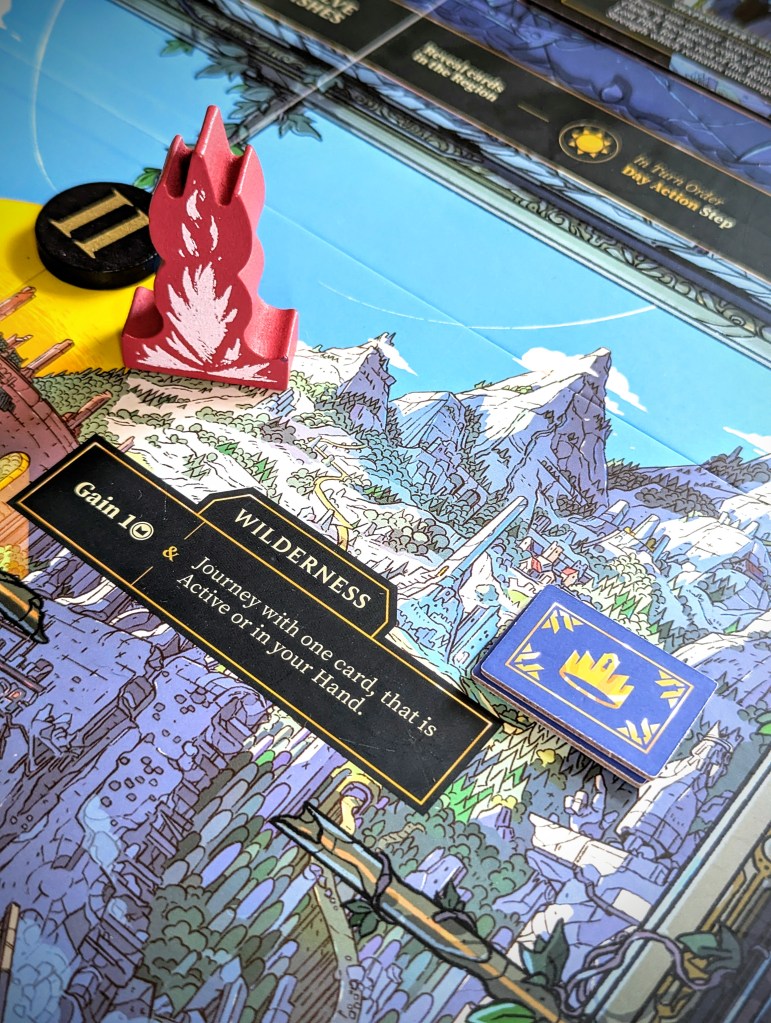
I doubt I need to say this, because everyone says it, but I’ll say it anyway: the game is bloody gorgeous. It could just have easily been set in a generic medieval kingdom, but Pablo’s phenomenal art and lore bring this unique and interesting world to life. Each different image tells a story and leaves me wanting more! We hope this is the start of many games set in the same world, similar to how Thunderworks use the World of Ulos or Red Raven Games use the World of Arzium. The production is also lovely, particularly the Herald and Supporter tokens – the cardboard lore and influence tokens did feel a bit out of place compared to everything else but didn’t impact the experience.
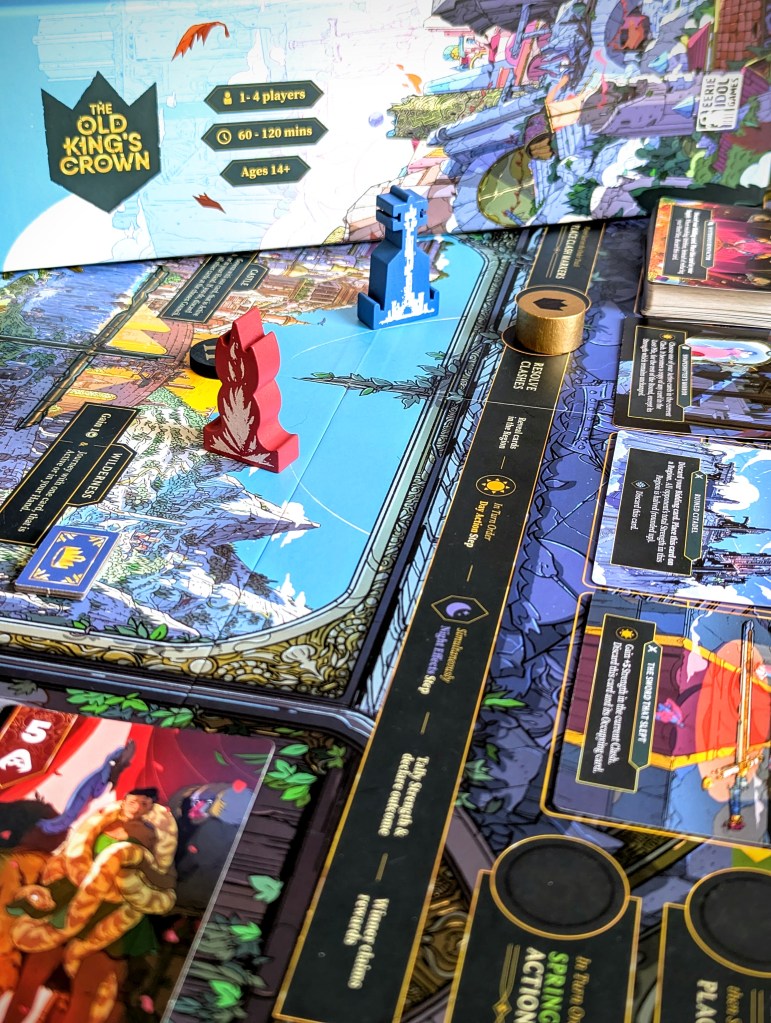
It’s because of the dedication to the art that the game is such a table hog. Each location on the central board has its own artwork. There’s a Council board placed about it, which needs space for the tarot-sized Faction cards. Then each player needs space for their personal faction board, draw/discard piles for Faction cards, Site of Power (where Advanced Faction Cards are purchase from) and personal supply (for lore/influence tokens, but you may also need space for additional location/kingdom cards). Oh, and don’t forget somewhere for the ‘Lost Pile’ – a sin bin where used supporters and some assasinated/journeyed cards get put out of play. On our (slightly slim) 4-6 person dining table, this was the 2-player set-up:
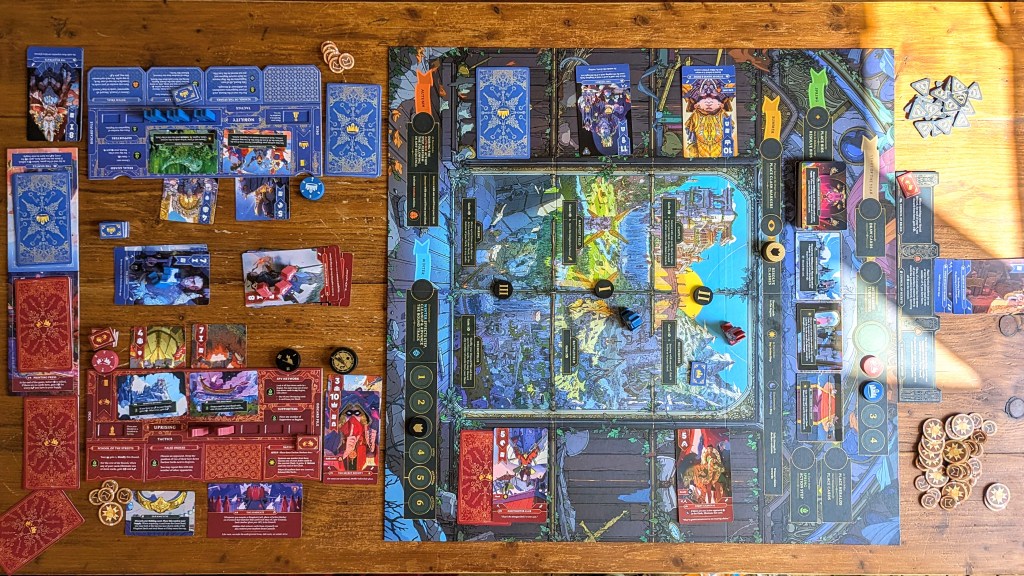
You could argue (as many have) that a lot of this is ‘unnecessary’. And sure, you could strip back the art and shrink the board/cards to save space. But as I’ve already mentioned, the art adds glorious worldbuilding that helps the game stand out, so I wouldn’t want to see it without. It’s part of the experience. But I DO think that some space could be saved by reducing the step-by-step phase order on the main board – it was useful in the first learning game but after that we often forget to keep moving the token and just didn’t need it.
Enough about how it looks, what about how it plays? I was apprehensive going into our first play because I’ve heard about how deeply complex OKC is, and we don’t often get to play games above a 3 rating on BGG. But my fear was mostly unfounded; the gameloop itself is quite straightforward and easy to pick up. The 51-page rule book is intimidating (and there’s a separate one for solo!) but comprehensive, with a very useful glossary.
The complexity comes from the finer details, of which there is…a lot. Each Kingdom card has a unique power. Each Faction has different Faction board abilities, tactics and advanced cards. There is a lorra lorra text in this game, lots of interacting abilities and triggers to keep track of, and it can feel overwhelming. It doesn’t help that the text is quite small and, in many cases, far away across the board. You need multiple plays of this game to get to grips with it all and pick up the synergies, and even then you’ll have moments of oh-shit-i-forgot-to-trigger-this-action. And that’s before you even start delving into the ‘deeper’ strategies of the asymmetric Factions…
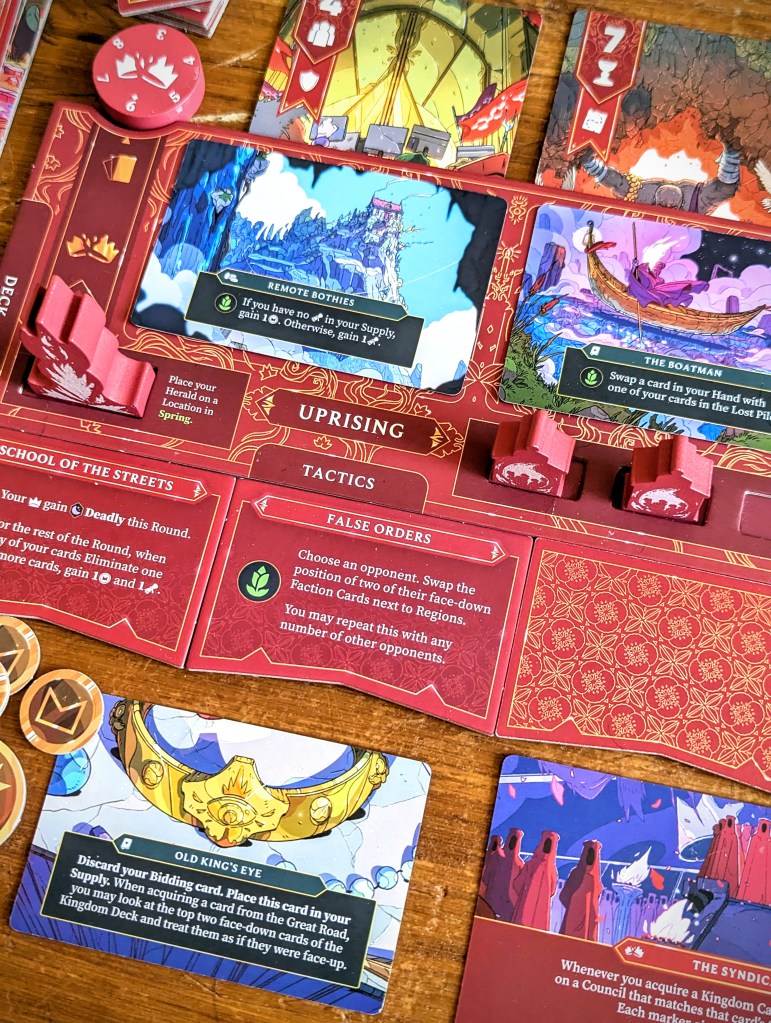
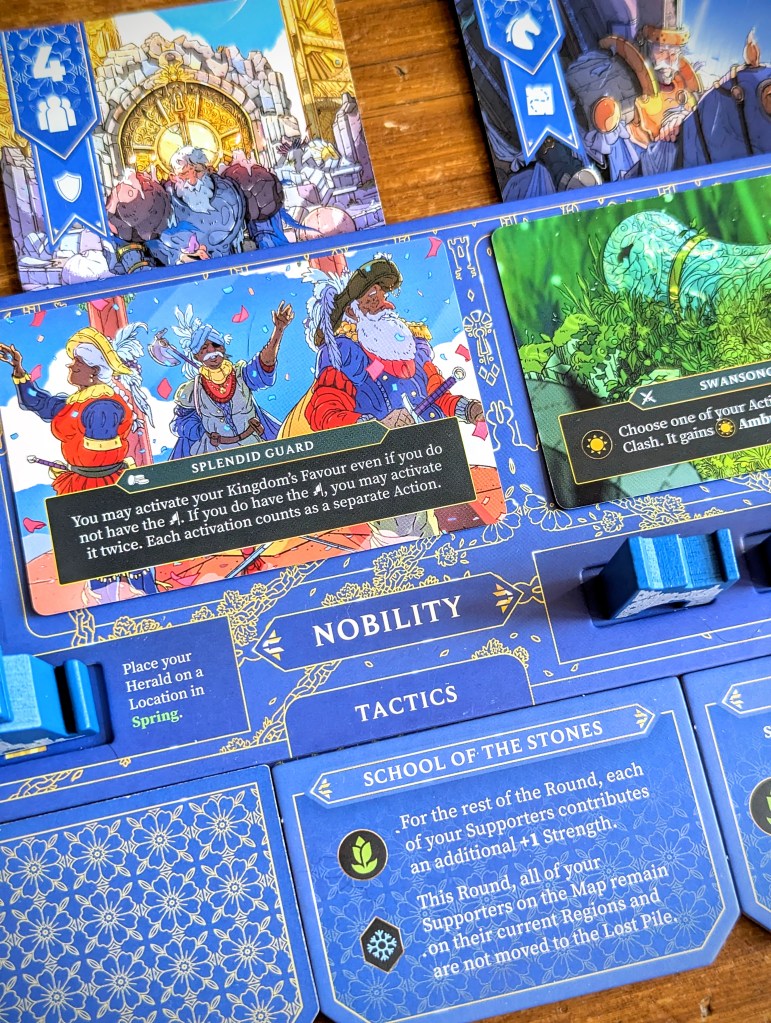
And even though it’s a strategic game, there is also a lot of chaos. It can feel impossible to plan what to play for each clash, especially at the start, because you have no idea what other people have in their hands or what they put where. After the cards are revealed, there’s limited options to swing a loss into a win, so you need to be able to roll with those losses and adapt. This style of chaotic high-conflict won’t be for everyone (I’d argue, won’t be for most), especially if you don’t like feeling you had no say in the outcome. BUT working around (or with) the chaos IS part of the strategy. And the more familiar you get with the game, the easier it gets to plan for multiple possibilities – a little bit of bluffing/negotiating can also come into its own here. And if you’re the one causing havoc, it’s a lot of fun!
So this game definitely opens up the more you play it. But I also think you can still enjoy OKC without going all deep dive into the various strategic nuances as long as you can get over the initial OMG THERE’S SO MUCH hurdle. And expect to lose if you’re a newbie playing against seasoned players.
Note: while writing this review, I’ve come across 2 VERY useful documents from the publisher. The Teaching Guide, which includes various suggestions to vary the setup up and reduce complexity for new players, as well as a gameplay walkthrough. And The Introductory Strategy Guide, which breaks down key concepts and strategic points. Both are very useful indeed!
Each Faction starts with the same starting deck of cards (it’s just the art that’s different). The asymmetry comes through Faction tactics and Advanced Faction cards you choose to buy with lore:
- The Nobility lean more into defence and Council politics.
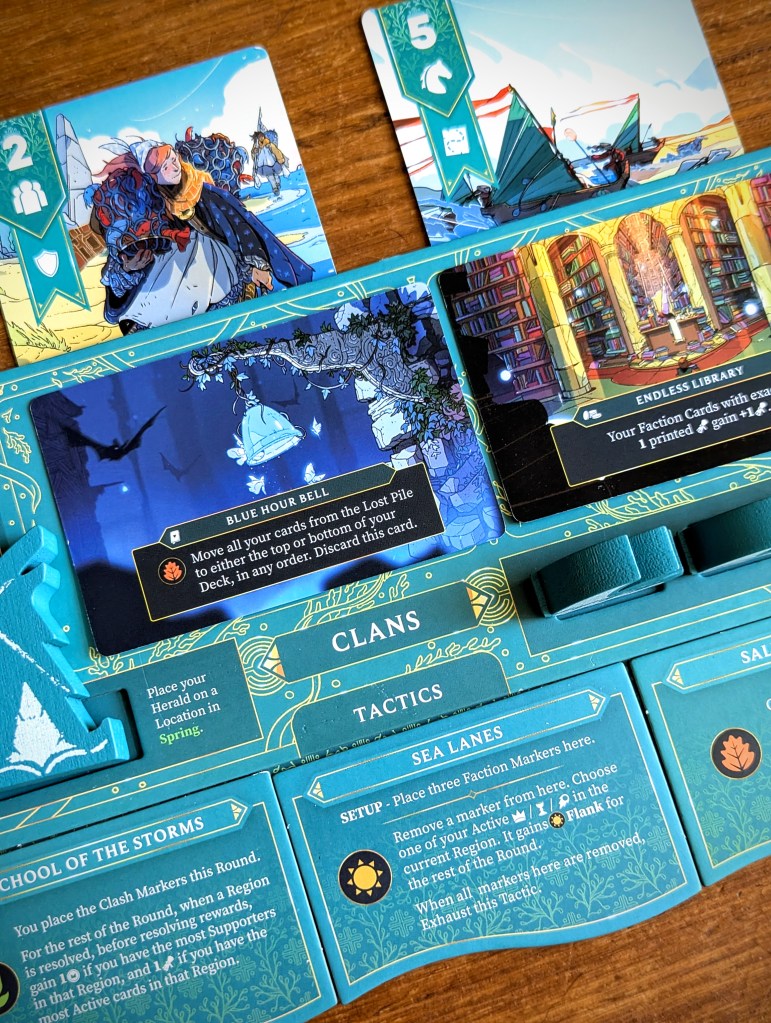
- The Clans lean more into mobility, like the Faction card Flank ability (which moves cards to different regions in clashes) and or moving your Herald & supporters around.
- The Uprising lean more into disruption and eliminating other cards (through the ‘deadly’ Faction card effect)
- The Gathering makes more use of sacrificing your cards and manipulating the Lost pile to slowly build momentum.
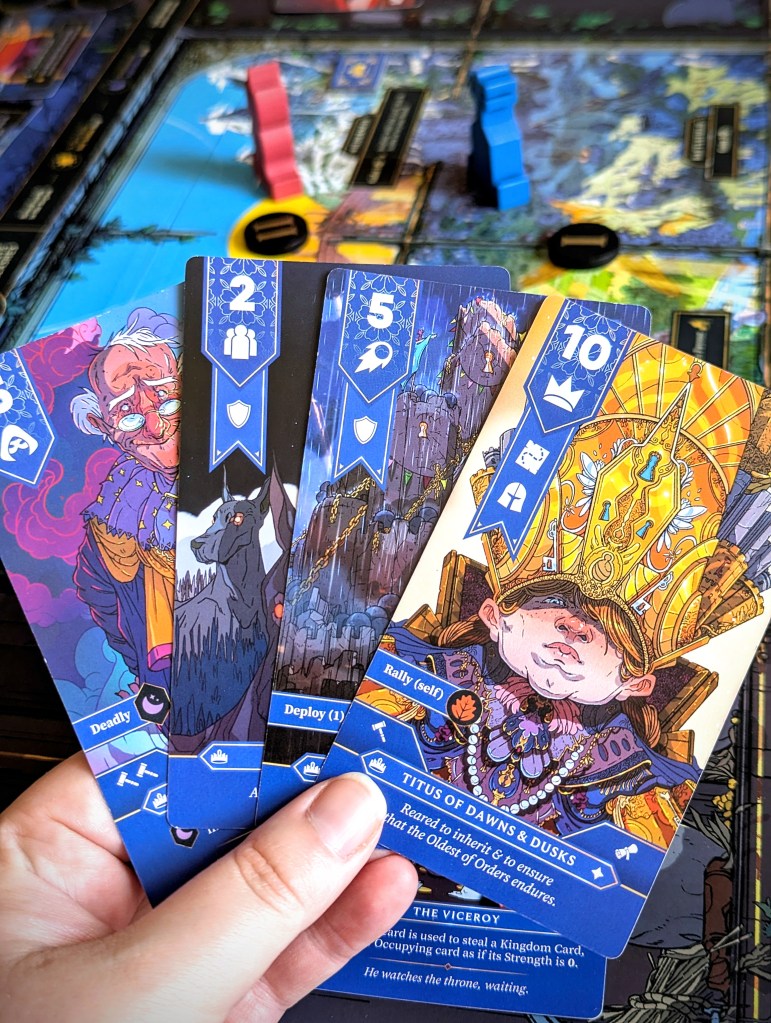
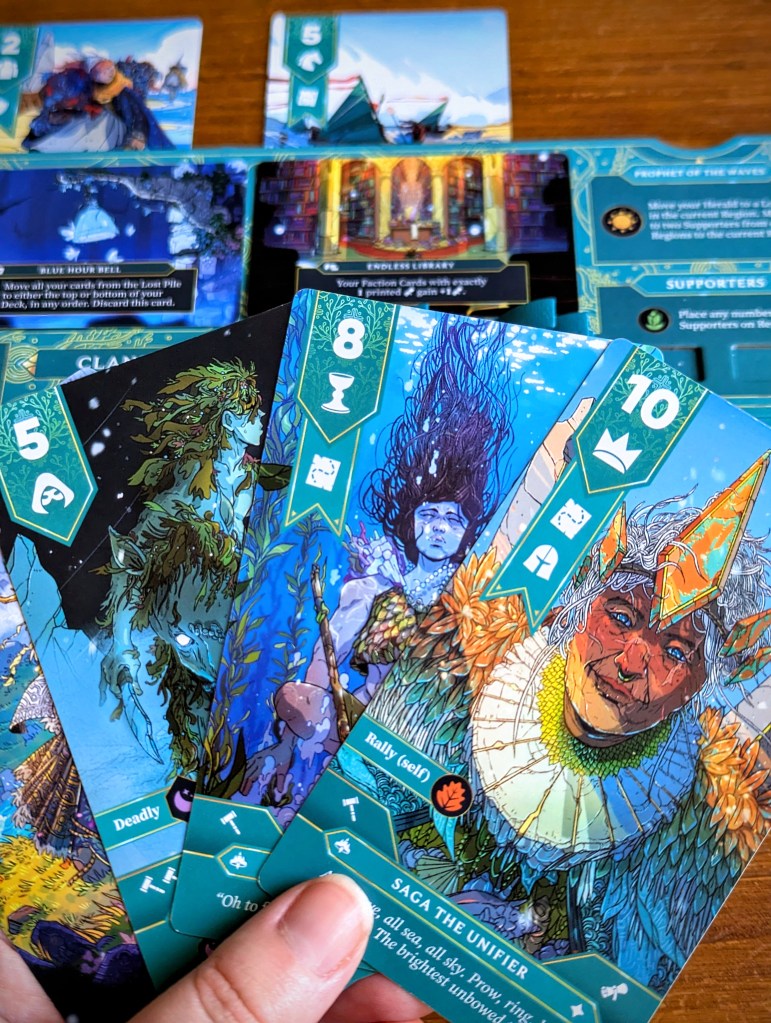
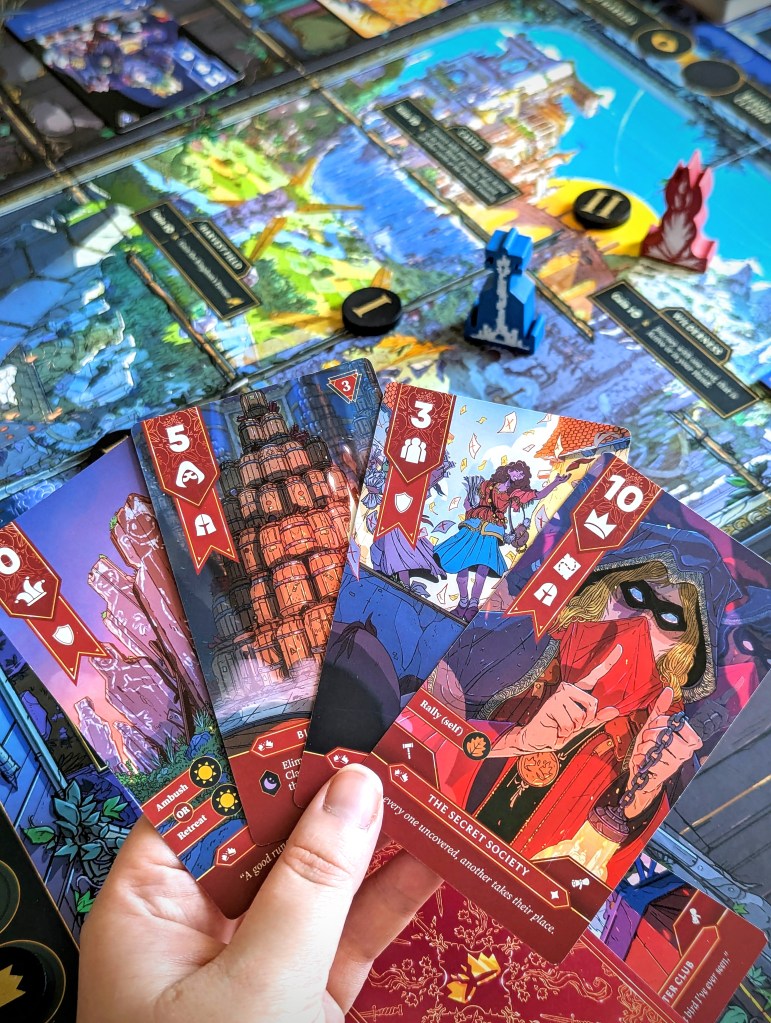
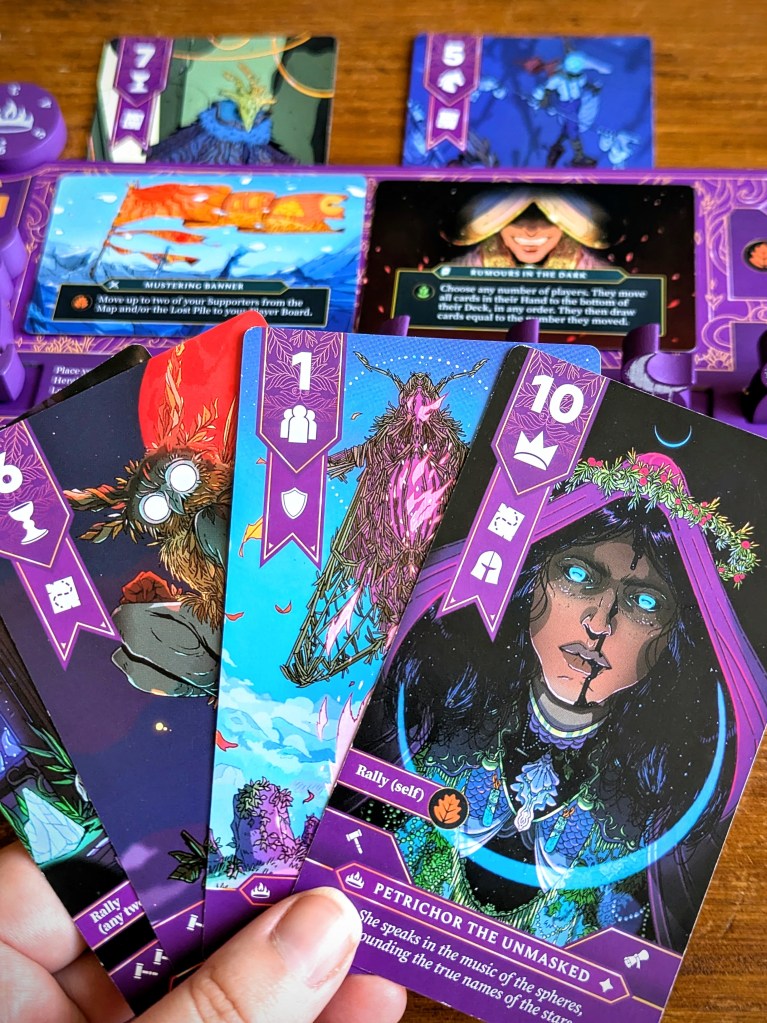
I have played with all but Nobility and had fun with all of them. I don’t think I’d have as much fun with Nobility, because it’s not my preferred playstyle. My experience with the Gathering and the Uprising is they felt quite similar to play, but it could have been because I didn’t lean into the Gathering enough (it was my first Faction, after all). Whereas the Clans Faction felt very distinct in comparison! I think overall my favourite was the Uprising, because I like sneaky assassinations and chaos.
I’ve seen a lot of people call this a lane battler – one of my fave types of games – but it’s not. Well, it might technically meet the definition on BGG and I can see why people say it with the way the regions are structured. But in my opinion OKC doesn’t have that tug-of-war feeling you get with lane battling. Just like I wouldn’t describe it as a deckbuilder, even though you buy cards to improve your deck. It’s almost like OKC takes a little of this, a sprinkling of that – you can sense flavours of area majority, deck building, bluffing, negotiation, politics – and blends them together into something that feels wholly unique to play.
One of my favourite parts of the game is the Kingdom’s Favour marker, which you can claim and place above your board if you activate the Harvest Field location. This unlocks a nifty additional action on your Faction board, which is obviously unique to each Faction. With the Uprising for example, once per round you can look at all the facedown cards in one unresolved Region AND swap one of your cards from any Region. Pretty powerful stuff! You get 3 uses out of it before it goes back to the board, unless you activate the location to refresh it OR someone else activates the location and steals it away! So as you’ve probably guessed, the Kingdom’ Favour is important to claim, tricky to keep, and vital to keep away from your opponents.
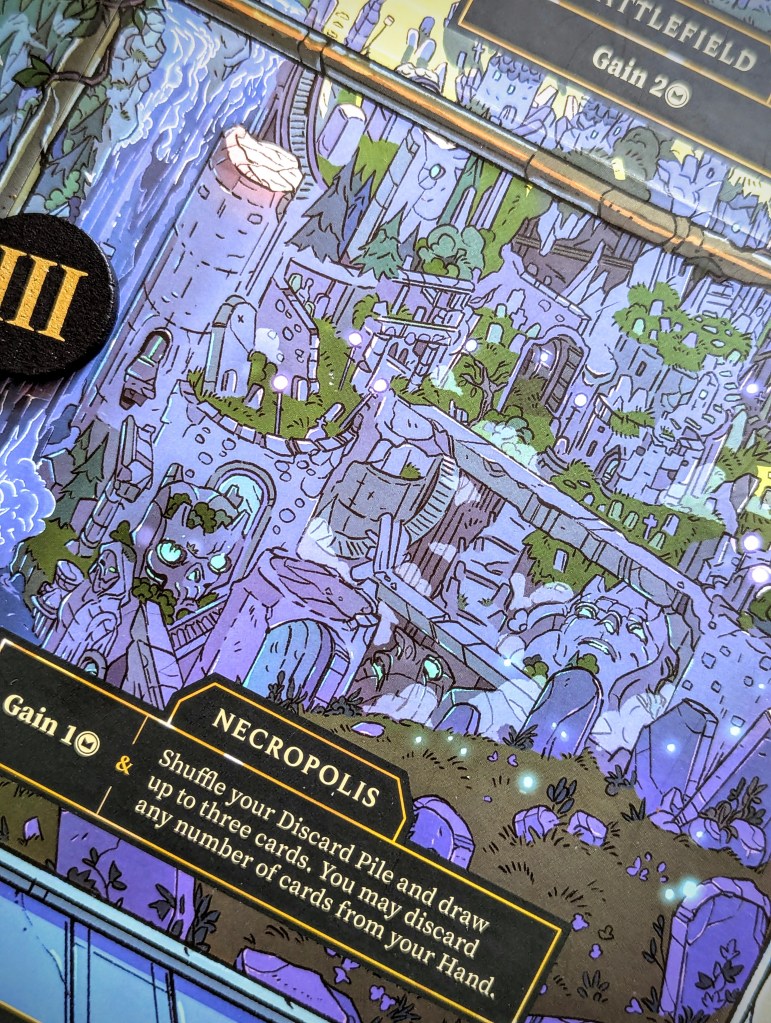
This kind of game is quite challenging to review with a loaned copy, because we only get a limited time to explore what it has to offer – and that’s why this is a first impression. I do think it clicked more with me than Matt, because I was able to dominate each game regardless of which Faction I played with, but I think he just needed more time with it (and he still really enjoyed it!). It’s also possible that going last in turn order (and deciding the order of the Clashes) isn’t enough to recover from someone taking an early lead, particularly in a 2-player game, but we’d need to test it with more people.
It’s quite clear 3-4 player games would be quite different. With more players, there’d definitely be more chaos and probably more bargaining and bluffing. And probably increased playtime because everyone takes turns reading the text on new cards (with some mitigation from the simultaneous steps). There’s also more competition for the three regions, which probably forces you to put your eggs in other baskets, like the Council (I don’t think we made the most of the Council in our games!). And obviously with more players, there’s more chance you get stuck with a Faction you’re not as in sync with.
I didn’t have a chance to try the solo set-up, but if you’re interested my friend Chris has summarised it beautifully in his review.
You’ll like The Old King’s Crown if:
- You like high player interaction with a side of mean.
- You enjoy games where you need to switch up your strategy in response to other players’ chaos.
- You want a unique playing experience – OKC really is something different.
- You want a game that reveals more with each play (and for multiplayer, have friends who are also committed to playing over and over).
You won’t like The Old King’s Crown if:
- You don’t enjoy conflict.
- You hate chaos or when your strategic plans are constantly disrupted.
- You don’t want (or don’t have time) to play the same game over and over.
- You have a small table!
Verdict
Going into OKC, I wasn’t sure what I’d make of it…if I’m honest, I thought I wouldn’t like it! But I was pleasantly surprised, enjoying it more with each play – and Matt enjoyed it too, despite the constant defeat. The artwork is gorgeous, the world is engaging and the gameplay is interesting, blending many familiar concepts in a way that feels different from any other game I’ve played.
I’d love to try it solo and with more players to see how the dynamics shift. I think it’s possible I’ll enjoy it less with more players because more people fighting over the same space will likely feel more punishing. But at 2 players I bloody loved it and I keep thinking about playing it again – I’m gutted we had to send it on.
Does The Old King’s Crown live up to the hype?
Yes and no. From a broader perspective, it is overhyped – NOT because the game is bad, but because it’s such a niche playing experience with an intimidating learning curve that rewards you for the time you invest in it. So in my opinion, it’s not accessible enough for the mass board game market. BUT there is absolutely no doubt that The Old King’s Crown is a brilliant, beautifully designed game that will meet the hype for a specific cohort of gamers.


