

Advert: We were loaned a prototype for review purposes. All opinions are ours. Design and components are subject to change.
Double double toil and trouble, fire burn and cauldron bubble! Today we’re looking at Trouble Brewing, coming to Kickstarter later this year!

Key stats
2 to 4 players | 60+ minutes | Age 14+
Publisher: Nightjar’s Rest Studio
Designer/Art: Ana Pickering
Themes: Magic, Fantasy
Key mechanics: Set collection, Dice rolling, Roll and move
Game overview
In Trouble Brewing, players act as mischievous pixies summoned to help a witch complete her potion(s). Visit locations around the board to plant, water and harvest herbs. Throw the right ingredients into the cauldron and get rewarded, with the biggest reward going to the player who adds the final ingredient. Throw in the wrong ingredient and the potion boils over!
On your turn, you’ll roll your D12 and move in one direction around the board. If you come across any action spaces you can perform an action:
- At the water space, roll a D4 and collect water droplets based on the result.
- At the seed space, you can pull 2 seed tiles from the seed bag, secretly look at their ingredient sides and choose one to keep (keep it seed side up in front of you).


- At the P space, you can either
- plant a seed (if you have one and if there’s space in the planter)
- water seeds that are already there (up to 1 droplet on each – if this means a seed is fully watered, you get to flip it and reveal the ingredient!), or
- harvest a fully grown ingredient (and put it in front of you).
- At the compost bin (spade) space, you can discard the ingredient you’re holding into the compost heap.
- If you stop movement anywhere in the inner circle, you can throw the ingredient you’re holding into the cauldron!


Actions are always optional. Some end your turn early, while others let you carry on your way (and potentially do more actions) until you’ve completed your movement. And some give you rewards from the witch! Planting a seed, placing the final water drop on a seed (completing the ingredient) and composting an ingredient all gain you 1 reward token. Adding a correct ingredient to the cauldron gains you 2 reward tokens – unless it’s the final ingredient, which gets you 4!
Each player also starts the game with 4 Glamour tokens (and the opportunity to buy 2 more back later in the game), which they can spend to perform some pixie glamour magic! The Glamour of Growth instantly grows a seed you just planted. The Glamour of Thievery lets you steal a seed, ingredient or water droplet from another player on your space. The Glamour of Control tricks the witch into switching the potion (the current potion Boils Over). And the Glamour of Distraction lets you search the seed bag for a specific ingredient. BUT the problem with pixie magic is it can be very tricksy – success is determined by a flip of the Glamour token!
The game ends when the set number of potions has been completed and the player with the most reward tokens wins!


Our first impressions
The witchy theme was very appealing, and I like that the potions are based on ‘real’ historical potions/herbal medicine (although this is why the designer has set the age limit to 14+ which is a shame because I personally think Trouble Brewing’s gameplay has great potential to be enjoyed with older kids). There’s lots of nice touches, from the design of the board, the choice of player tokens and colours (each one representing a season). Even the carry limit is cute: because you’re a pixie, you can only carry 1 fully grown ingredient in your hand plus 2 seeds (one in each pocket!). There’s no limit on water though, so I imagine that the droplets float behind my pixie single file.
The gardening aspect – pottering back and forth, collecting seeds & water, watering & composting plants – feels quite relaxing, and quite like a farm sim! (a la Stardew Valley). And it almost feels semi-cooperative, because you’re all tending the same plants and working to complete the same potion – but still with the selfish goal of being the person to finish watering a plant, or swooping in to harvest it for the potion and those sweet sweet reward points. We liked that you could still earn a lot of points through the gardening side, and that completing the potion(s) didn’t necessarily win you the game, although there’s also incentive to do them to trigger the end if you think you’re winning.
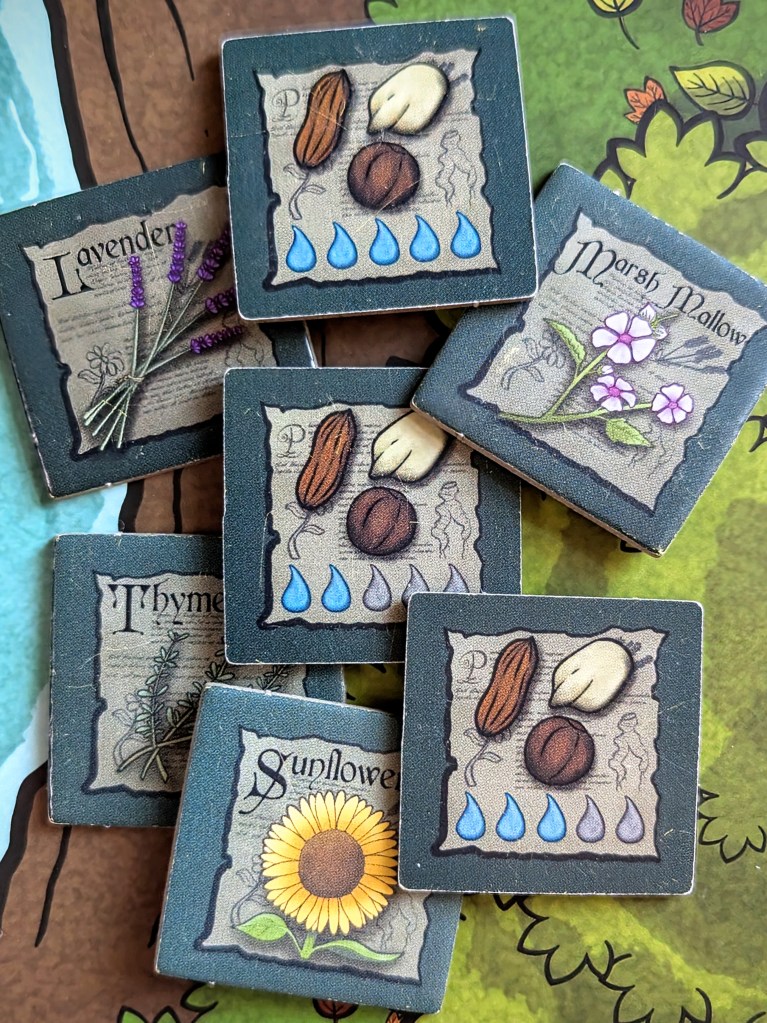
Some ingredients are rarer than others, and they all require various amounts of water to grow (shown on the seed side of the token). In the prototype there isn’t a list indicating which seeds turn into which plants, so if you’re new to the game there can be a lot of guesswork with what you should focus on watering. As you get more familiar with the game, you’ll get to know how much water each ingredient needs. So if a player plants a seed that needs 3 water, you’ll know that’s either the Chamomile you need for the potion, or a less useful Motherwort. This is where a little bit of bluffing can come into it as well, as you try and trick each other into focusing on decoy seeds! I would quite have liked the watering info on a player aid or similar – it would help even the playing field for newer players, and there’s more than 1 type of ingredient for each watering requirement, so it wouldn’t give the game away completely.

Before playing Trouble Brewing, we thought that getting the potion to Boil Over was going to be our favourite part – we don’t mind a bit of cheeky sabotage and I loved the thematic logic behind it! But to our surprise, we didn’t actually use it much. Completing a potion can take up to an hour (depending on player count), so resetting to a new potion would extend the playtime by quite a bit, and we never thought that was worth stopping someone claim at most 4 reward points. I do think it can be useful – once we used boiled over because we were struggling to find the right ingredients. I can imagine someone doing it to stop the game ending because they know they’re losing, but I’m not sure it’s always going to be worth the ire from other players because you added 20+mins to the game time. And because there’s not cap on how much you can do it, there is a risk of a player doing it over and over just to wind everyone up.
Our favourite part of the gameplay was actually the Glamours, especially the Glamour of Thievery. It transformed our cozy witchy garden sim into a tense battle of pixie robbing mischief and sparked many of the best ‘in game’ moments. It was almost a shame that it was restricted by the Glamour tokens, some of which you’ll want to save for other Glamours (getting a specific seed out of the bag is VERY useful). We usually saved thieving for the ‘final ingredient’ because of this.


The rules include a recommended number of potions for each player count – in our 2-3 player games these worked well to give the game a similar playtime (60-90minutes). But the rules state you can add/reduce the number of potions if you want, which is nice.
This is a roll & move game, and this does mean that you can have turns where you only move. We also found our games had slow phases (most of the garden pottering) and tense phases. None of this is a criticism of course, but if you aren’t a fan of slow/relaxed gameplay, this might not be for you.

Verdict
If you’re looking for cozy garden magick with a sprinkling of cheeky sabotage, Trouble Brewing is one you want to check out!


That sounds great! I’ll keep an eye on kickstarter for it!
LikeLiked by 1 person