
Advert: This game was loaned for review through the UK Board Game Review Circle. All opinions are our own.
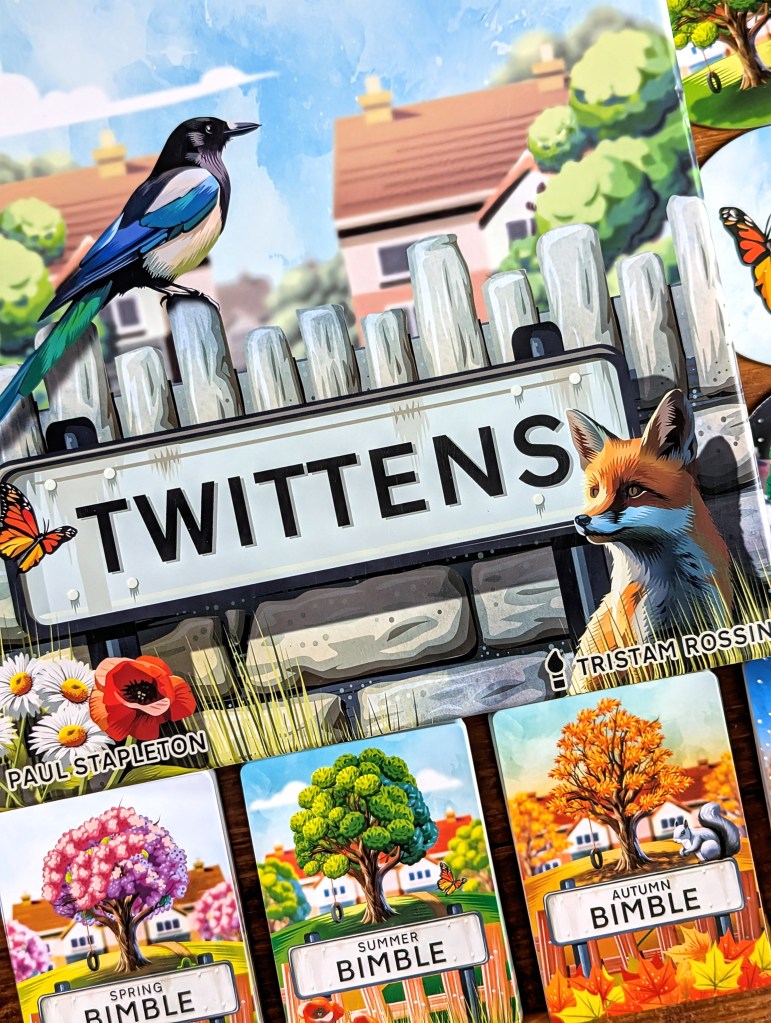
Twittens sounds dreadfully British – and that’s because it is! Sussex slang for the alleys and backlanes that run behind houses, in this game you explore the twitten of your local neighbourhood to find point-scoring points of interest.
(there are lots of equally British-sounding regional names for these backlanes: ginnel, snicket, gwli [pronounced gully] and wynd to name a few).
Let’s go for a bimble, shall we?
Key stats
1 to 5 players | 30 to 45 minutes | Age 10+
Publisher: Bedsit Games
Designer: Paul Stapleton
Art: Tristam Rossin
Themes: Nature, Countryside
Key mechanics: Tile placement, Push your luck, Set collection, Mission/Campaign game (solo only)
Game overview
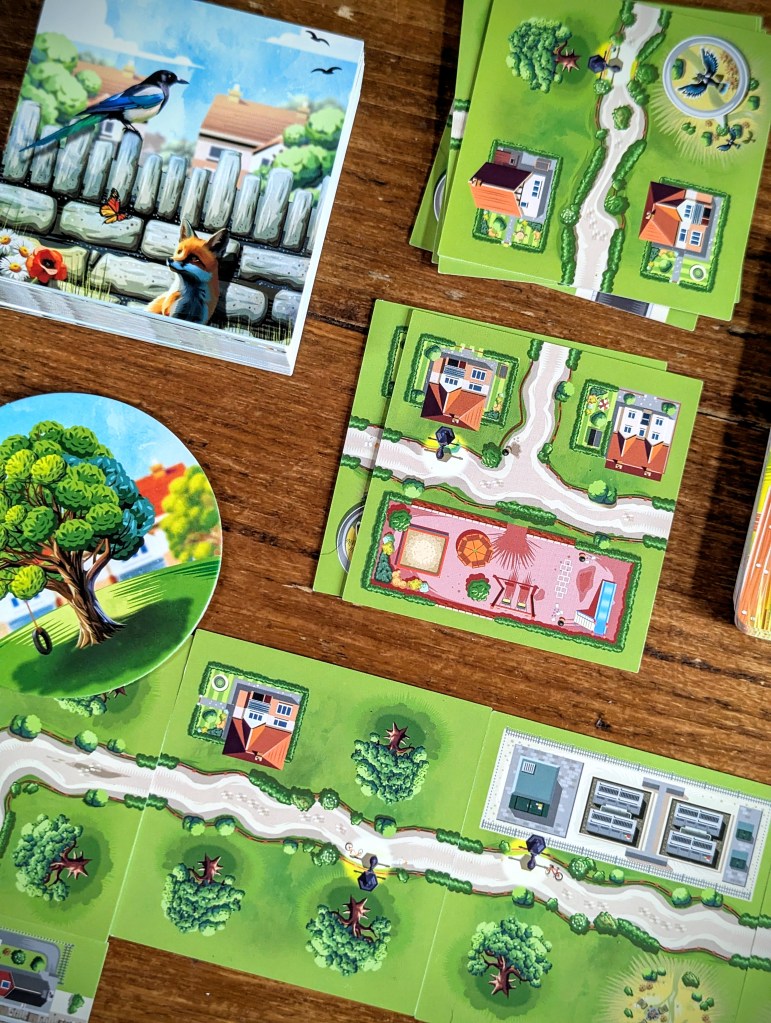
In Twittens, players alternate adding tiles to their own twitten, scoring as much as possible with houses, various infrastructure and wildlife before heading home for tea. The tile you place can come from:
- the top of one of the 2 face-up stacks
- the draw pile – pick 2 and choose 1, discarding the other onto one of the 2 face-up stacks)
- your ‘favourite place’ – a secret tile you picked from 3 options at the start of the game.
The only rules when placing a tile is it has to join to your current twitten path, and paths can only connect to paths (you can’t have a twitten veer off into grass).
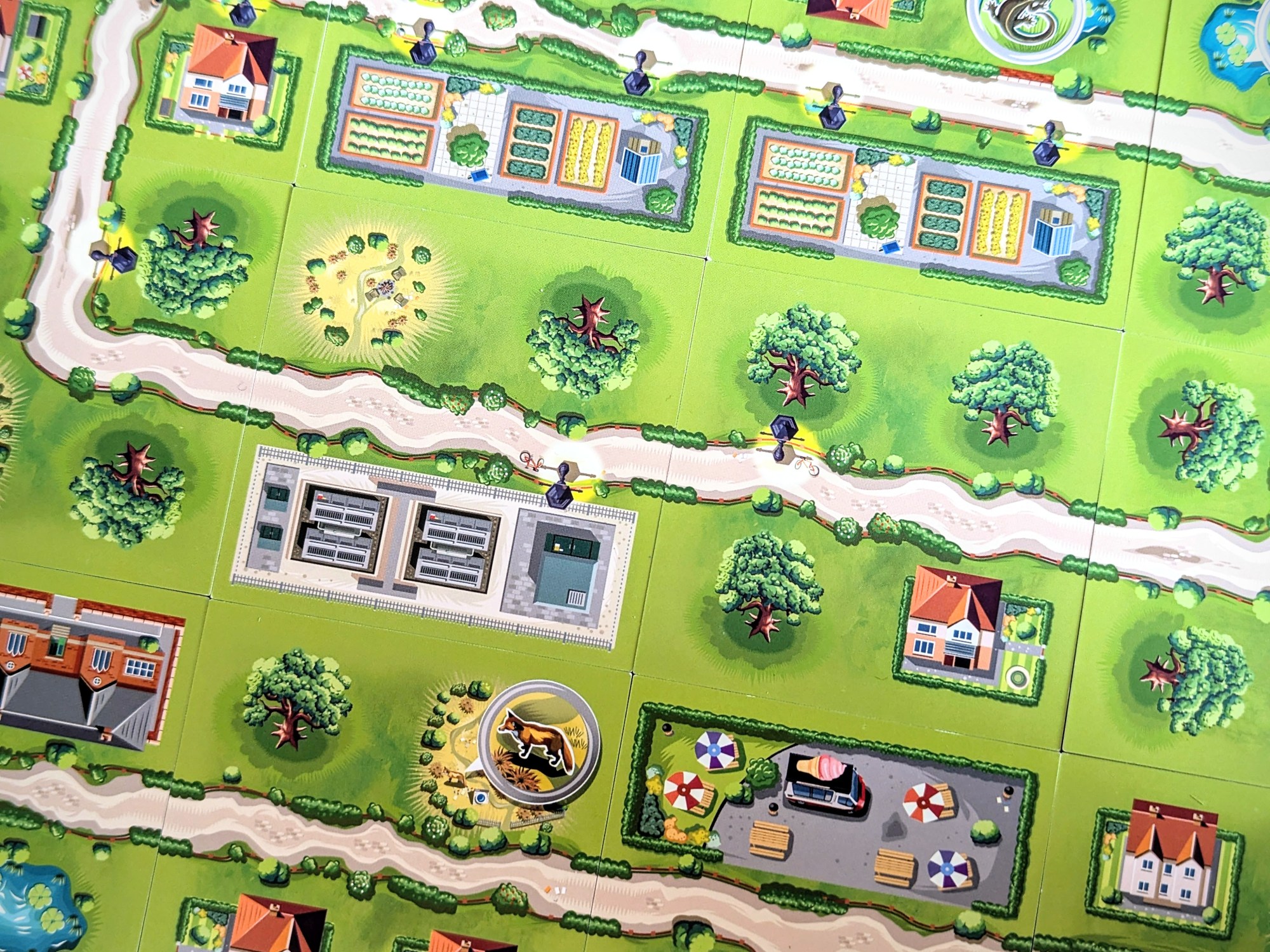
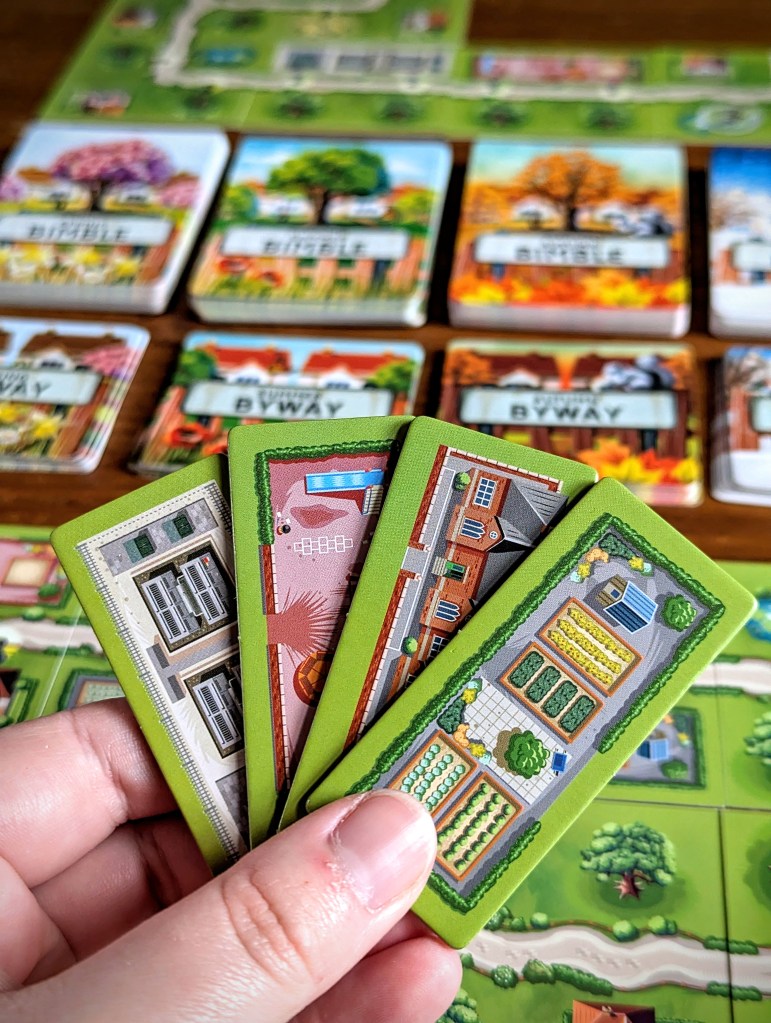
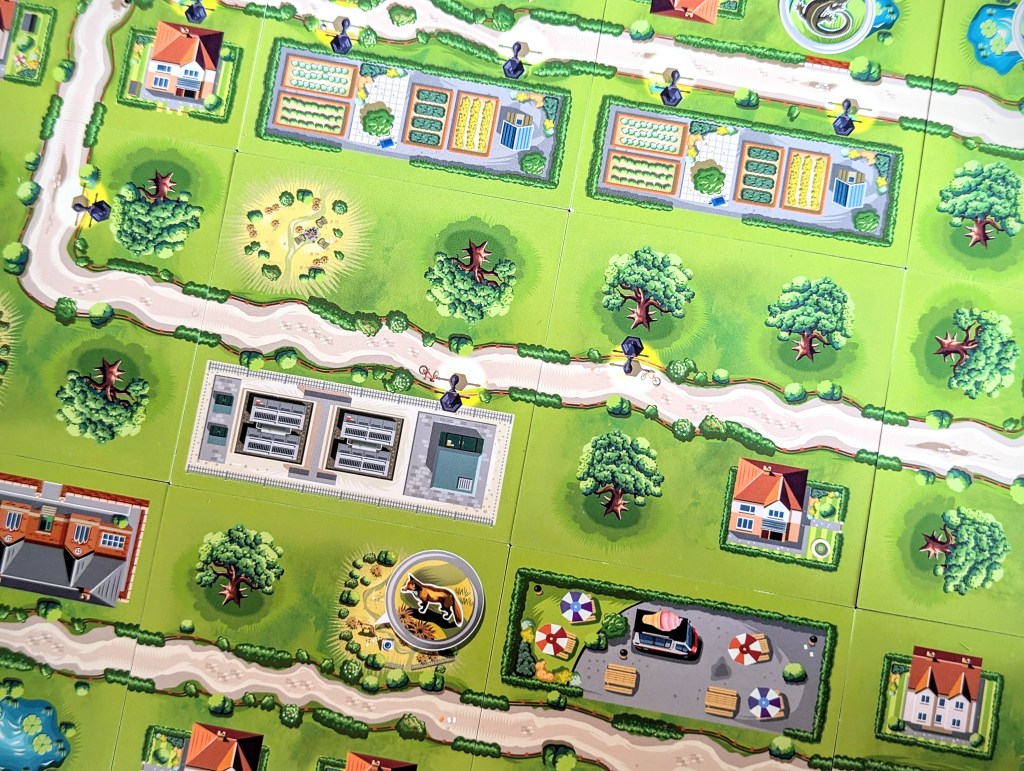
Each element on the tiles have their own scoring criteria: trees score if they’re in your largest tree group, allotments score based on adjacent trees, playgrounds score based on adjacent houses, streetlights score if they equal the number of tiles in your twitten, wildlife score if they can access a train station, roads score if they are at the end of your twitten. Houses are the most interesting of the lot, because you only score them if you have 7 or less – any more and not only do you go bust and lose the points, you also can’t take any more turns this round. Substations don’t score anything, but they can up your house limit to 8.
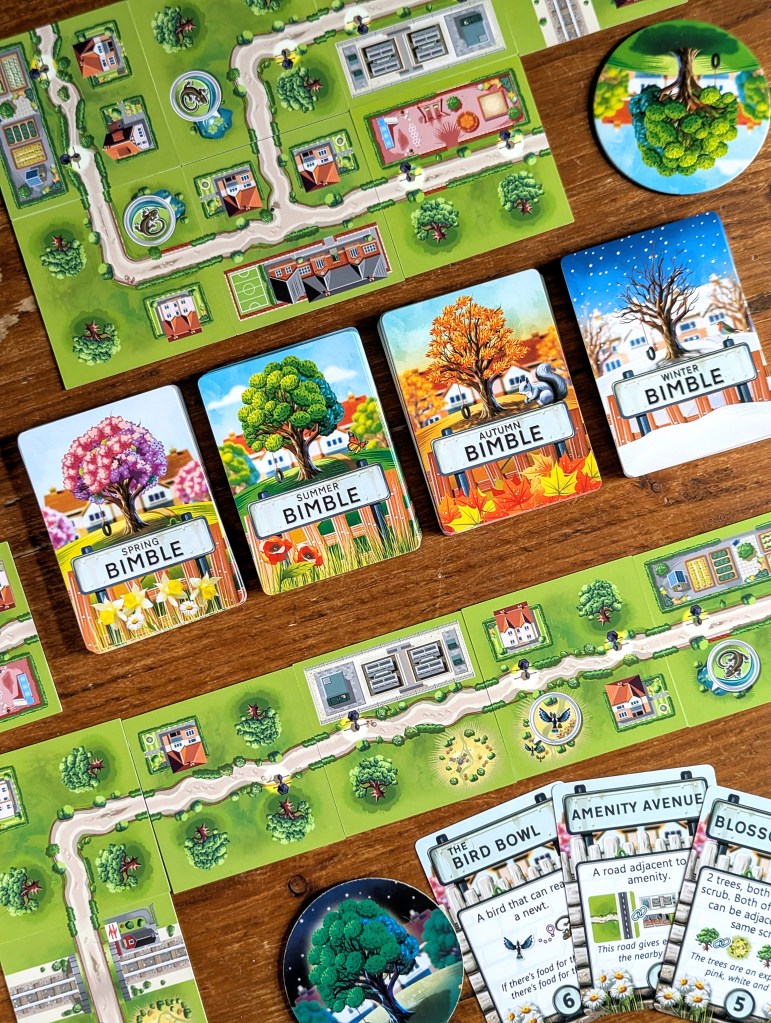
The other way to score points is through Bimble cards (yet another lovely word from British vernacular – bimbling is walking). These are hidden objective cards that range from 4-9 points, with the higher scorers usually being trickier to complete. You start the game with 2 or 3 bimble cards, but you can gain more by placing tiles with School (which lets you draw 2, keep 1 or none). You can complete as many Bimble cards as you like in a turn, but any you don’t complete by the end of the round score negative points!
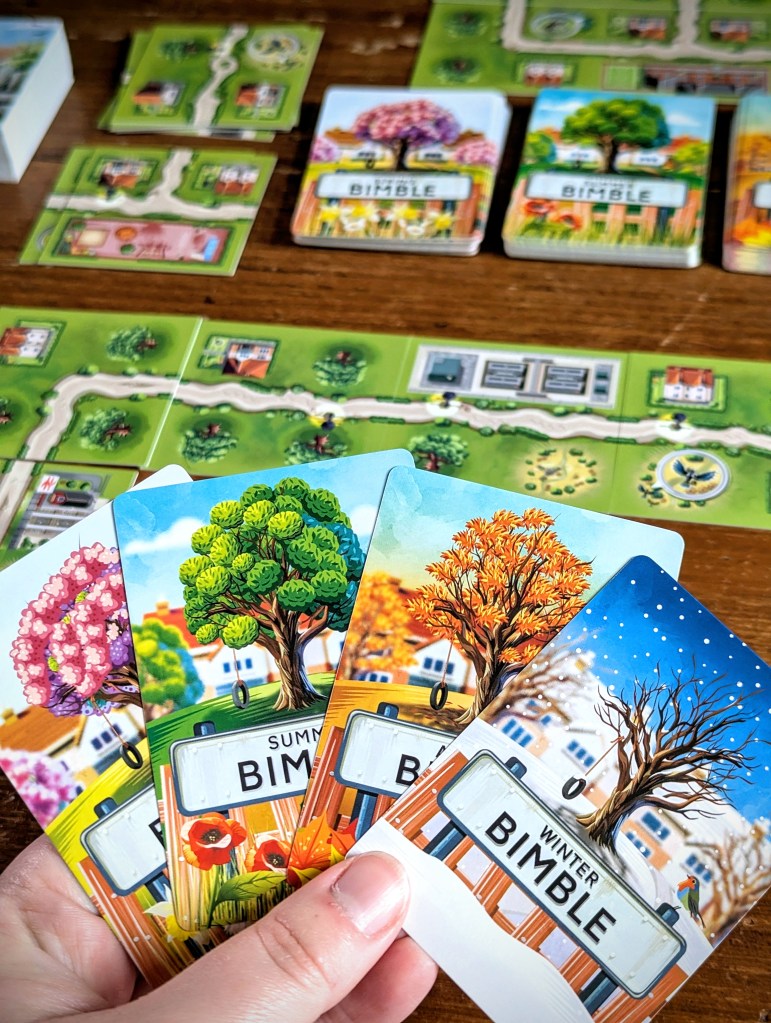
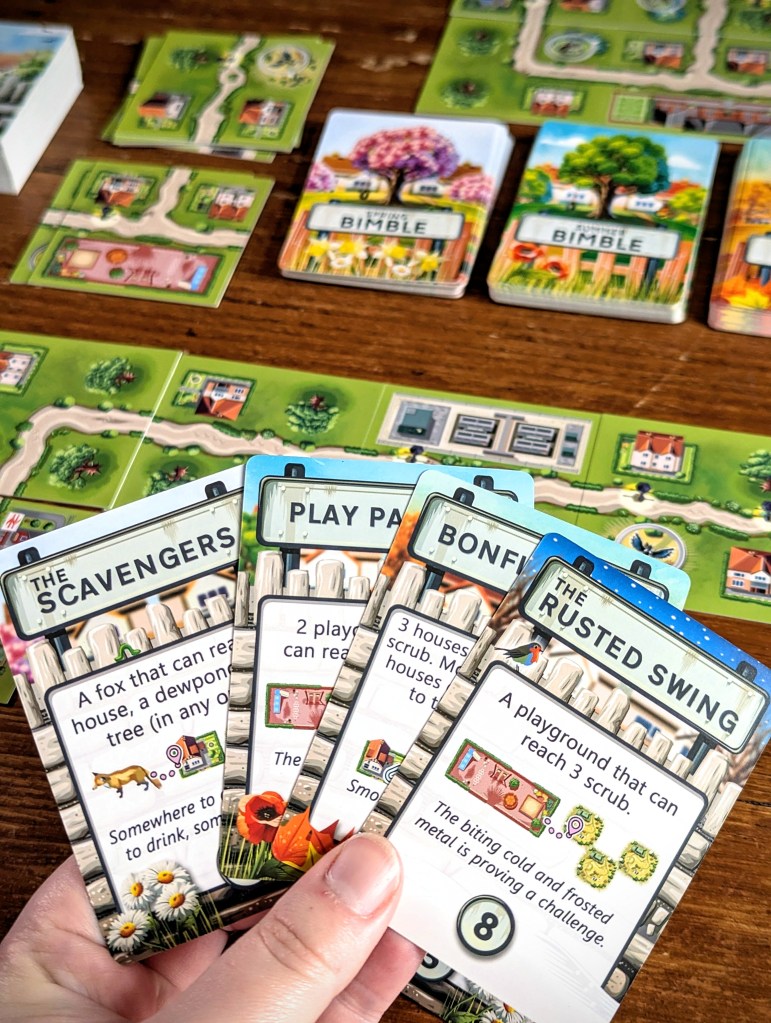
At the end of each round, and once you have a minimum of 5 tiles in your twitten, you can choose to go home for tea – this means you pass until the end of the round. But if you ever hit that 7 house limit (or go over and go bust), you have no choice and off home you go. When players start going home for tea, remaining players’ tile options get more limited (for example, in a 2 player game, when someone goes home the remaining player can’t draw from the face-up stacks).
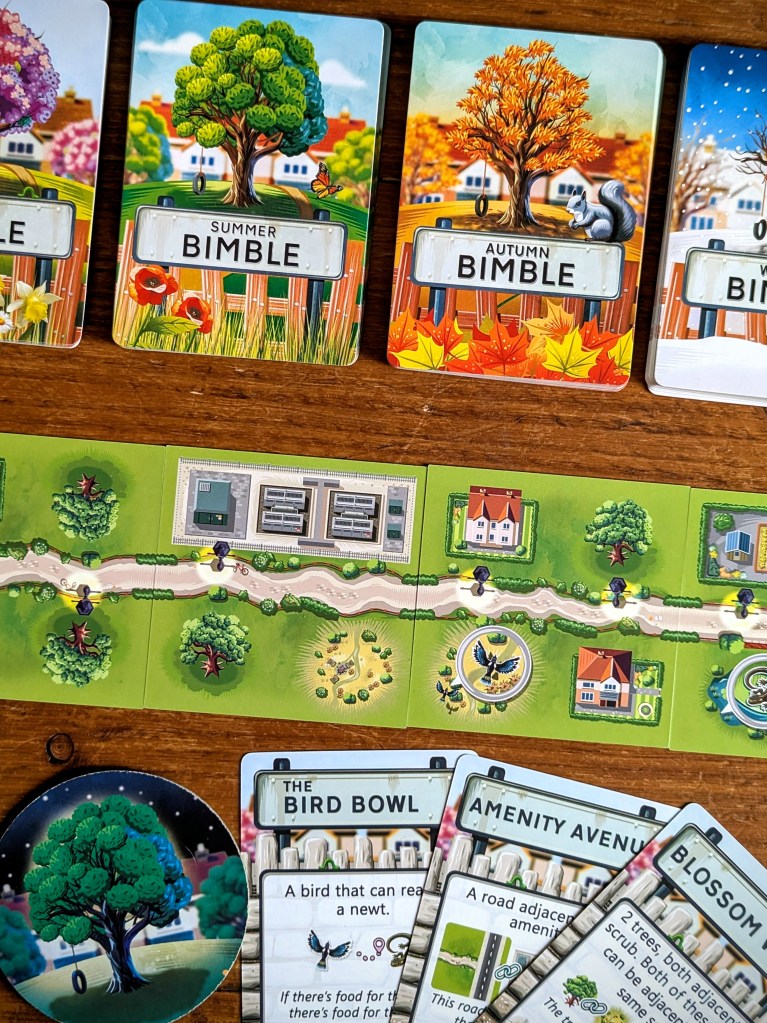
Each game plays through 4 seasons (rounds), starting of course with Spring, and each has their own Bimble cards to reflect the time of year. The player with the most points after all 4 seasons wins.
Twittens Detours (mini-expansions): Byways, Lollies and lanes, Passages of time, Seasonal lights.
The box includes for small expansions (or rule variations) for Twittens, that can be introduced separately or together:
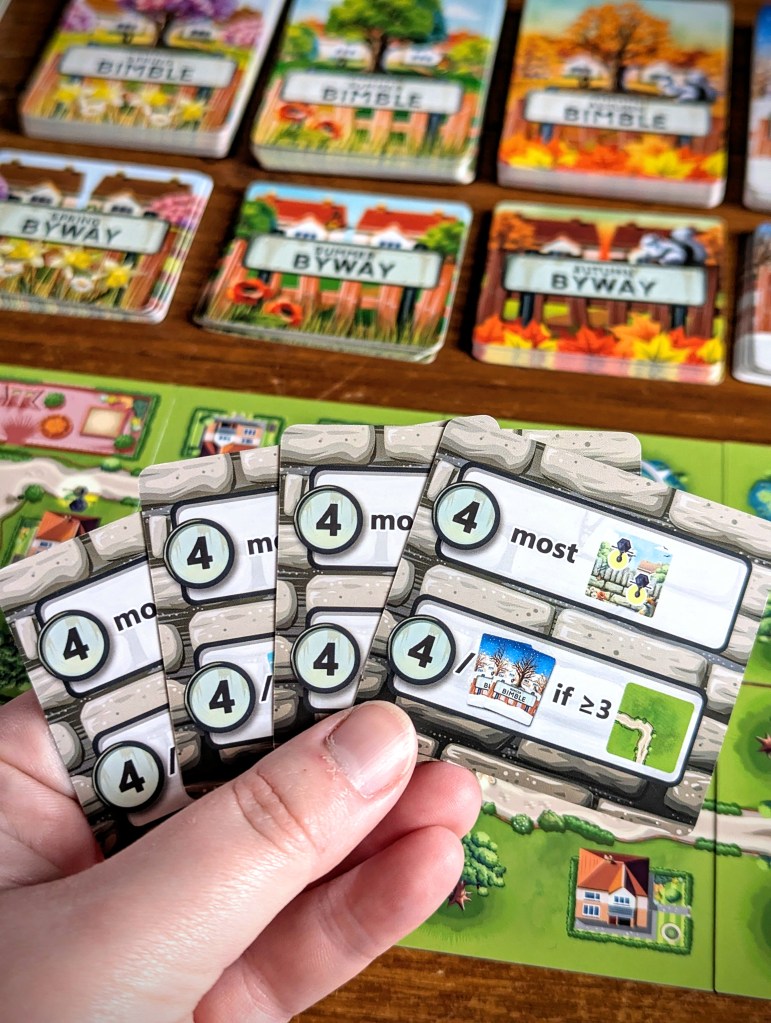
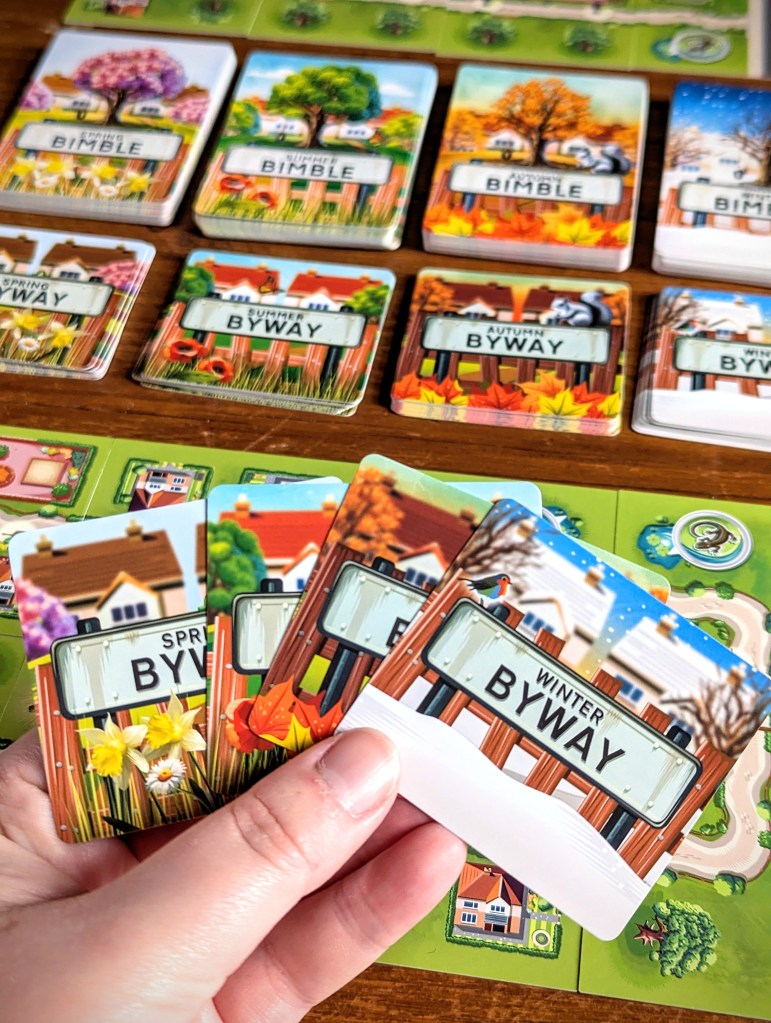
- Byways introduces Byway cards with additional scoring opportunities for each season. Each round 1 Byway card is revealed for everyone to see, and is scored at the end of the round.
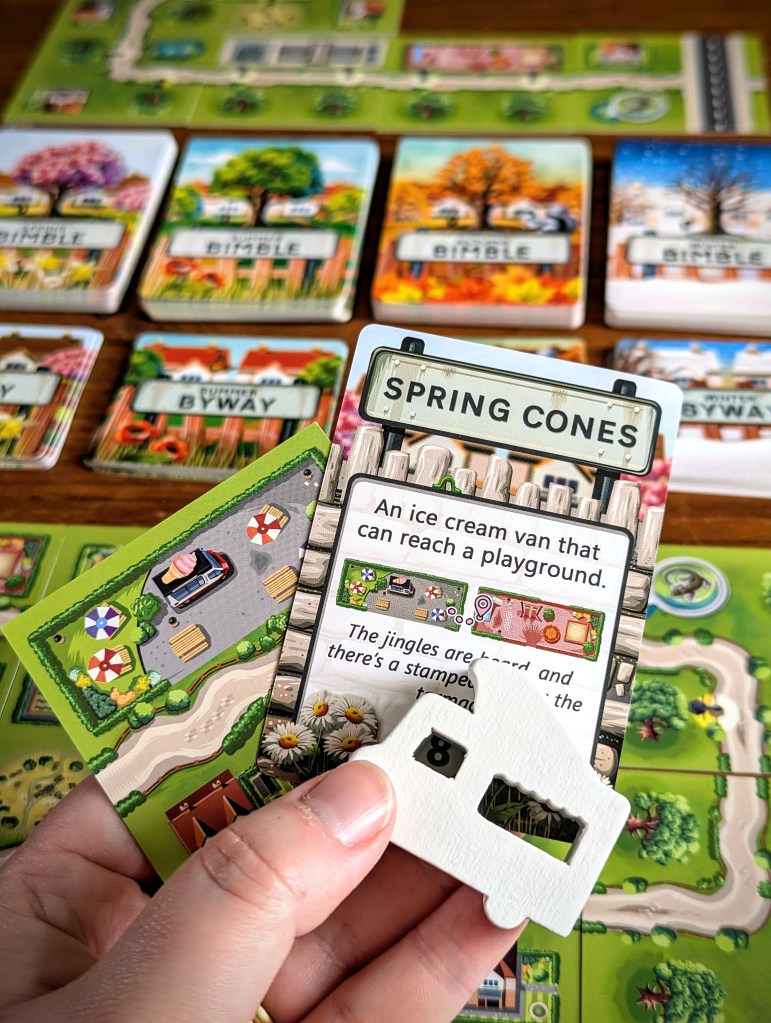
- Lollies and lanes introduces 4 new Twitten tiles with an ice cream van amenity, and new Bimble cards that relate to the ice cream vans (2 new Bimbles for each season). Whenever someone plays a twitten card with the ice cream van, they place the wooden ice cream van token there too. Whoever still has the wooden van at the end of the round will score or lose points based on the season (e.g. 6 points for summer, -6 points for winter!).
- Passages of time gives each player 4 amenity tokens (1 each of the substation, school, playground and allotment). Players can place these into their twitten covering trees/scrub/ponds (and at least part of their current tile) and treat them like a normal amenity. Once used they can’t be used again, and players score 4 points for each tile they have left at the end of the game.
- Seasonal lights is a scoring variation for streetlights, which score differently based on the season. Spring and Autumn score normally (the number of streetlights must equal the number of tiles), but in Summer you score if you have fewer lights than tiles (points given per each tile), and in Winter you score if you have more lights than tiles (points given per streetlight).
Solo variant
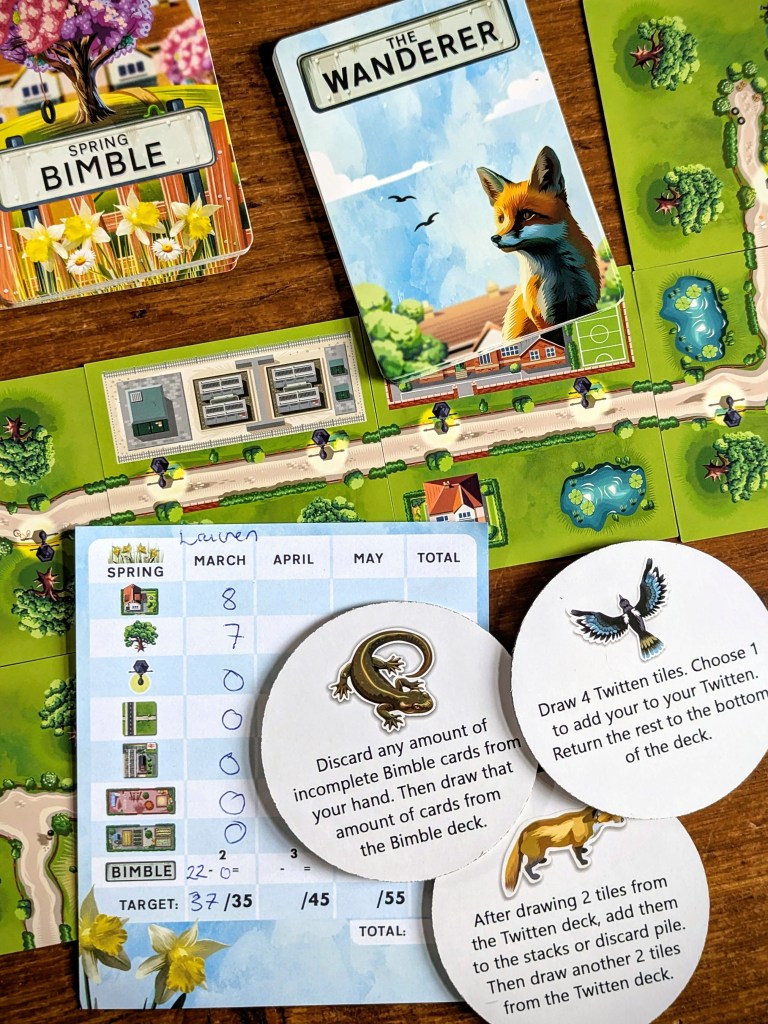
The solo mode works similarly to a multiplayer game, but with a ‘Wanderer’ deck that serves as your opponent. You also get 3 wildlife tokens with special abilities you can use (note: when you do, it’s exhausted until you meet requirements to refresh it!).
After you take a turn, you draw a Wanderer card for their turn, which will be either:
- Taking a tile from the face-up stacks. The card will say if it’s the left or right stack.
- Drawing 2 tiles and keeping one based on a hierarchy of preferences (e.g. most trees, most houses, most wildlife, least streetlights). The card will say if the other card goes on the left or right face-up stack.
The card the Wanderer takes goes in its own row, it doesn’t build a twitten.
A solo game is a campaign of sorts, played over multiple rounds. Each season is split into 3 months, which represents 3 different scores you have to beat before you can progress to the next month. Each month also specifies how many Bimble cards you will start the game with (for example, in March you have 2 Bimble cards and need to beat a score of 35).
Our thoughts
Twittens is a detour from the very unique aesthetic you may have seen from Bedsit Games before (those games are still on my to try list), but it’s no less appealing. The artwork evokes that British nature-meets-suburban-life whilst also keeping the tiles and elements clear and uncluttered. I particularly enjoyed the seasonal artwork across the Bimble and Byway cards, and that the Bimble objectives were somewhat related to the current season (and even included some lovely flavour text). Building up your twitten could feel very satisfying, and no two twittens felt the same.
As for the gameplay itself, I will be honest and say at first I wasn’t sure, but the more I played Twittens the more I enjoyed it. In our first game, I was frustrated because I had Bimble objectives that were impossible to complete, simply because the features/elements I needed didn’t come out of the draw pile in that round. These cards then giving me negative points just added salt to the wound. BUT as I got more familiar with the general scoring criteria – and more accepting of of the bad luck in the draw – the puzzle clicked and with each play I liked it more and more (to the point that I’m sad it’s gone to the next reviewer, because I still have the urge to play it!). There is still a risk of it feeling punishing when you get stuck with an impossible objective that was outside of your control – especially if it’s one you’re stuck with from the start, and especially if it’s a lot of points, because it can be tricky to recover from. This may be more of an issue with a 2-player game, as more players would mean more tiles are drawn (although then you’ll have more people competing over them!).
What I enjoyed most was the interesting push-your-luck balancing act between getting the tiles you want and the houses that may be on them. It makes every tile decision count as you try and puzzle out the most optimal scoring. In our games the substations quickly became hot property!
Once you’ve played the base game a few times it’s easy to throw in the mini-expansions for some added scoring variety. The Passages of Time in particular can help mitigate a bad draw because you can use them to achieve Bimbles that involve facilities. The Byways cards add a little friendly competition during rounds, e.g. competing to have the most/least of certain elements. As does Lollies and Lanes as you might fight to get or not get the ice cream van (depending on the season). And the Seasonal Lights tweaks the lamp scoring in a way that makes sense for each season. I think my favourites are the Passages of Time (due to the mitigation potential) and seasonal lights, but they all add there lil somethin somethin and it doesn’t feel too much to have them all mixed in together.
I played one solo game and it felt very similar to my multiplayer games. The Wanderer with its prioritisation criteria works well to emulate a real opponent’s moves and I like how the campaign is set up with increasing difficulty through the months and seasons. Some seasons include a couple of the mini-expansions, and each month has its own number of starting Bimble cards, so there is some variability throughout the campaign.
Overall I found the rulebook straightforward and clear and the text is quite large (which is great for accessibility – too many rulebooks have small fonts and poor contrast against coloured backgrounds!). I think my only minor criticism is that for some reason I found the thin page margins made it harder for me to read, but I’m not sure why.
What we liked
- Lovely art across the game, that doesn’t sacrifice readability of the tiles and their elements.
- Puzzly tile laying with different ways to score.
- Light but tricky push-your-luck with the houses, forcing you to choose each tile carefully.
- Mini-expansions add additional scoring variety.
- Solo mode replicates multiplayer mode well, and includes a beat-the-score campaign style progression through months of the year(mixing in a couple of the mini-expansions depending on the season).
Considerations
- In 2-player (and solo) you can have objective cards that are just impossible to complete because the right Twitten tiles don’t come out, and if you have a particularly bad round it may be hard to catch back up. This may be less likely with more players drawing tiles.
Verdict
Twittens is a lovely tile layer where the gameplay is deeper than it looks, and the modular expansions add even more as and when you want to use them. The luck of the draw has the potential to feel frustrating on occasion, but if you can live with that and enjoy a game with puzzly point-scoring optimisation, it’s definitely worth getting to the table.


