

Advert: This game was loaned for review through the UK Board Game Review Circle. All opinions are our own.
Many years ago Matt and I were lucky enough to visit Keukenhof gardens (a short ride out of Amsterdam) and see the beautiful tulip fields it’s so well known for – if you’ve never been, I strongly recommend the trip!
The inspiration for today’s game stems from Keukenhof, so let’s see if Tulip Season captures its essence.

Key stats
1 to 4 players | 15 to 25 minutes | Age 14+
Publisher: Sinister Fish Games
Designer: Joshua Lobkowicz, Kathleen Mercury
Art: Jacqui Davis
Themes: Farming, Flowers
Key mechanics: Tile placement
Game overview
In Tulip Season, players alternate placing Flower tiles from their hands to build a shared landscape of colourful tulip fields. After playing a tile, you can also choose to take a Windmill from your supply and put it on the tile you just placed, ‘claiming’ one of the two fields. At the end of the game, players score points based on the size of the coloured fields they have windmills in (1 point per tile).


If a Windmill’s location becomes less than ideal you can spend your whole turn to take it back from the fields and add it to your supply, giving you another opportunity to place it at a later turn. If you do this, you draw a Flower tile from the draw stack (like you would if you were replenishing your hand at the end of a turn) and place it face down in front of you. Any tiles collected this way are worth 1 point at the end of the game.
Players also start the game with 2 Greenhouse tiles, which show various additional scoring objectives, like having the most/least of a certain flower colour. On their turn, they can choose to place one of these Greenhouse tiles instead of a Flower tile and place their Greenhouse on it. The other Greenhouse tile is out of the game. These tiles have flowers on their edges that match up to Flower tiles, and the player will get points at the end of the game for each one that matches an adjacent flower tile. BUT the scoring objective itself is fair game for any player and whoever wins it gets those bonus points. Note that an extra Greenhouse tile is put out during set-up (for the scoring objective only, it’s not added to the playing area).


The game ends when a player draws the end game tile, which is shuffled randomly into the bottom of the Flower tile stack. The player with the most points from fields, greenhouse tiles and facedown tiles in front of them wins the game.
Tulip Season mini-expansions: Bicycles and Drones
Tulip Season comes with 2 mini-expansions that can be added in separately or together:
- Bicycles – each player has a bike that travels around the edges of fields. On turns where you place a Flo wertile but don’t add a Windmill, you move the bicycle one space in the direction it’s facing. At the end of the game, you earn points based on how far away the bike is from your nearest Windmill.

- Drones – Instead of placing a Windmill you can place your drone, which unlike a Windmill covers both sides of the tile. At the end of the game, the drone scores points for any spaces that surround it and match the colours of the tile it’s on.


Solo mode
Solo gameplay is similar to multiplayer, with the exception that you don’t play with the Greenhouse tiles. So the only actions on your turn are to place a Flower tile (and optionally add a Windmill) or Relocate a Windmill from the fields to your supply.
In solo you’re also playing against a RoboFarmer. On RoboFarmer’s turn they draw a Field tile from the stack and place it according to priority criteria listed in the rulebook (basically in whatever way will benefit the RoboFarmer the most). If placing the tile creates a field of 3+ spaces that doesn’t already have a Windmill, the RoboFarmer places a Windmill on it. At the end of the game, any Windmills left in the RoboFarmers supply get placed on the largest unclaimed fields. The difference between your and the RoboFarmer’s score determines how well you did (there’s a scoring table in the rulebook).
We didn’t play solo, so won’t be commenting on it further in this review.
Our thoughts
As you might have guessed from the intro this theme is close to our hearts, so I was really excited to see it come to life in Tulip Season. The game itself is super quick to set-up, learn and play, and because the gameplay and actions are so straightforward we had little downtime during our 2-player games. It’s also fairly portable (the box could be a little smaller) and because the tiles are small it can fit on most tables, so we often took it to the coffee shop to play. I also really love the chunky wooden player components.
That said, at 2 players we felt the base game on its own was a bit too light for us, there wasn’t enough puzzliness or interesting decisions. I liked the potential choice between building your own fields versus cutting off the other player’s, but in a 2-player game it was too easy to mostly stay out of each other’s way. The mini-expansions made a big difference in a 2-player game, adding more layers to the gameplay that we felt was lacking.
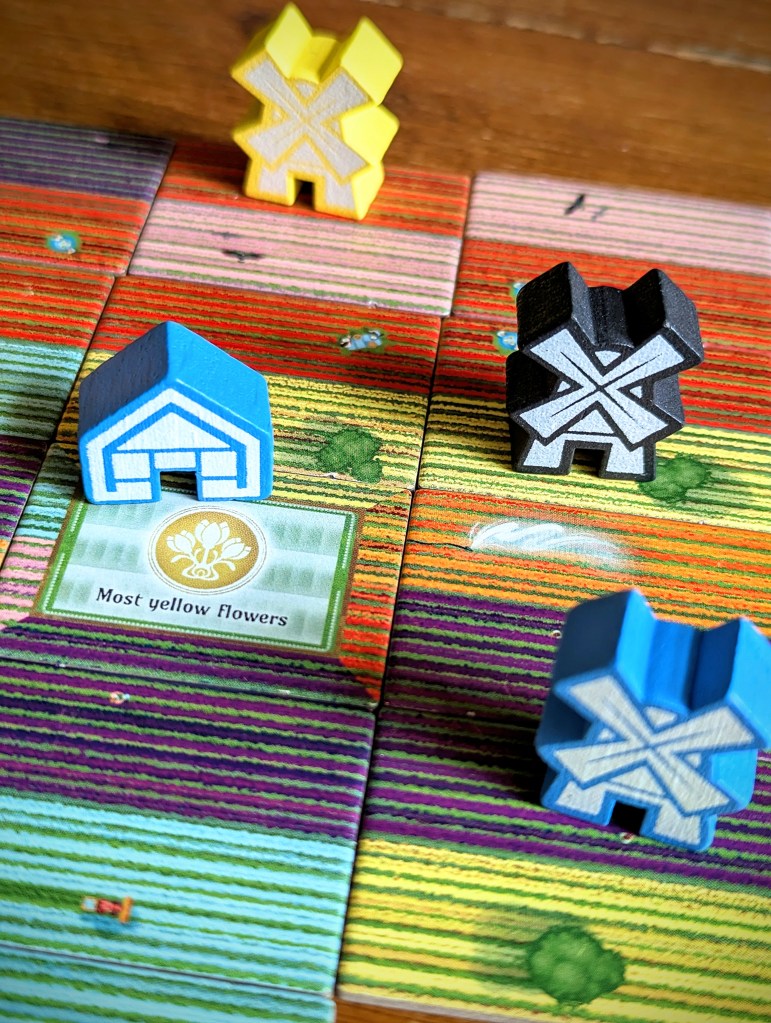

Even though we didn’t get the chance to test it with more I think it will shine with more players. This is partly because you use the same number of tiles regardless of player count, so I think more players will make the gameplay feel tighter as you compete more over space (and likely sabotage each other more). The other factor is the Greenhouse tiles – with two players it felt like there wasn’t much competition over them, especially if we had 2 out with opposing objectives (e.g. more and least of the red flowers). More players would mean more objectives, likely more that don’t directly conflict with one another, and also more people competing to win them.
I’ve seen some criticism in other reviews about the field tile colours, that they aren’t bright enough. I actually disagree, I didn’t mind the colours and tones and thought they were more realistic. I also like that each colour had a little something in the field to help differentiate them (yellow spaces had a tree, pink a bird, etc). However, there are small bits of field on the edges of the Greenhouse tiles that don’t have these indicators. To be fair, they wouldn’t fit, but if these indicators were supposed to help people who can’t differentiate colours as easily it’s not quite succeeding.

Verdict
Tulip Season is a cozy tulip tile-layer with a lovely theme and quick gameplay – although the coziness may fade with more players and more competition! At 2-players the gameplay felt like it was missing something, but the mini-expansions did definitely help and overall we enjoyed playing. Whilst the theme really spoke to us, I don’t think it’s a game that we would personally reach for often. I think it would be more interesting (although probably more mean) at the higher player counts.


