
Advert: We were loaned a copy for review from Hachette Boardgames UK, via the UK Board Game Review Circle. All view are ours.
The days are getting longer, the sun is shining more…it’s the perfect time to plan a hike up a mystical mountain full of animal spirits!
Key stats
1 to 2 players
15 minutes
8+ years
Publisher: Lumberjacks Studio (distributed by Hachette Boardgames UK)
Designer: Bruno Cathala, Corentin Lebrat
Art: Manu Gorobeï
Theme/category: Mountains, Nature
Key mechanics: Tile placement
Gameplay overview
You and your opponent are competing to explore a mountain, befriend spirits and light the fires atop the mountain peaks. On your turn, you capture a Land tile from the central display using one of the three tiles in your hand (matching in either colour OR number), and place both tiles in your personal panorama. There’s only 1 copy of each Land tile in the game, so once it’s taken, the other player can’t get it.
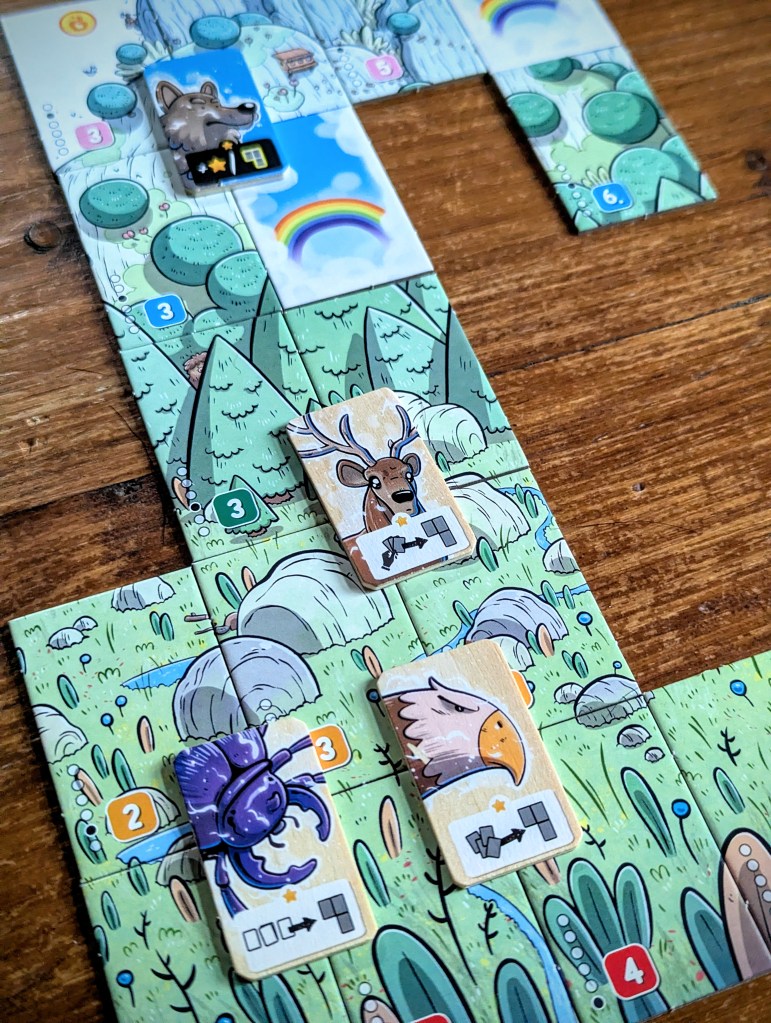
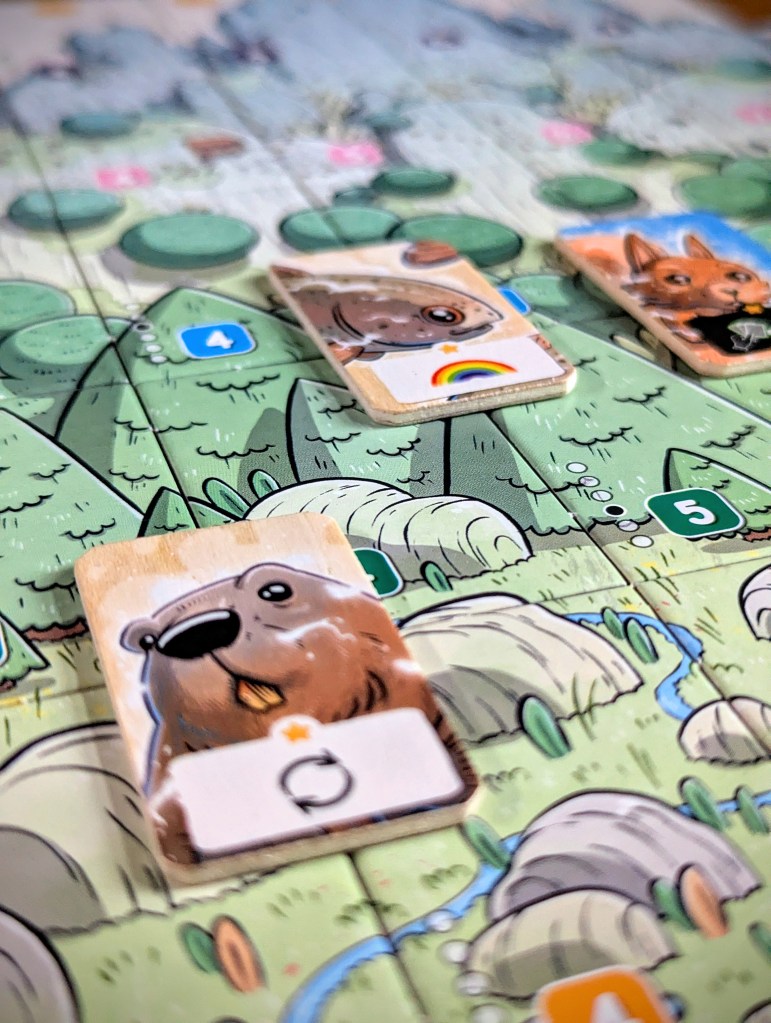
Alternatively, you can add a tile with no matches to the central display, which lets you draw a ‘second chance’ Land tile from the stack. If the new tile matches anything in the display, you capture like normal. But if it doesn’t, you add it to the display and get a wild Rainbow tile to place wherever you like! If you ever want to place the actual tile that the Rainbow is substituting, you get to take the Rainbow tile back and put it somewhere else in your panorama, unless it’s been covered by a spirit.
When adding these tiles to your panorama, if you create a 2×2 group of orthogonally adjacent tiles you get to summon a spirit! You can either pick from spirits already drawn and face up (if available), or draw 2 new spirits to pick from (but if you do this you have to pick one of the new ones – no backsies!). There are two different types of spirits:
- Spirits with a plain (beige) background trigger an instant effect, like adding a tile from your hand/the display/your opponents hand/the Land stack or getting a free Rainbow tile
- Spirits with a blue background have an end game effect, usually related to scoring. The wolf gives you 1 point for each separate panorama section you have built, whereas the lizard gives you a point for each Rainbow in your panorama.
Note that even if you make more than one 2×2 in one go, you can only summon 1 spirit. And if you create a new 2×2 using a spirit’s power, that doesn’t trigger another spirit summoning.
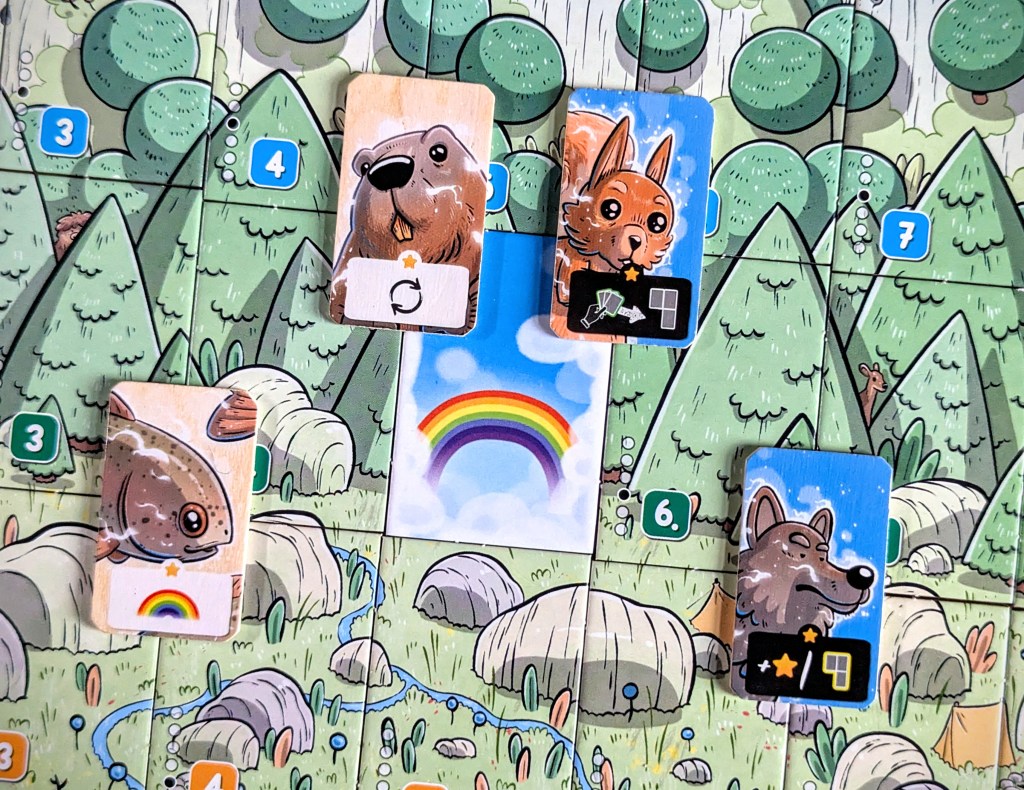
When your tiles are placed and any spirits resolved, you draw back up to 3 tiles and end your turn. The game ends when the Land stack is empty and there’s either no tiles left in the central display, or neither player can make any more matches.
The player with the most points wins, based on:
- 1 point for each tile in the biggest connected area of your panorama (Rainbow tiles connect other tiles together, but don’t score points).
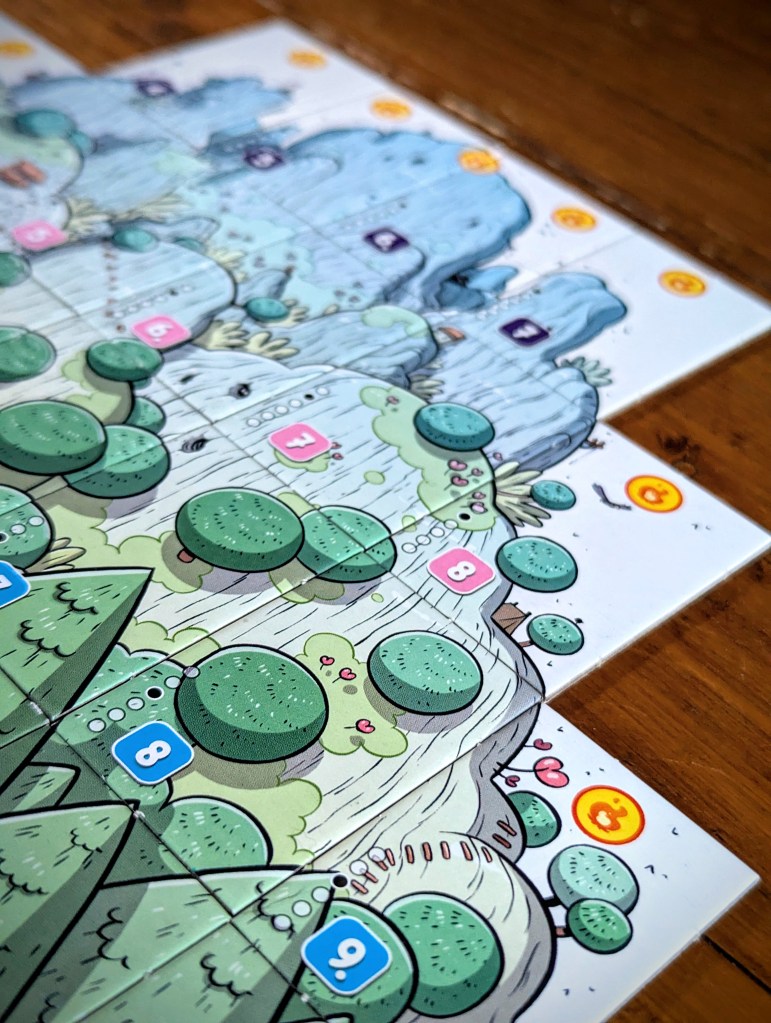
- 1 point for each ‘lit’ fire. Tiles across the mountain peaks include fire symbols, and if there is a connected path of tiles from the top of the mountain to the bottom the fire symbol counts as a lit fire.
- 1 point for each spirit in your panorama, plus any points earned from spirits with a blue background.
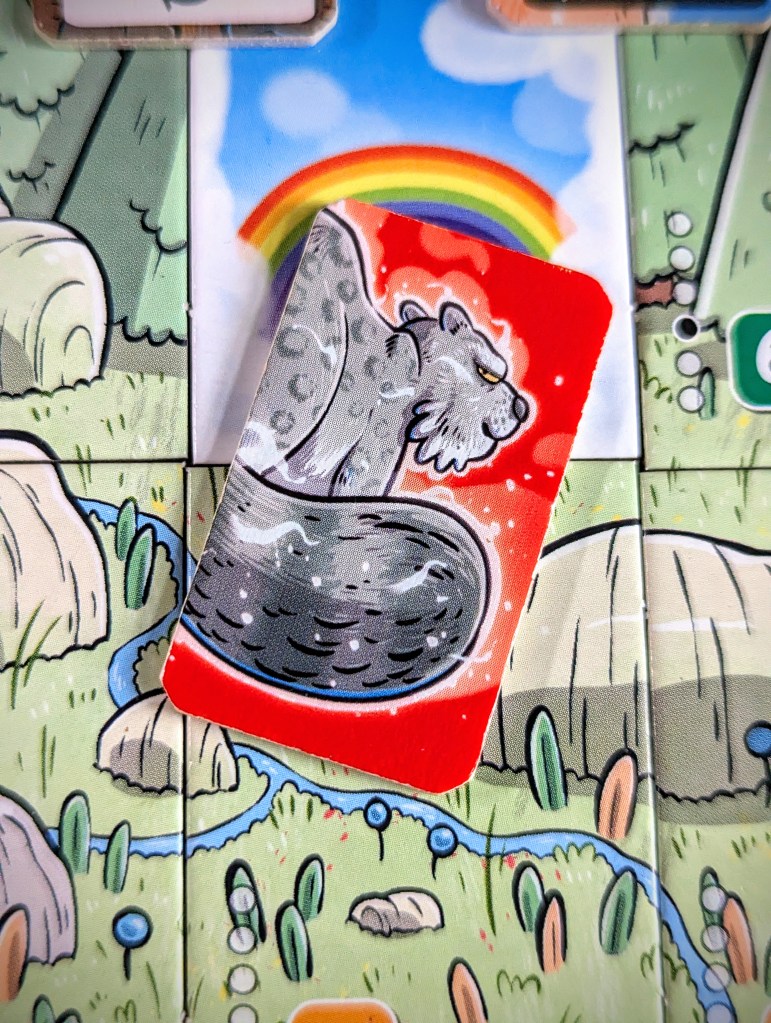
Solstis also comes with an optional Evil Spirit with a red background. When drawing 2 spirit tiles, if you ever reveal the Evil Spirit you must take it and put it next to your panorama, then take the other spirit and add it to your panorama as normal. The next time you encounter a spirit, you give the Evil Spirit to the opposing player who puts it next to their panorama. This pass-the-evil-parcel continues until the end of the game, where whoever is still stuck with spirit puts in in their panorama, covering one of their nice spirits – and the opponent gets to pick which one.
Solo mode
Solstis solo is similar to the 2-player version, but instead you’re competing against the Evil Spirit! The Evil Spirit’s ‘hand’ of tiles is placed face down in a line. And while your turns are the same as in a 2-player game, the Evil Spirit’s turns are slightly different.
On its turn, you reveal the first (rightmost) tile in the Evil Spirit’s hand. It captures ALL of the matching tiles from the display (any matching colours AND any matching numbers). If no tiles match the Evil Spirit gets a Second Chance, but again captures all matching tiles. If the Evil Spirit gets a Rainbow tile it goes next to its panorama until the end of the game, when these are added in a way that most benefits the Evil Spirit (building its biggest panorama area while trying to connect different areas together).
If the Evil Spirit creates a 2×2 panorama, then it draws the top tile from the spirit stack and places/activates the effect as normal. At the end of the game, scores are calculated as normal.
Our thoughts
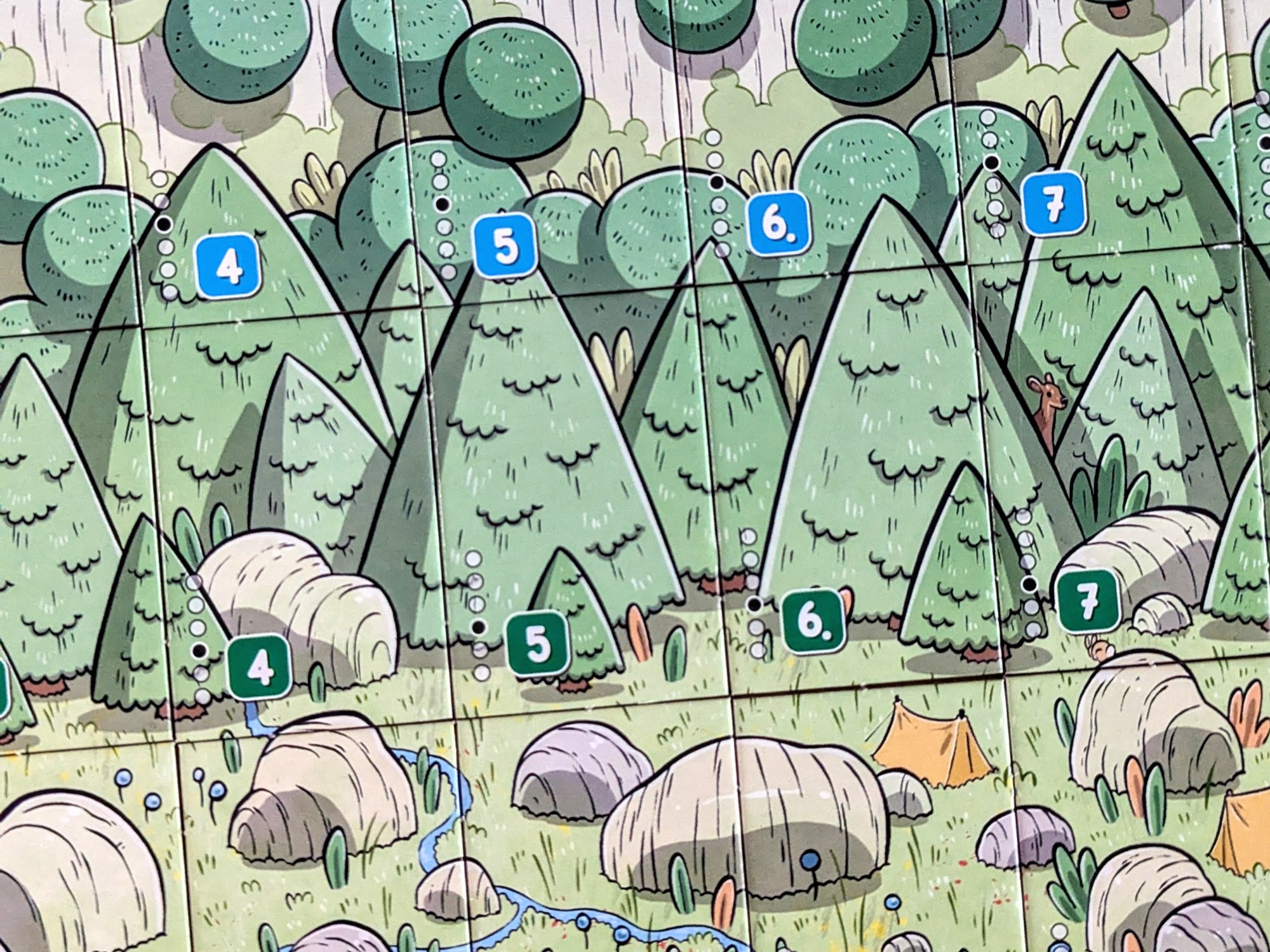
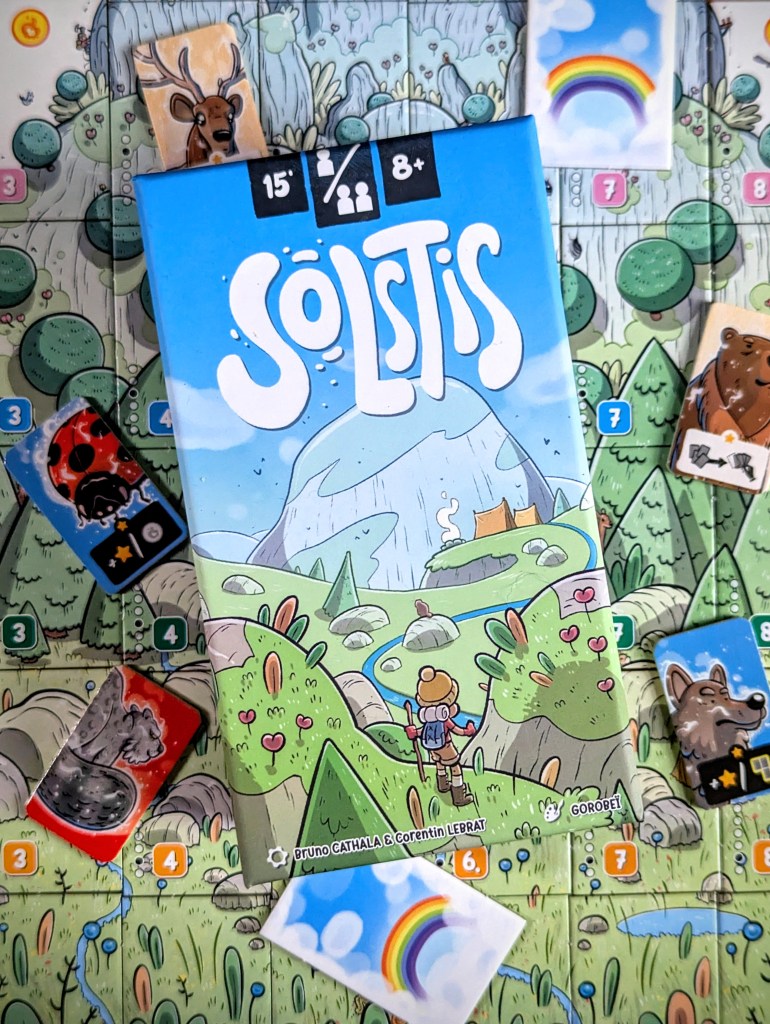
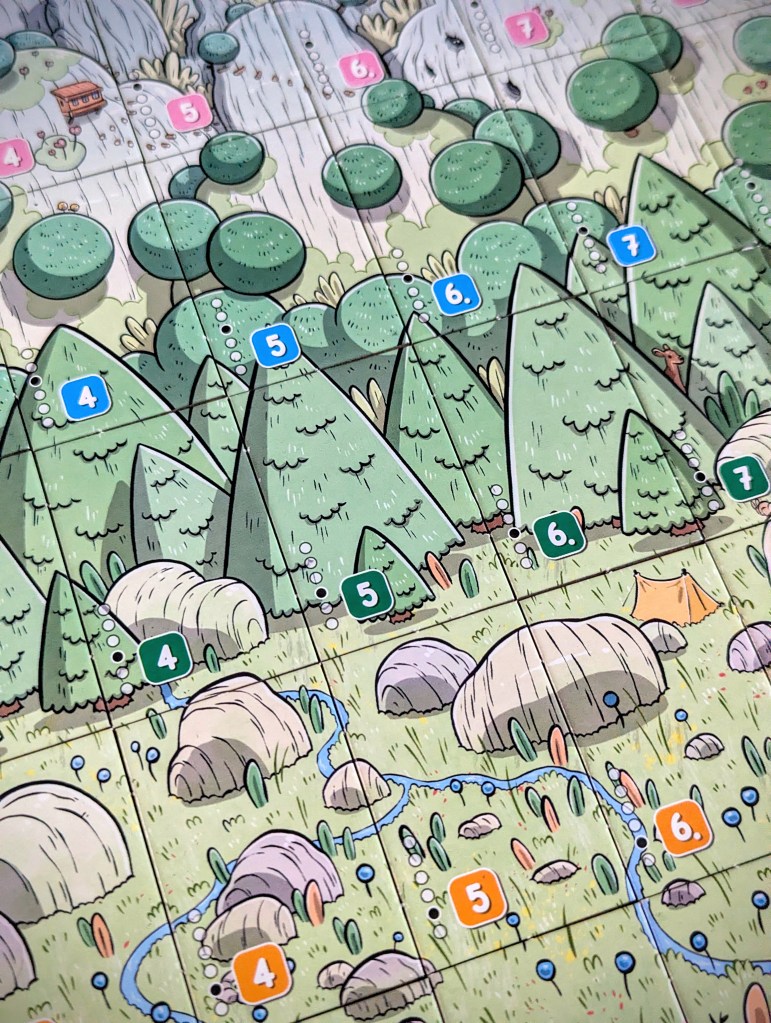
Solistis is cute and portable, with some adorable artwork from Gorobeï, particularly the different animal spirits that somehow manage to portray a lot of personality. The art on the land tiles seamlessly join together to make one whole mountain panorama, although you won’t achieve that in-game with your opponent grabbing half the tiles. I also really enjoyed the tactility of the wooden spirit tiles. The player aid, which has spirit powers on one side and the land tile arrangement on the other, is super useful but it would have been better if there was one for each player.
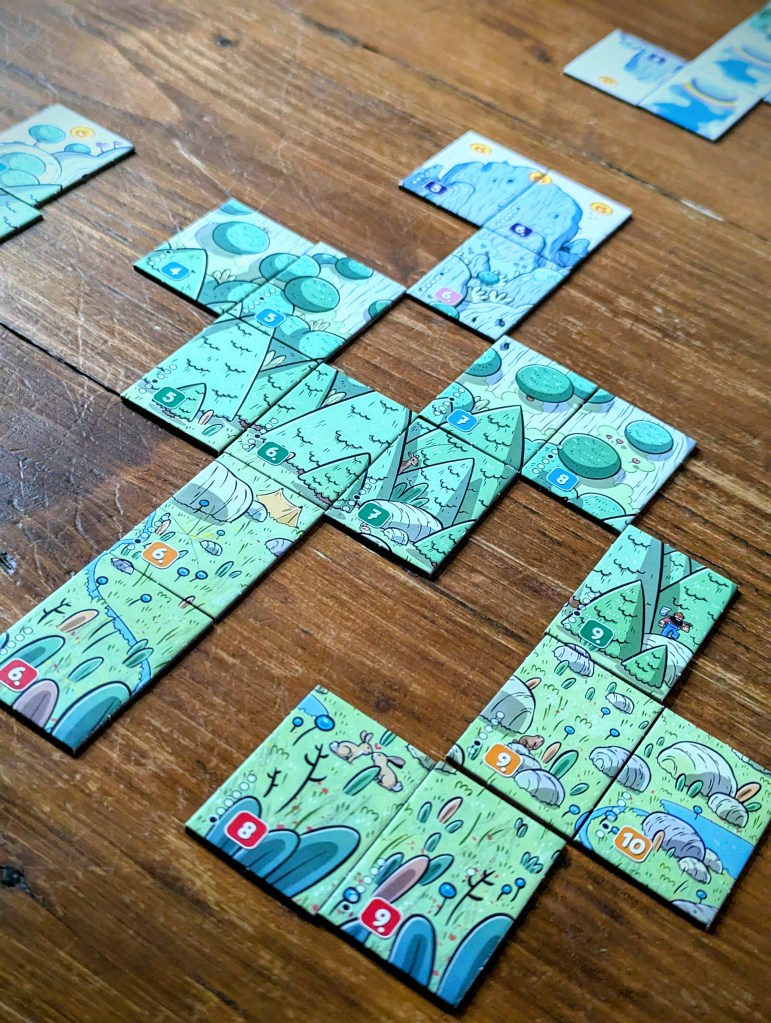
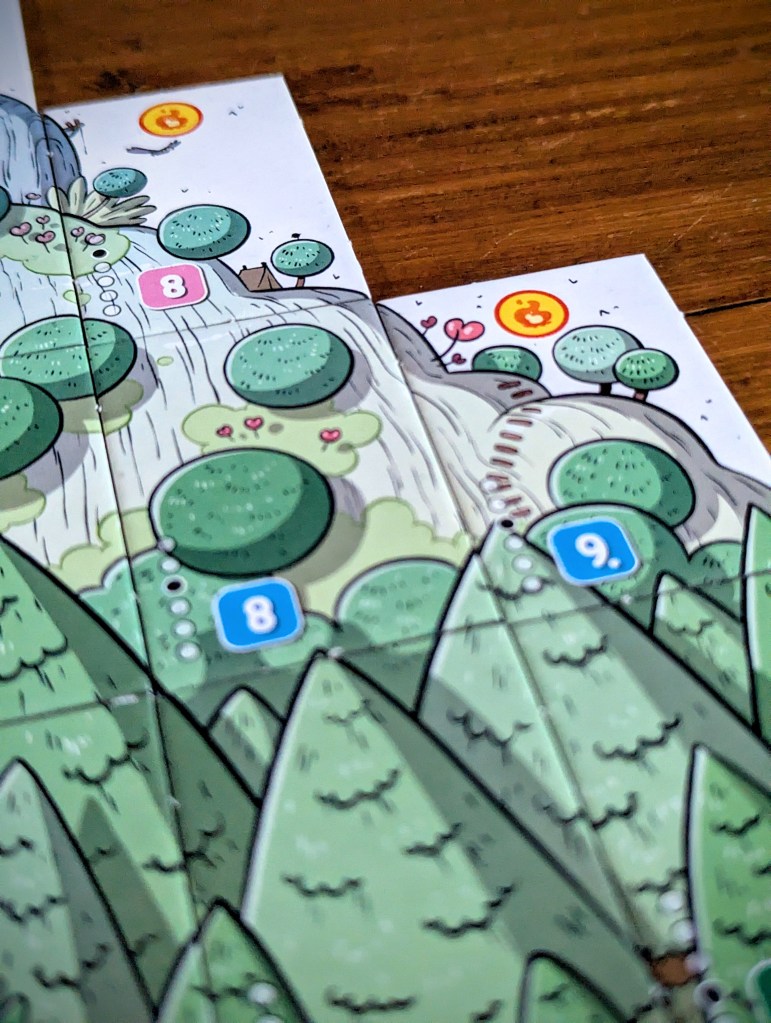
Each land tile goes in a specific ‘space’ on the mountain, in colour-coded rows and ascending numerical sequence. The player aid helps with the spatial locations, but it’s still tricky to place them perfectly when there’s tiles missing so it feels like you’re constantly tweaking your panorama as it fills up. There are promotional paper mats (or fancier neoprene ones to buy) if you can find them, which would make a big difference. In my opinion, paper mats should be included as standard because not only does it help with placement, it makes such a visual difference (as you can see from these photos, without a mat the gappy panoramas don’t look the prettiest).
The tactical highlights (in my opinion) come from the second chances and which spirits you choose. Even if you have a tile in hand that can match to one in the display, you can still choose to play a different non-matching tile to risk a second chance – gambling that a better match will come out of it, or that you’ll end up with a rainbow. That educated gamble (if you’ve been keeping an eye on the tiles that have already come out) can really pay off if you time it right – and have luck on your side. With spirit tiles, you’re making the choice of picking from the spirits you know (that have already been drawn face up), or hoping something better comes out in the draw – another fun gamble, if you have luck on your side. You’re also often picking between a useful instant effect or something that could be beneficial at the end game. There are definitely some spirits that are more popular because they feel more useful.
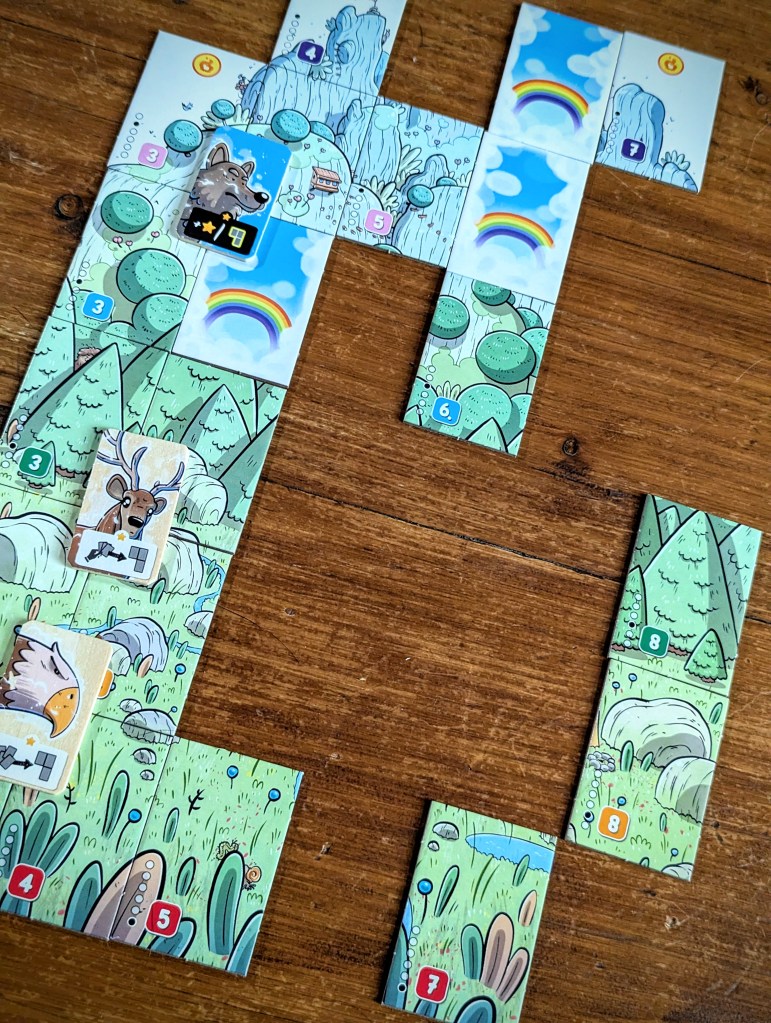
Arguably capturing land tiles also gives some tactical choice, but only if you’re in a situation where you have multiple options to choose from. Occasionally you have more than one tile in your hand that can capture another tile. Occasionally you’ll have a tile in your hand that could capture a choice of display tiles. But there are often times when you can only make one match, so there’s no choice – apart from whether you go for a second chance instead, but sometimes even that isn’t an option and you can be stuck forced to match tiles you don’t really want. Conversely, you usually get to a point where there are no tiles left in the display (because they’ve all been captured), so a second chance is your ONLY choice.
You may have noticed a pattern, and my main issue with Solstis: winning is heavily (and I’d argue predominantly) down to luck. I do enjoy luck in games, but there’s a sliding scale and I don’t tend to enjoy games where luck is so influential to the point it feels like you have little to no agency or mitigation over the outcome (obvious exceptions are party games that are supposed to be lighthearted, silly and random). And after all my games of Solstis, it’s clear you have little control over the outcome of the game. You can try to make the best choices with the hand you’re dealt, but you’re fully at the mercy of those tile stacks. You can see the influence of that luck in the massive final score variations: sometimes people come out with reasonable even scores, sometimes there’s such a dramatic difference (say 15 versus 30) but the same two players over multiple games swing between being the winner and loser. And if there’s a game where Matt is beating me around half of the time you better believe lady luck has her mitts all over it.
So with all its swingy luck-driven gameplay, I shouldn’t enjoy Solstis…and sometimes if I’m having a particularly frustrating game I don’t. Yet I keep coming back to play it! Since sending the review copy to its next destination, I’ve played more than 170 games of Solstis on Board Game Arena. I tend to go through phases where I play over and over, then stop for a while, but I always come back to it eventually. And it’s been hard to pinpoint why it keeps hooking me back in! The best answer I can come up with is that I get a similar feeling playing Solstis as I do with Solitaire (Patience); playing through the game is quick, snappy and actions feel habitual. The gameplay is so quick you can have multiple games on the bounce in a lunch break. And when it’s going well it feels very satisfying.
The BGA implementation works really well by the way, although missing the solo mode. In a way I prefer it because your captured tiles are placed over a full mountain (so emulating a player mat).
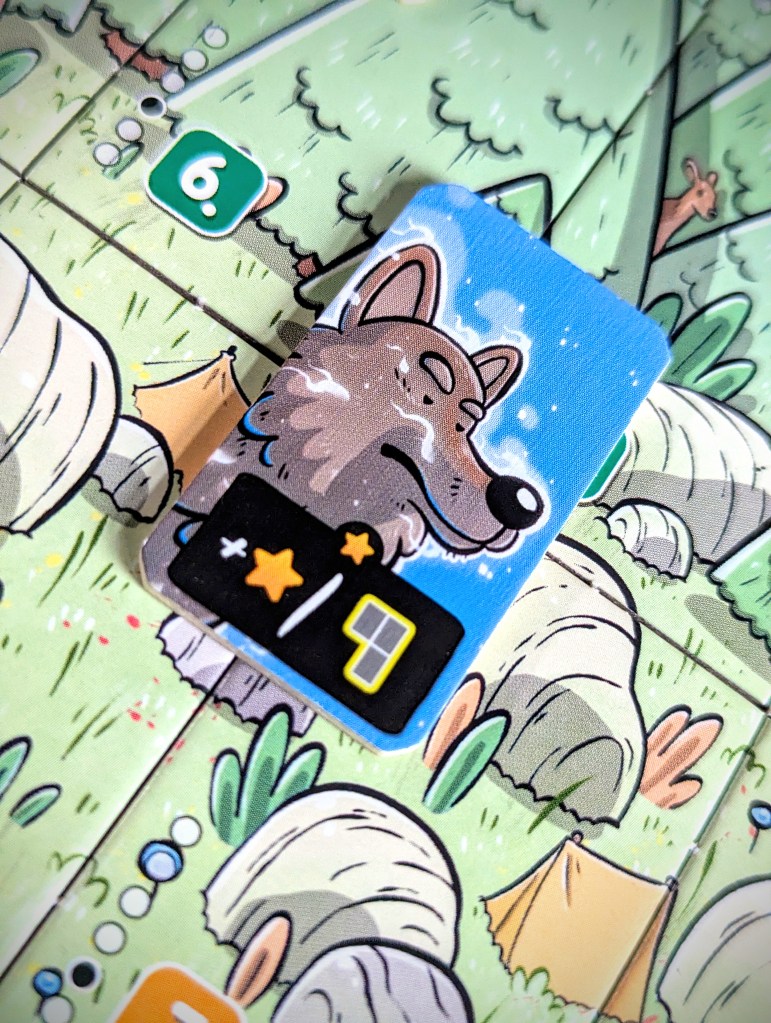
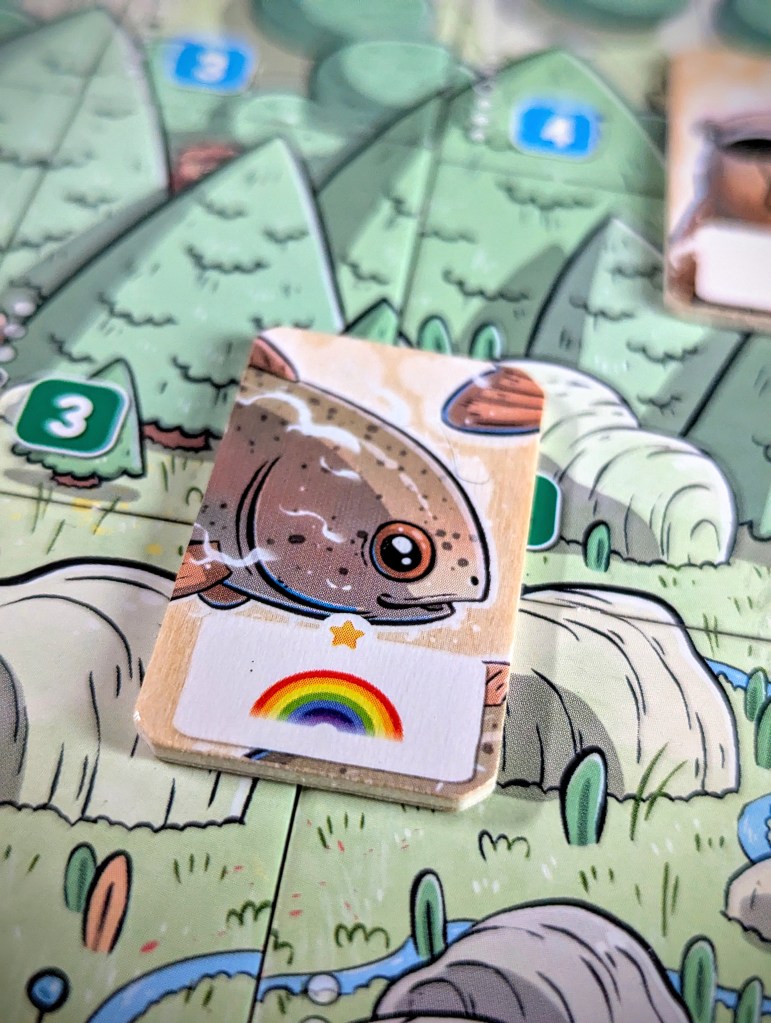
The evil spirit addition is…okay but adds less tension than I expected. It only has an impact when you can cover a blue-backed spirit (blocking the spirit from scoring), but often the evil spirit has no effect (either there was no spirit to cover, or only beige-backed spirits that don’t score). He didn’t feel evil – more ever-so-slightly-bothersome. It probably works well for people who really don’t like to be mean to each other. (The evil spirit has a better purpose in the Solsit expansion, which we’ll review another time!)
The BGG description says that Solstis is zen and quick to set up and I’d mostly agree with this, although the tiles can be a bit fiddly to shuffle and stack due to their size (I can accept this thought as I wouldn’t want the table footprint to be bigger). But zen? Like with A Gentle Rain (which I also enjoy playing by the way!) I wouldn’t say zen is quite the right word for my experience, because it can get very frustrating when you’re having a lot of bad luck. But in my experience that frustration is short lived, and I still keep coming back for more.
What we like:
- Cute artwork with tactile tiles.
- Super portable and quick to play (needs a bit of table space for your panoramas though)
- Some fun tactical choices, if they’re available, like choosing which tile to capture, gambling with a second chance or picking a spirit.
- The solo mode works well (but I’m sad it’s not available on BGA)
Considerations:
- Very very very luck dependent! A game of Solstis can be super satisfying or super frustrating, and which direction it goes feels very much out of your control.
- The evil spirit isn’t very evil (unless it’s thrashing you in solo mode). It’s better in the expansion.
Verdict
This has been one of the hardest reviews I’ve written, because Solstis has me all confused! I can get really frustrated by the luck-driven gameplay, and on that basis I was expecting to walk away not liking it. But actually I really enjoy playing it (mostly) and find it almost addictive.
If you’re happy to take the luck on the chin, Solstis can be a great 2 player quickie to have in your collection. And even if you don’t like a lot of luck in games, it still might be worth giving Solstis a go – like me, you might be surprised.


