
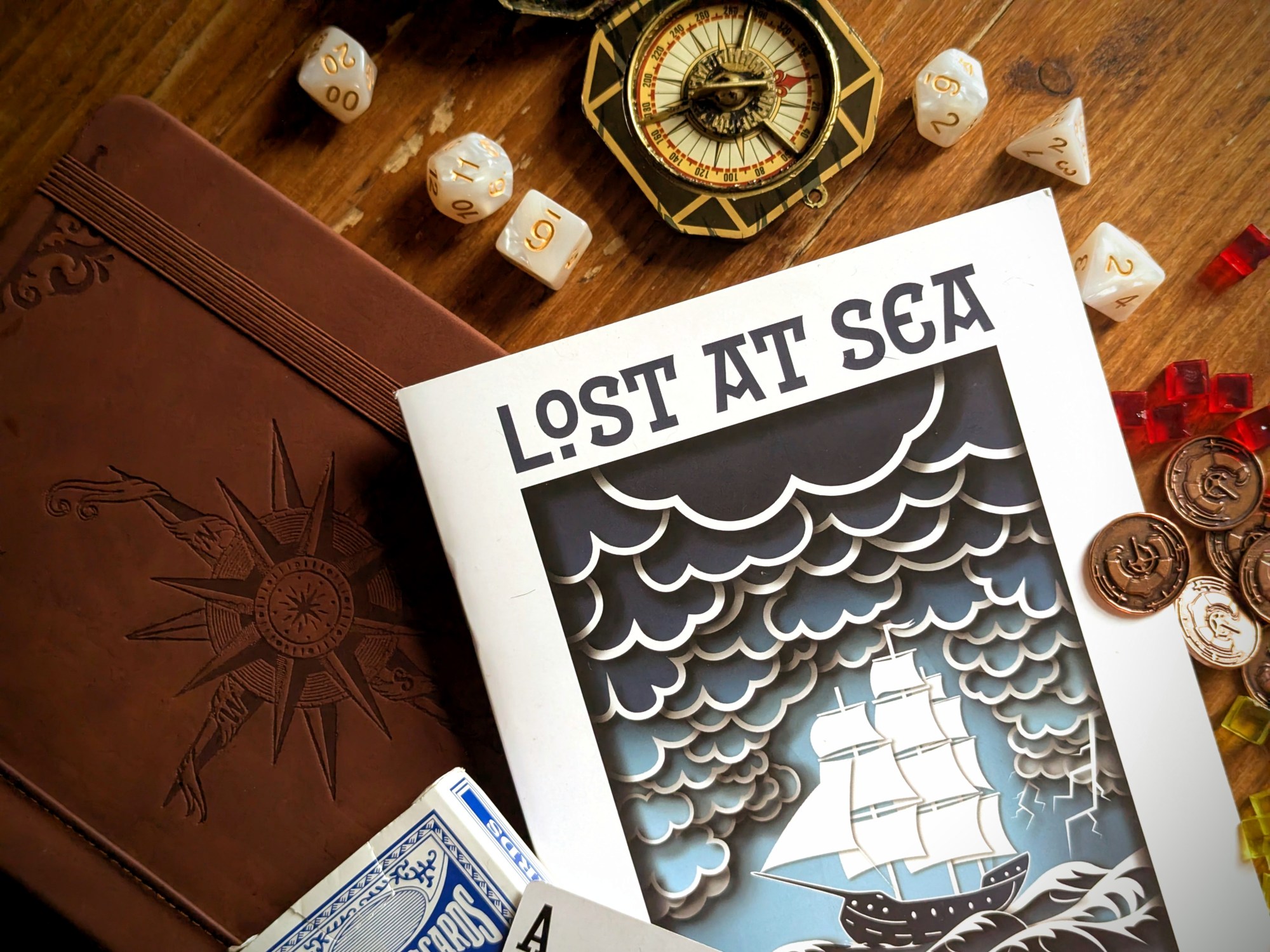
Advert: This game was gifted from Critical Kit via @UKBG_ReviewCircle in exchange for an honest review. All opinions are ours.
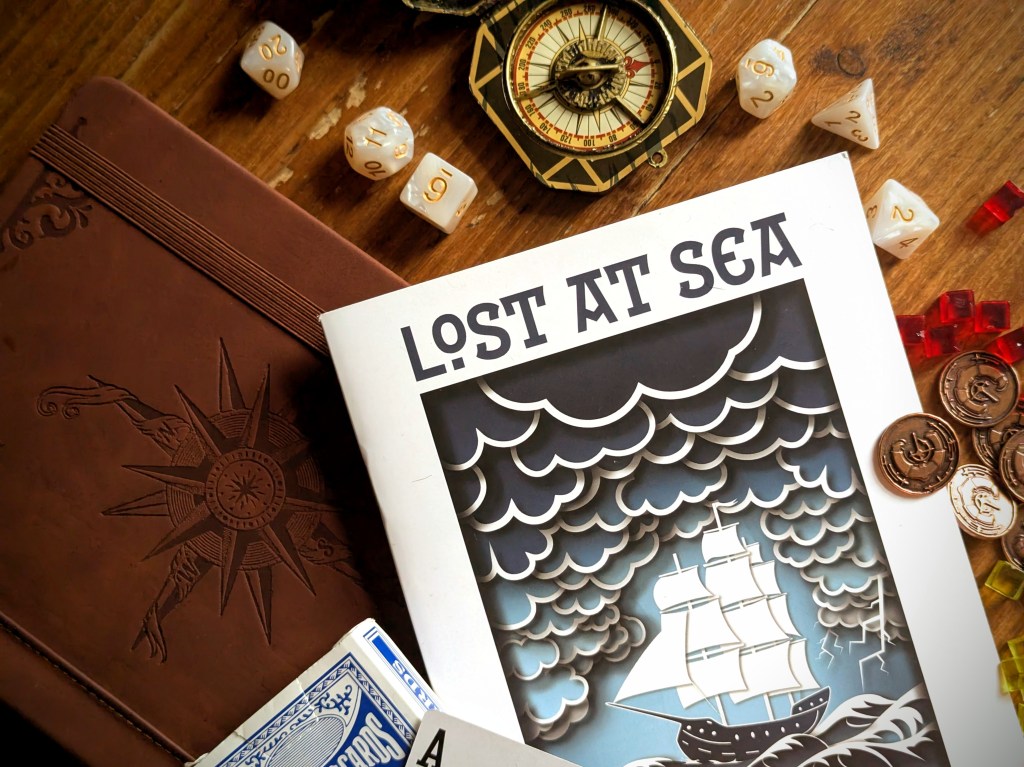
Yo-ho, yo-ho, a pirate’s life for me. Well us, not just me. We recently played Lost at Sea, a GM-less RPG by Tolkraft and published by Critical Kit. So how did we get on when we spent time amongst the tides.
Set up
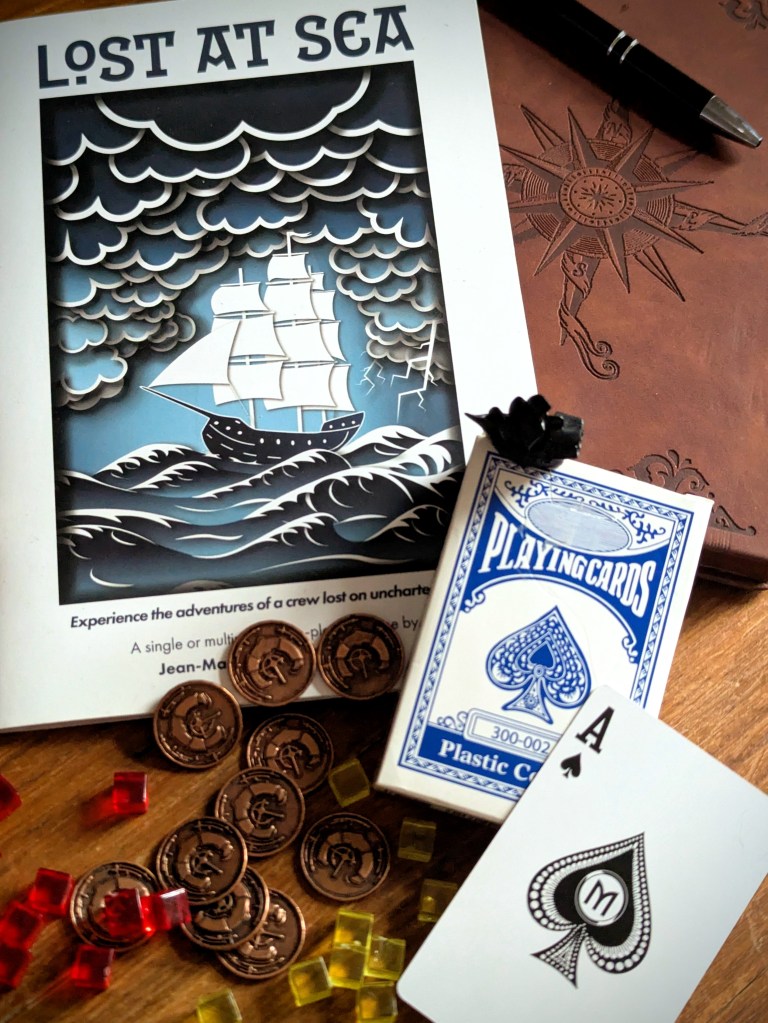
As with most RPGs there is a little bit of preparation to get through before you can start your game. In Lost at Sea it’s fairly straightforward and involves naming your ship, setting your era (Baroque, Roman Empire, etc.), defining your occupation, and setting up your crew characters.
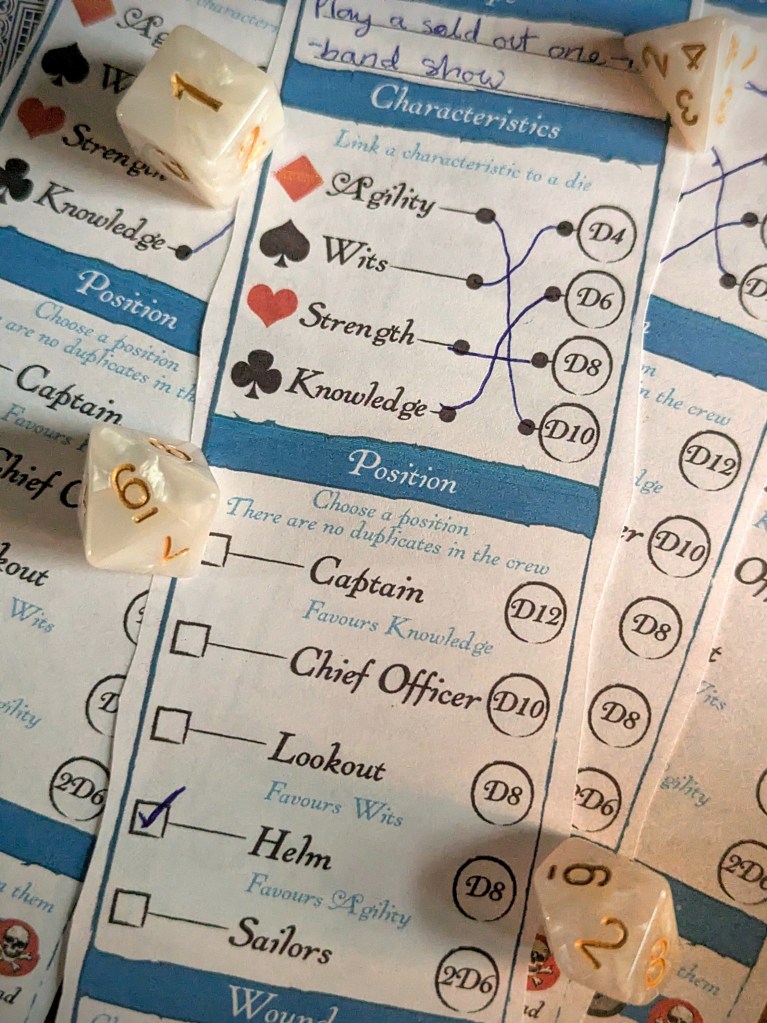
Your crew is made up of 6 characters: the Captain, the Chief Officer, the Lookout, the Helm and the Sailors (the Sailors function as 1 character, but represent the generic rabble of the ship’s crew). For each character of the ship you give them:
- A name
- A catchphrase
- A hope
- Their skillset, setting each dice (d4, d6, d8, d10) to a specific characteristics (Agility, Wits, Strength, and Knowledge – each represented by a card suit)
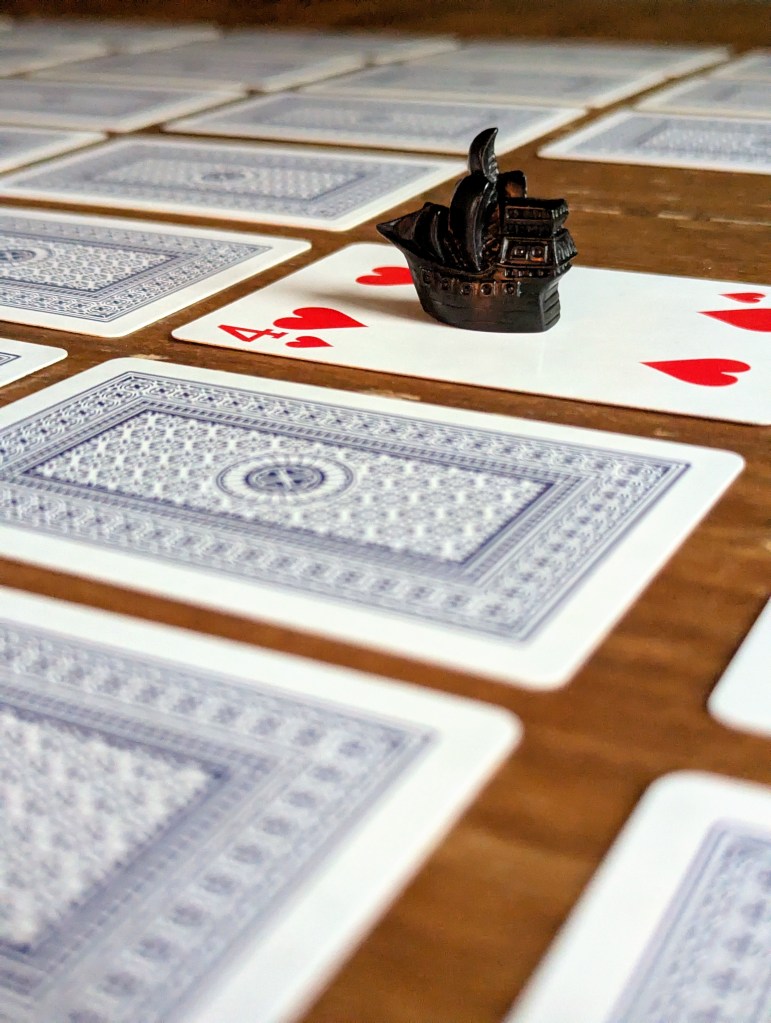
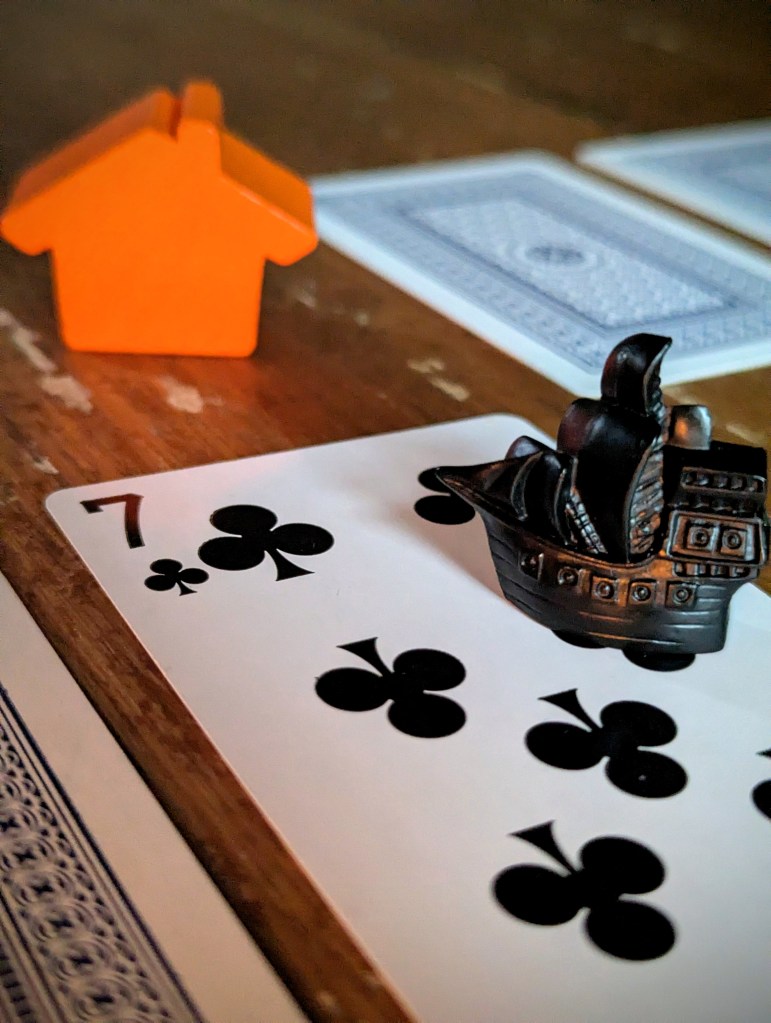
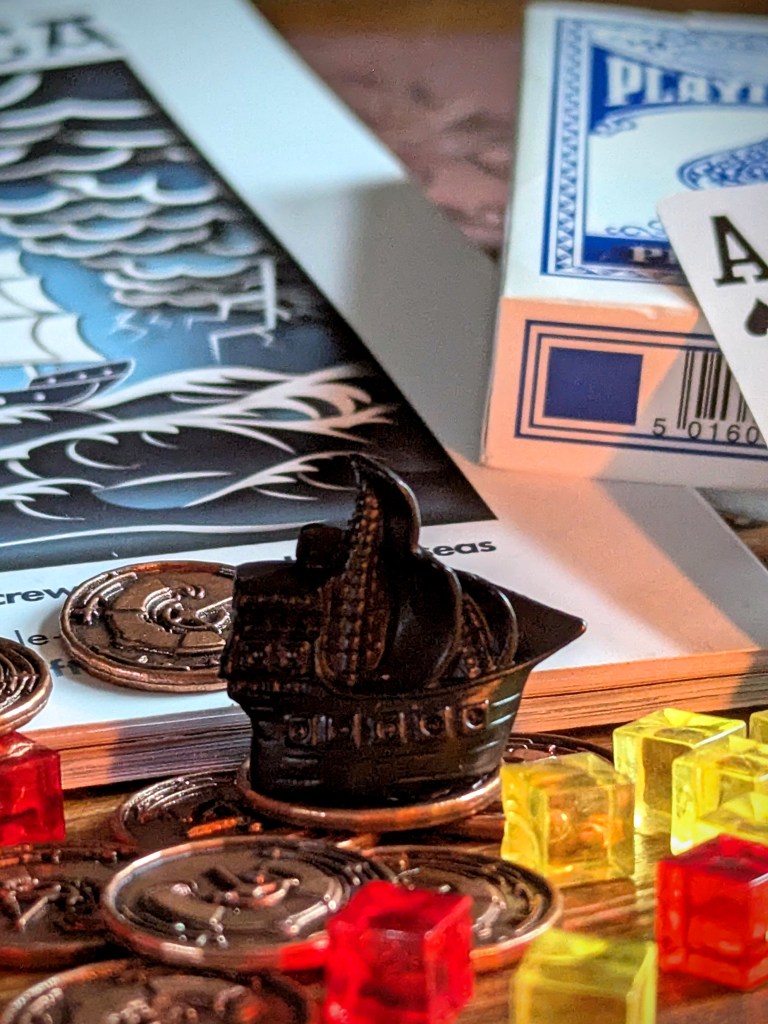
After that you build your sea using 49 random cards from a standard deck (inc. jokers) in a 7 x 7 grid. On one end you remove a card and place a token representing your ship (we used a ship from our copy of Jamaica) and at the other end you remove a card and place a token representing your home. This is your destination for the end of the game.
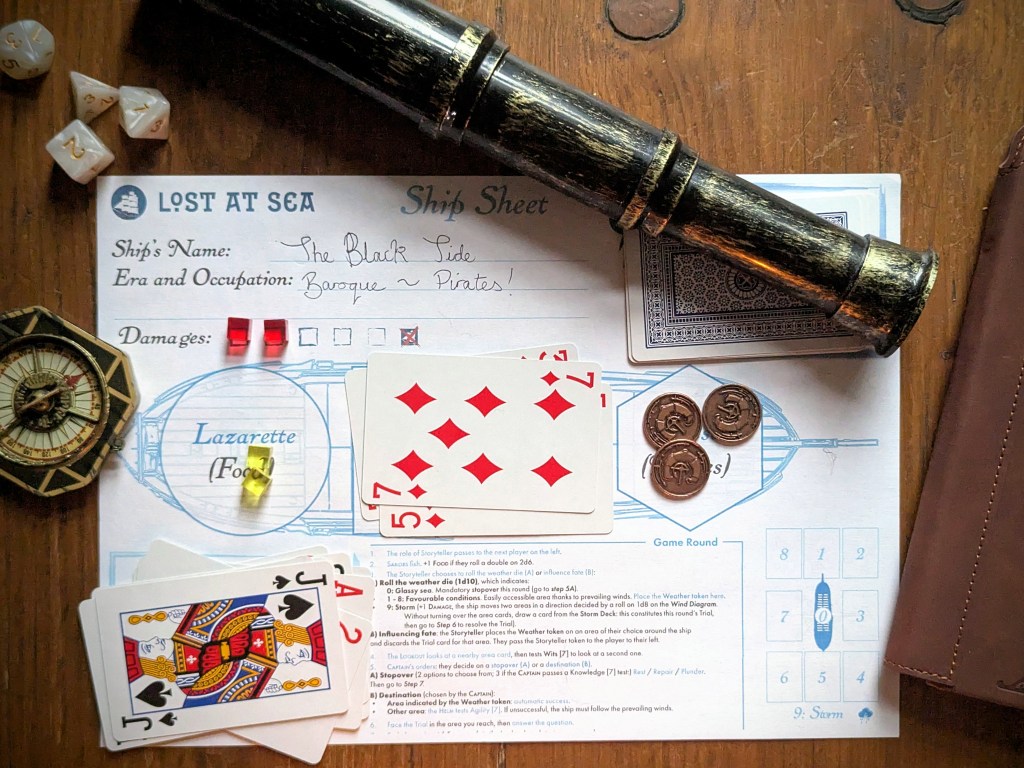
Setting up took us a couple of hours but this included a dry run of the first couple of rounds, so we were ready to play properly the next night. A good chunk of that time went into developing the characters, coming up with solid catchphrases, hopes and personalities, which really did help us steer the game.
Gameplay Overview
Over the game the players are sailing a ship across the sea, attempting to make it home (at the other side of the board). The ship travels from card to face down card revealing each card as it travels. These cards represent trials (encounters) of varying skill type and difficulty depending on suit and value.
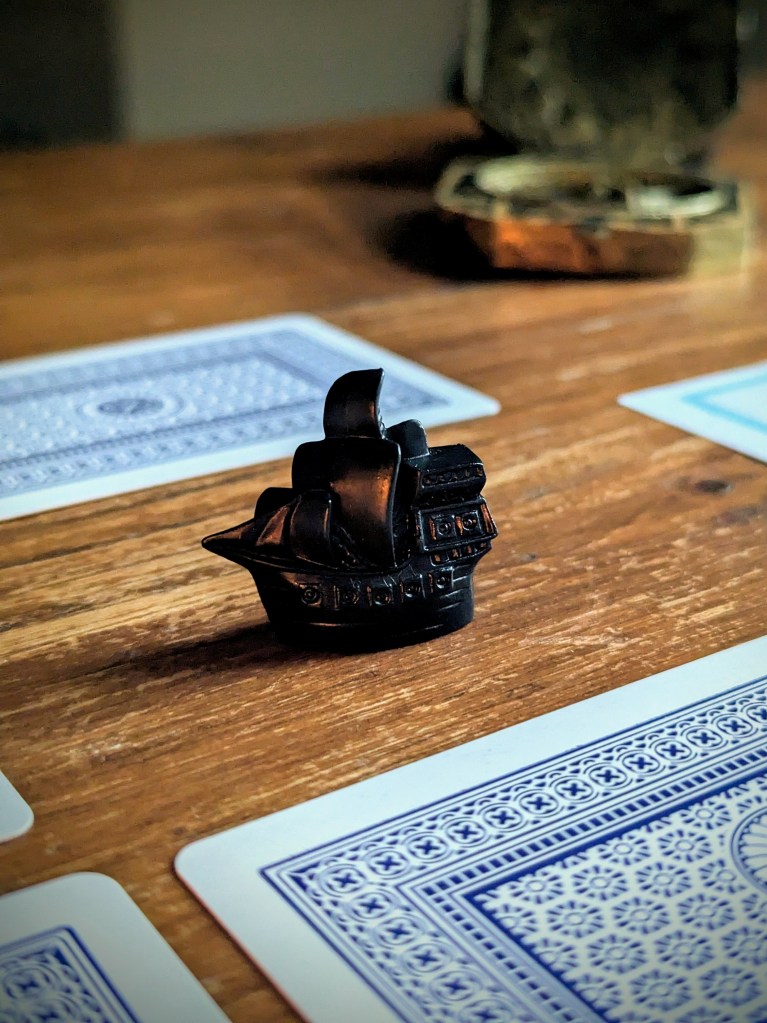
Each round, one of the players becomes the Storyteller who guides players through the necessary steps:
- The Sailors try to fish. This is a skill test (Rolling 2 D6 dice). If successful, they add an extra food token to the ship’s supply.
- The Storyteller determines the weather. The Storyteller rolls a D10 which tells players which way the wind is blowing. If they roll an unlucky 9, a storm blows the ship 2 spaces in a random direction, determined by rolling a D8)
- The Lookout inspects the options. The Lookout takes a peek at any facedown card adjacent to the ship – or two if they want to take a Wits skill test. They can indicate whether a route is favourable or not, without stating the specific cards seen.
- The Captain sets the course. After taking onboard the previous steps (and any potential discussion amongst the crew), the Captain ultimately chooses the direction of travel. They can also decide to lay over and spend time repairing the ship or undertaking additional fishing.
- The Helm steers the boat. If sailing in the direction of the wind, the ship travels with ease. If the Captain wants to travel in a different direction, the Helm must pass an Agility skill test – if they fail, they move in the direction of the wind.
- The Trial is revealed. The card the ship sails to is flipped (if there’s no card, nothing happens) and the Storyteller looks up the relevant Trial (encounter) and reads the scenario. They can embellish the scenario as much as they want – or even make up their own. The players choose which crew members are facing the skill test – only one character needs to succeed the test for everyone to pass, but if no one succeeds everyone who took part gets wounded. And if you succeed, there’s often a reward, for example +1 Fish or +1 Riches.
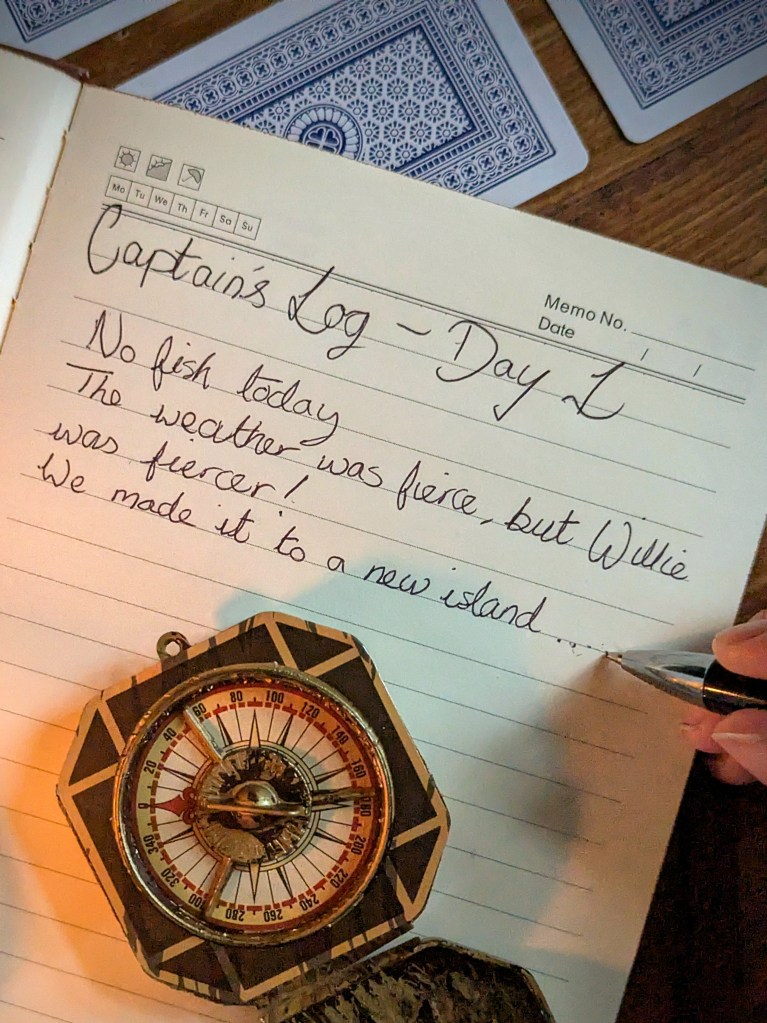
- The crew are fed. At the end of the round, remove a food token from the ship’s supply to feed the crew – if you can’t, apply wounds. The Captain records the happenings of the day in their Captain’s Log.
This might all sound simple but the dice rolls, encounters, and unexpected storms will ensure your journey isn’t as simple as it sounds! When (if?) you arrive home, the crew will face one final trial, their toughest yet.
Our Story – Lost At Sea
In our story, we joined Captain Morgana McGill and her crew on The Black Tide, the day after a very strange occurrence. A mighty storm had thrown the ship against The Fall (in our world the 49 card sea was surrounded by a great waterfall on all sides) which pushed the ship under the water. The crew awoke on deck, unharmed but…different, all having some kind of aquatic transformation, like their DNA had been mixed with ocean creatures. Eight-Armed Willie the Helm woke up with eight octopus arms and could only communicate in Zoidberg style noises. Chief Officer Barnacle Bill was covered in barnacle-like growths. Raven the Lookout was covered in black feathers.
Before the storm (and the bizarre new looks!), The Black Tide was heading home, on its final voyage. And now, the crew were still heading home, but were going to take every opportunity to investigate what happened to them along the way. After all, Captain McGill had high hopes of publishing her Memoirs of a She-Shanty when she got home, so the more excitement she could add to those pages the better.
The Black Tide’s journey was arduous. They were hit by two more storms, each one blowing them further away from home. They encountered rival pirates, lost treasure, and another stranded hermit crab mutant Dave, to name a few highlights. There were revelations amongst the crew – Raven turned out to be Captain Morgana’s long lost daughter! Unfortunately, Morgana was more excited about how this would make a thrilling chapter for her memoir (‘A Reunion Amongst the Waves’) than Raven being her daughter. Eight-armed Willie and the rescued mutant Dave quickly fell for one another as they both spoke in zoidberg or clicking noises and could only understand themselves.
Whilst they did eventually make it back home, what had felt like 18 days away to the crew was in fact over 100 years back home… and it’s safe to say home wasn’t home anymore.
If you want to read more we have written up the ‘Captains Log’ from our game in another post which will be posted in the next week or so.
Our thoughts after playing Lost At Sea
Lost At Sea is a stepping stone into roleplaying games, advertised as “a gaming experience between a board game and a traditional role-playing game”. You’re encouraged to role-play where you feel inspired, and skim over bits you don’t. We’ve been wanting to dip our toes into GM-less RPGs that we can play as a couple (or even solo) and with the maritime theme and beginner-friendly board game-esque mechanics, Lost at Sea felt like a perfect starter and didn’t disappoint.
True to its intention, it is really accessible for new players like us who don’t have much experience with roleplaying games. Our experience before this was limited to a tiny bit of Dungeons & Dragons, so we are very much RPG novices! The flexibility to roleplay when we were inspired and play it straighter when we weren’t really took the pressure off. We felt we were playing it as it was intended despite roleplaying more flexibly.
That said, roleplaying multiple characters (3 each) was tricky and I think we both probably put more energy into the same ‘preferred’ characters when we were inspired to do a bit of roleplay, which meant that some characters didn’t get as much development.
As we outlined above, the set-up took us some time but it was well worth the time invested and really helped us make decisions in the game. We really made use of Captain Morgana Mcgill’s motivation which was to return home to retire and write her memoirs which worked really well to make some chaotic choices (In the hunt for something exciting for her memoirs) and Barnacle Bills desire to get home to his love whilst staying sober (too much rum enjoyed in his past).
We omitted it from the overview, but at the end of each encounter there is a question that the Storyteller can direct to any character they choose. We thematically thought our characters were hearing these questions in the whispers of the sea winds, inspiring them to share something about themselves. Whilst we found some of these prompts an interesting way to explore how the characters interacted or felt about each other, we did encounter some repeats so would have preferred every encounter to have a unique question (next time we’ll probably come up with some of our own, which again you’re encouraged to do when inspired).
Overall our game took a good 2-3 hours. As I’ve mentioned, we were held back by two storms – they could have blown us in any direction, but unfortunately it was always backwards! – and some bad rolls. The theme and outcome of the Final Trial is linked to how many rounds it takes you to reach home – and because we played over 18 rounds we automatically passed!. We loved that the Final Trial is tied to the number of rounds you take, adding a variety of prompt to close off your story. For example, if you reached home in 2-4 rounds then 2-4 months had passed and the themes were sadness, grief, disbelief, but if you took 10 turns about 15 years had passed and the themes were pregnancy, oath, surprise, abandonment. With that said, we did think the scale was a bit skewed as it feels pretty hard to get home in a handful of rounds when you’re using a 7×7 grid, without something strange occurring (like storms blowing you in the direction of home). But it’s still a good guide for gauging the outcome and there is nothing stopping you as the players to go off piste and use a different set of outcomes if you want.
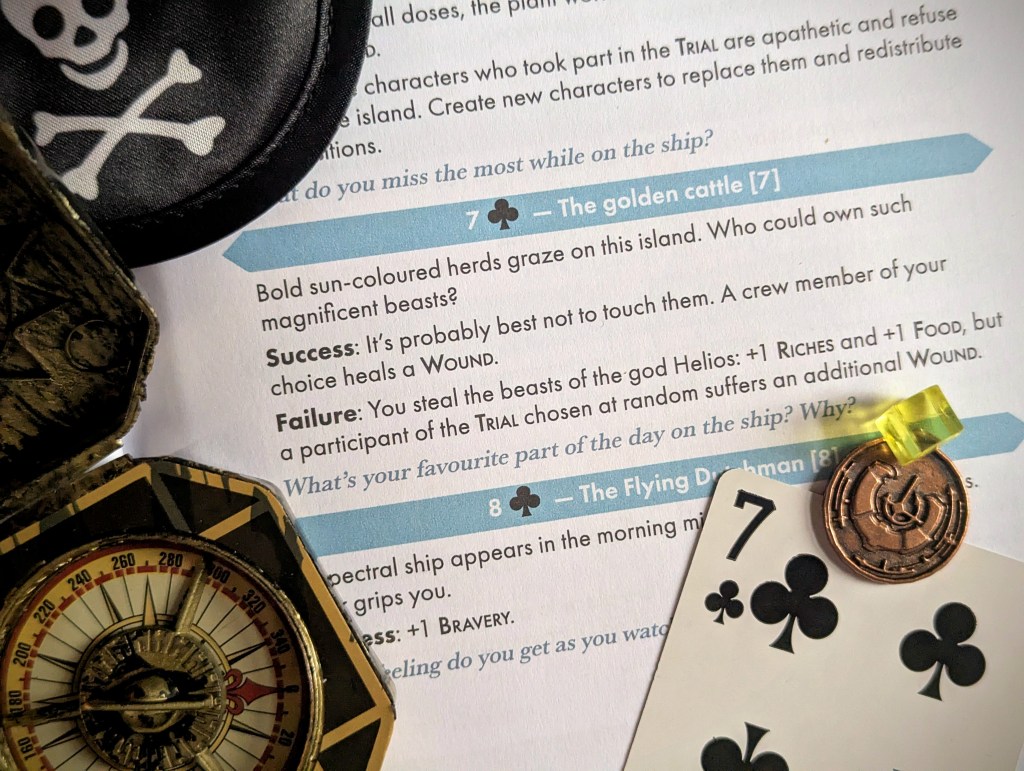
Lauren and I had a bit of a split opinion with the trial descriptions. The book essentially gives you a title, a very brief 1-2 sentence summary of the scenario and then a 1 sentence summary of the success or failure outcome. For example:
‘7♣ – The golden cattle
Bold sun-coloured herds graze on this island. Who could own such magnificent beasts
Success: It’s probably best not to touch them. A crew member of your choice heals a wound.
Failure: you steal the beast of the god helios: +1 Riches and +1 Food, but a participant of the trial chosen at random suffers an additional wound. ’
I felt this was the perfect length for the Storyteller to get the gist so they can dramatically work something into the overarching story using this as a prompt – but also it was fine if you just read it straight. Lauren would have liked a little bit more to these, similar to the encounter book in Above and Below.
RPGs can be very mathematically heavy combining multiple rolls and effects to calculate if you passed a skill check. True to the accessible nature of Lost at Sea, skill checks were really easy as there is no math required; you just need to roll appropriate dice for the characteristic being tested and see if you pass the check with the difficulty being determined by the card value.
The downloadable resources (ship and character sheets) were really helpful and were easy to access and use. We would have liked the back of the book to say that you need some additional tokens for damage, wound, riches and food. Being board gamers, we just reached for games off the shelf with suitable tokens when we realised, so it wasn’t an issue for us, but some people might need warning.
Finally, while we’ve said that Lost at Sea is a perfect entry level RPG for newbies like ourselves I want to emphasise that I also think that established RPG players would enjoy it too – it’s a brilliant structure with a relatively blank canvas to develop the story, for a one-shot or even over several sessions.
Verdict
Lost at Sea achieves exactly what it intends to: it’s a simple to play, easily accessible, entry point to the world of RPGs for solo players, couples or groups. This is mainly due to the flexibility in the system, which allows you to play it as a board game, or a full on roleplay experience, or anywhere in between depending on your comfort level. This low pressure hybrid was the perfect entry point for us. Complete beginners might find it a little tricky balancing roleplaying of multiple characters but I suspect they would just focus their efforts on their favourite characters as we did, which isn’t a problem.
We decided to write up the Captain’s Log so we have a permanent record of our story. Head on over to Lost at Sea: Captain’s Log [Captains Log to be posted here on the blog in a week or so].


