
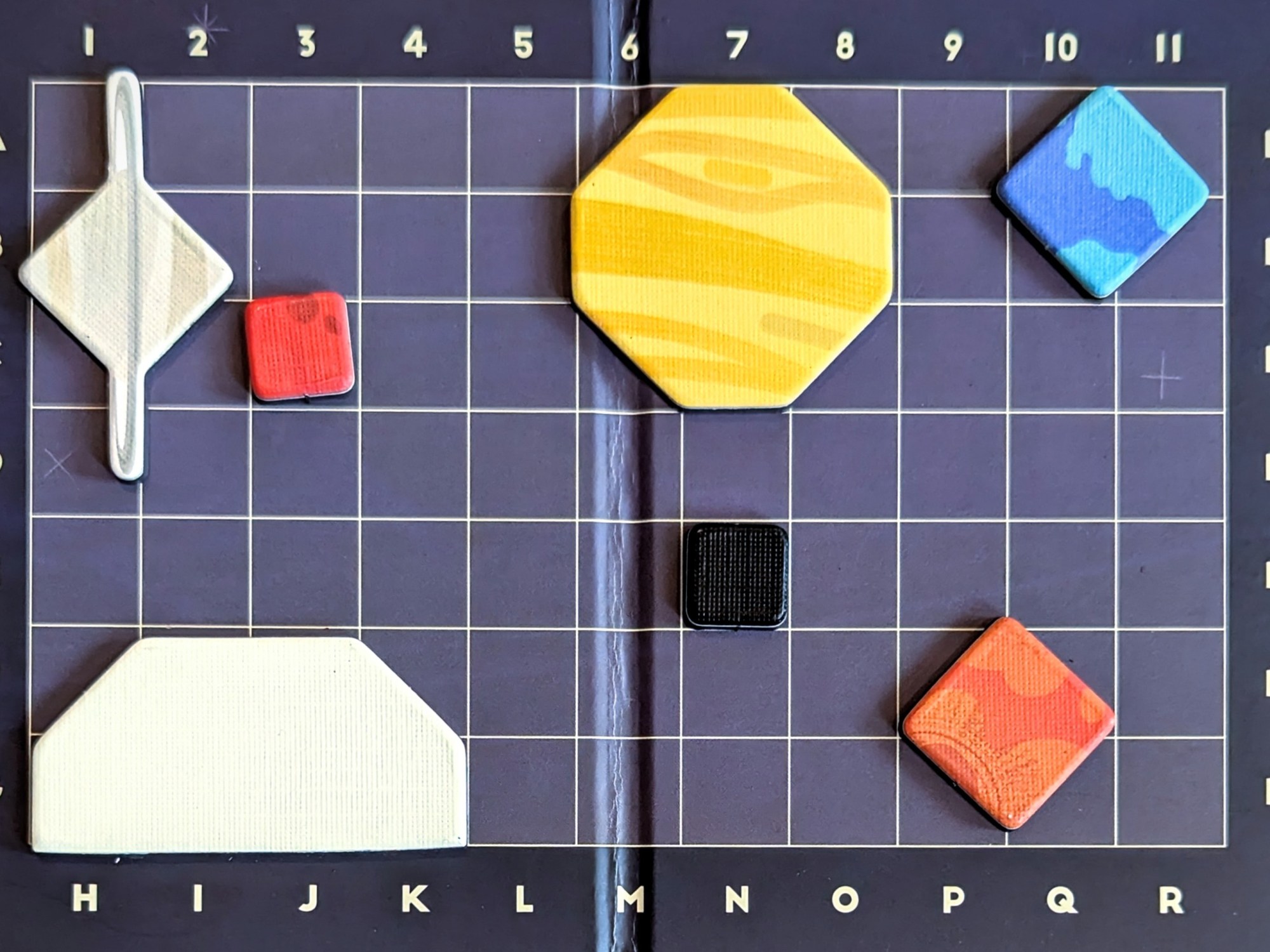
Advert: we were sent this game from Playte in exchange for a review.
It’s Battleships (sort of), but in SPAAAAAAACE! Let’s take a look at Orapa Space, a deduction space race to locate your opponent’s planets.
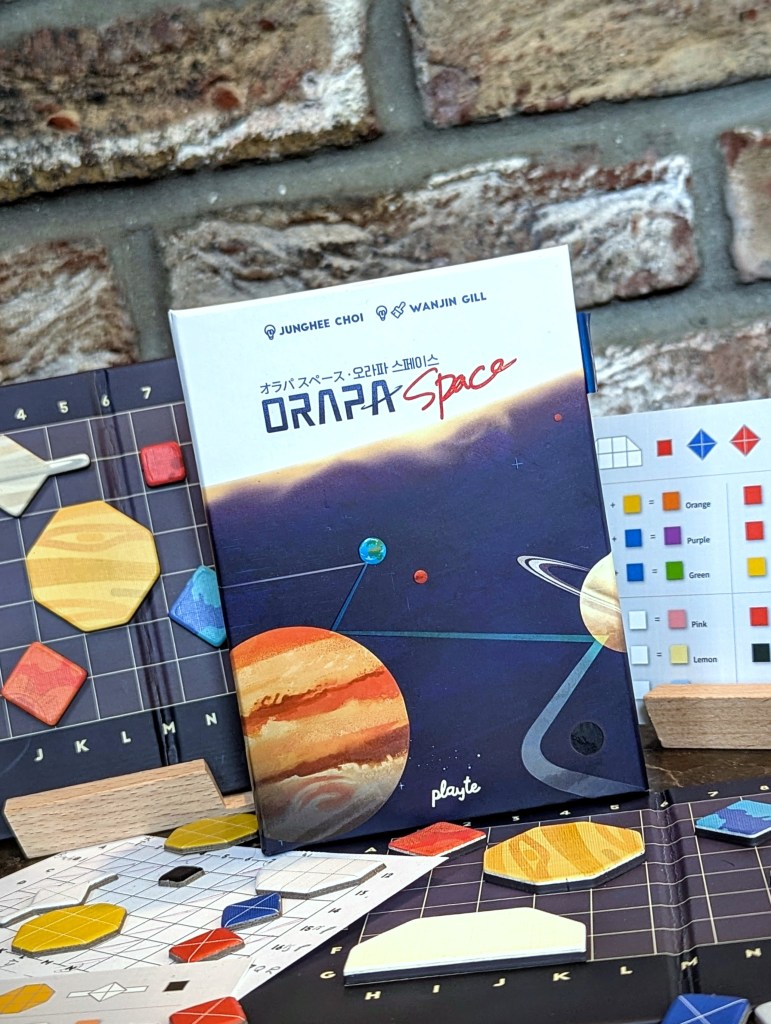
Key stats
2 to 5 players | 30 to 45 minutes | 8+ years
Publisher: Playte
Designer:Shota Hasuike
Art:Wanjin Gill
Theme/category: Abstract, Puzzle, Deduction, Space
Key mechanics: Deduction
Gameplay overview
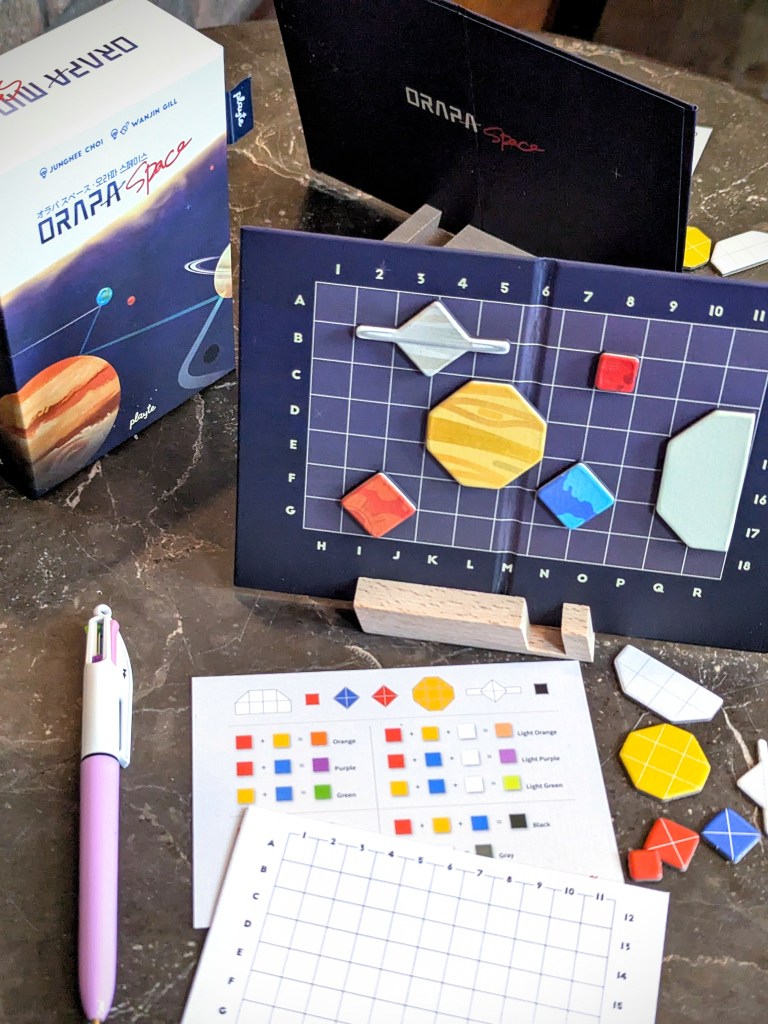
In a 2 player game of Orapa Space, you’re trying to deduce the location of all your opponent’s planets before they find yours. At the start of the game, both players secretly place planets of varying shape, size and colour on their own hidden space grid. Then, it’s a simple case of taking turns to gather intel until someone is ready to make their guess.
There are 2 ways to gain information. Just like Battleships, you can ask your opponent about a specific [X,Y] coordinate, and your opponent will tell you what colour occupies that square, or if there’s nothing there. But the main way to get info is to send a ‘laser signal’ from the edge of the board, from a row or column of your choosing. That laser will fly through space, bouncing off each planet it hits (if it hits any), until it comes back out of the grid. What direction the laser bounces depends on what it hits – angled planet edges bounce the laser 90 degrees, whereas flat edges bounce the laser back in the direction it came from!
Your opponent will tell you the laser’s exit location and what colour it has changed to based on the planet(s) it hit. If the result is purple, you know the laser hit a blue and red planet on its travels. If the laser exits at the same point you sent the signal from, you know at some point it hit a flat edge that bounced it back in the same direction. All you have to do is piece together the different laser results to deduce where those planets are hiding!
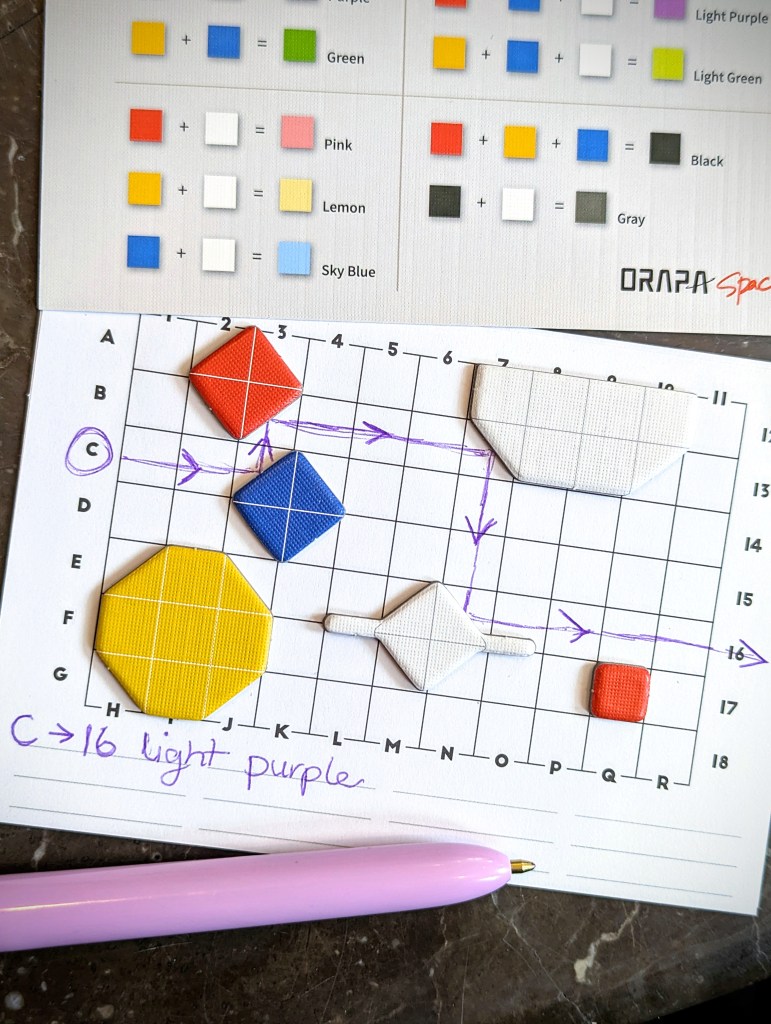
The game comes with an optional black hole expansion. The black hole is a small black square (the size of one grid space) which gets added to the grid along with the planets during set up. If a laser directly hits the black hole, it ‘disappears’. If the laser travels right next to the black hole (adjacent column/row) the laser ‘refracts’ around the black hole, bending 90 degrees – this only happens the first time the laser goes past, if it goes past again there’s no further effect. And it is possible for the laser to get trapped when this happens!
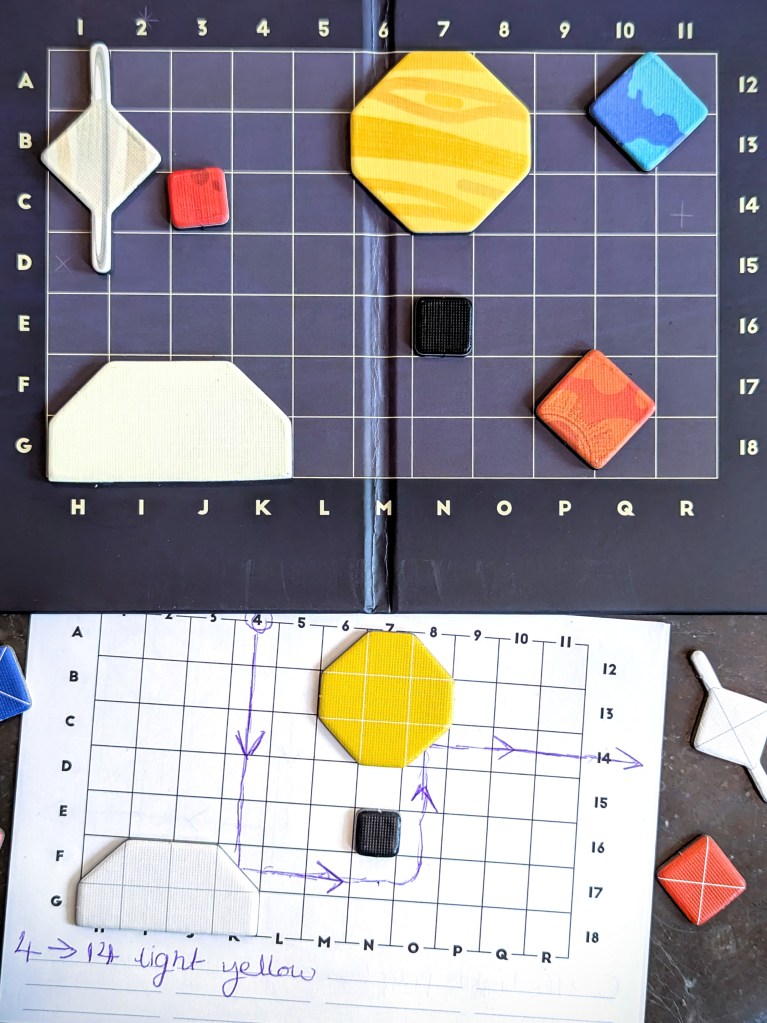
In games with 3 or more players, one player sets the planet locations and the remaining players take turns to ask questions, meaning everyone has the same information. The first player to guess the solution correctly wins (everyone has 2 chances to get it right).
Our thoughts
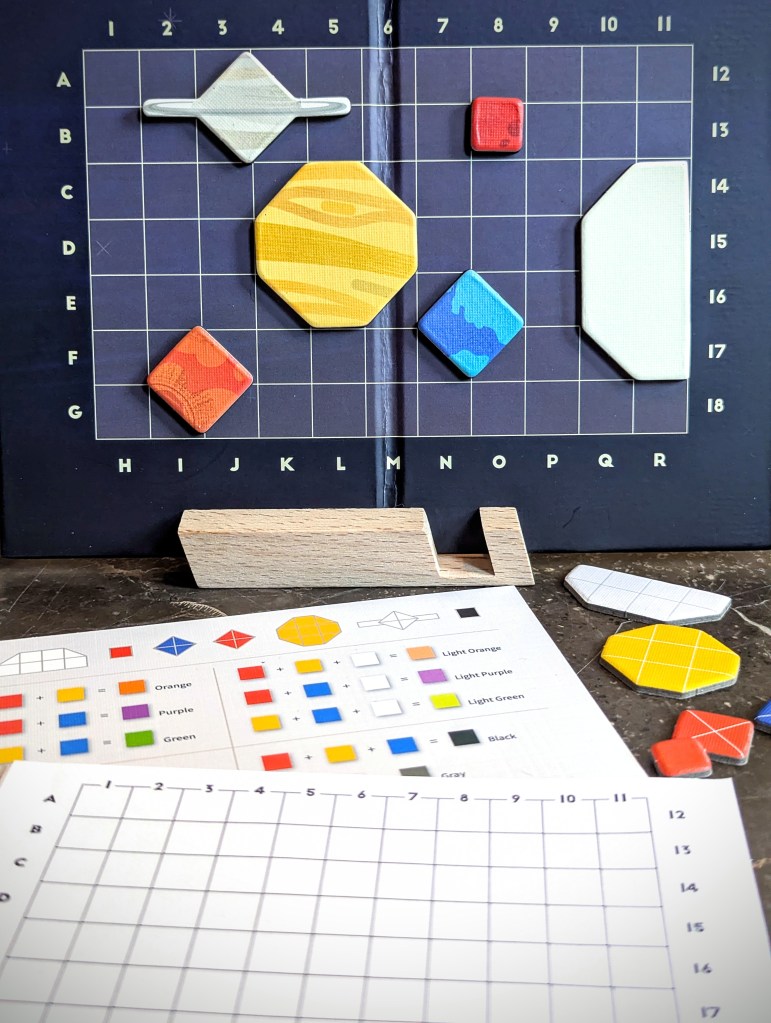
I’ve played a lot of Orapa Mine on Board Game Arena (the first Orapa game), so I was mega-keen to see what Orapa Space had to offer. Firstly, I love that it comes with magnetic planets and grids. The magnetic boards have a fold down the center, but the magnets work over the crease with no problem, even the little red square planet. I love the simplicity of the Digit/Alphabet Code games, but these components give Orapa Space a lovely quality-of-life design boost and makes it feel more substantive as a game.
It’s worth noting we have the second edition with straight sides. These look less ‘planet-y’ than the original version, but it makes it easier to see how the laser will bounce. Playte also included some additional planet tokens to add a bit of pizazz to the paper grid you use for your solutions. The little wooden stand is cute too, but I have noticed light scratches on the grid board…not a world-ending issue, but it will show wear quite quickly.
But enough about the components, what about how it plays? Well, the planets come in 4 different colours: red, blue, yellow and white. This can obviously create loads of different colour combos as the laser bounces around. Puzzling this out is my favourite part of the game, and I always get more excited when I get a colour combo!
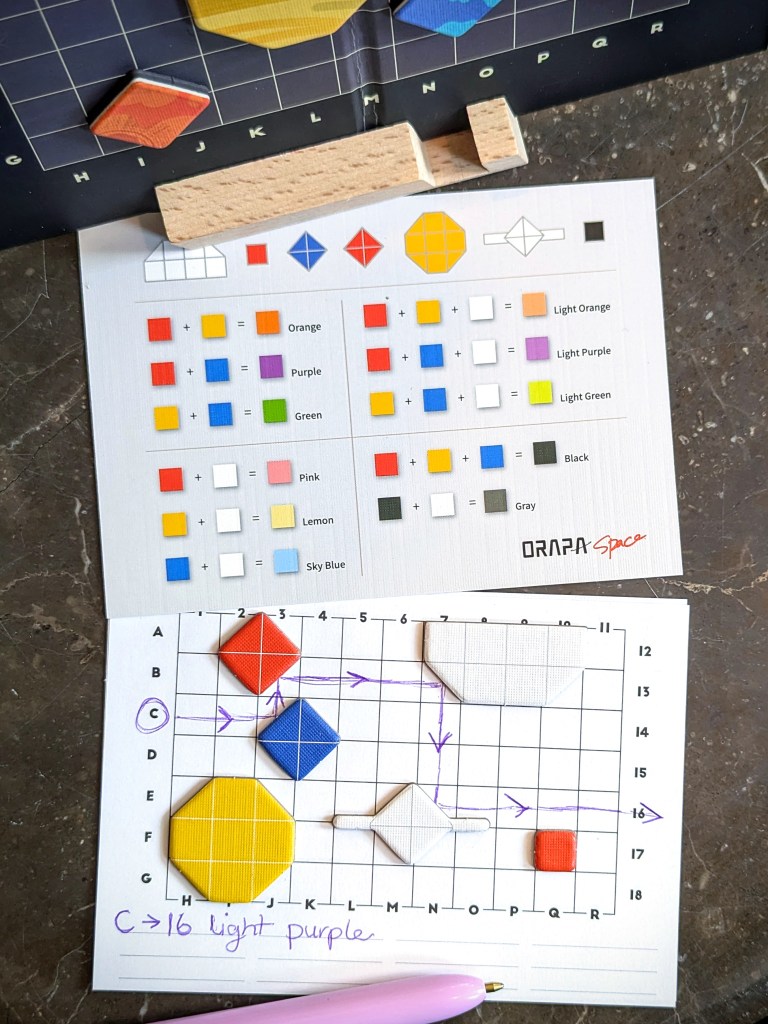
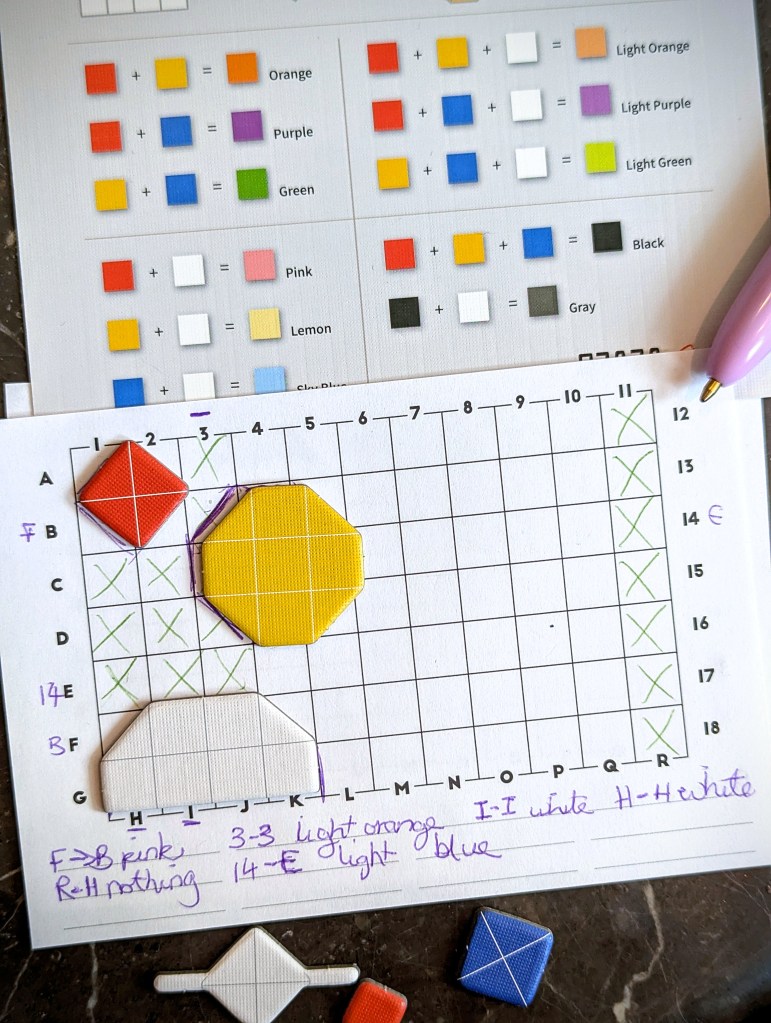
There are 2 different white shapes and 2 different red shapes, so you also have to figure out which specific shapes are part of the puzzle – if the laser is purple, you know it bounced off the blue diamond…but did it bounce off the red diamond, the red square, or maybe even both? This adds a little layer of intrigue, but not too much. The shapes are actually quite distinctive so it doesn’t take long to tell them apart. Plus most of the shapes can only be placed in one orientation. The white planets are the exception but even then, the big planet is limited to being on the edge of the board so you can pin it down quickly. And the white planet with ‘rings’ can only be one of 2 orientations.
I find deducing the elements easier in Orapa Space than Orapa Mine because the shapes are more straightforward. In Orapa Mine there are more triangles, which makes orientation matter and adds more challenge. This isn’t a bad thing at all – different difficulty levels means there’s a game for different abilities. Orapa Space is the better option if I want a quicker game or I’m playing with someone who is less familiar with these types of deduction games. But if I want more of a challenge I’ll throw in the black hole, which is literally a game changer. (It’s important to remember that it can only warp the laser once – otherwise it would make the game impossible!)
As with all of the Playte deduction games we’ve played to date, Orapa Space is advertised as 2+ player but in our opinion works best at 2-player only.
What we like:
- Great components – especially the magnets – which elevate the feel of the game.
- Fun battleship style deduction but with the extra puzzliness from the laser journey and colour.
- Fun space theme.
- Different difficulty level to Orapa Mine (it’s easier, but you can add the black hole to increase the challenge).
- Small box, relatively small table space – perfect portability.
Considerations:
- Best at 2 players.
Verdict
Orapa Space is a brilliant little deduction game with a cool theme and fun puzzly colour logic. The components are top notch, giving the game table presence without taking away the portability. The easier shapes and spacey theme make it more accessible than Orapa Mine, with room to grow with the tricky black hole expansion. If you’re a fan of deduction, or want to go beyond Battleships with your family, we strongly recommend checking Orapa Space out.
I just want Playte to release a magnetic version of Orapa Mine so I can have both!
Playte will be at UKGE on 29-31 May 2026 – you can preorder games with them for UKGE pick-up here and check out their stand at 3A-602.
They will also be at the Tokyo Game Market 23-24 May, and you can preorder games for that here.

 Our Board Game Life