
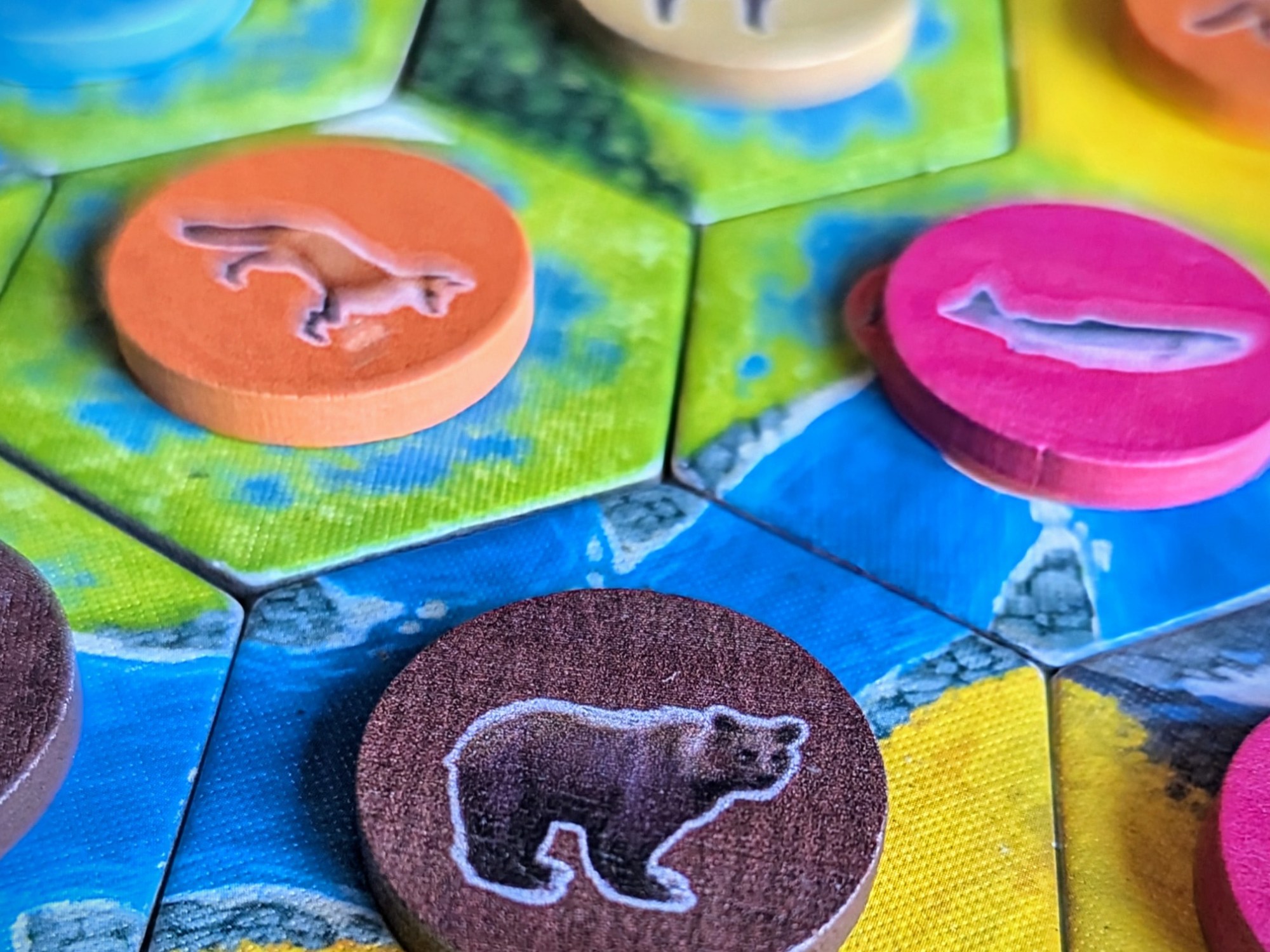
I’ve wanted to play Cascadia from Flatout Games / AEG Games for a long time, because whenever it gets mentioned among my Instagamer pals, everyone always talks about how great it is! So it was the first game I grabbed when we were at Chance & Counters last week.
Everyone also seems to be comparing Cascadia to Harmonies – which I’ve been playing A LOT on board game arena. But are they really that similar? Let’s find out!
Gameplay overview
👥 1 to 4 players
⌛ 30 to 45 minutes
🧠 10 years+
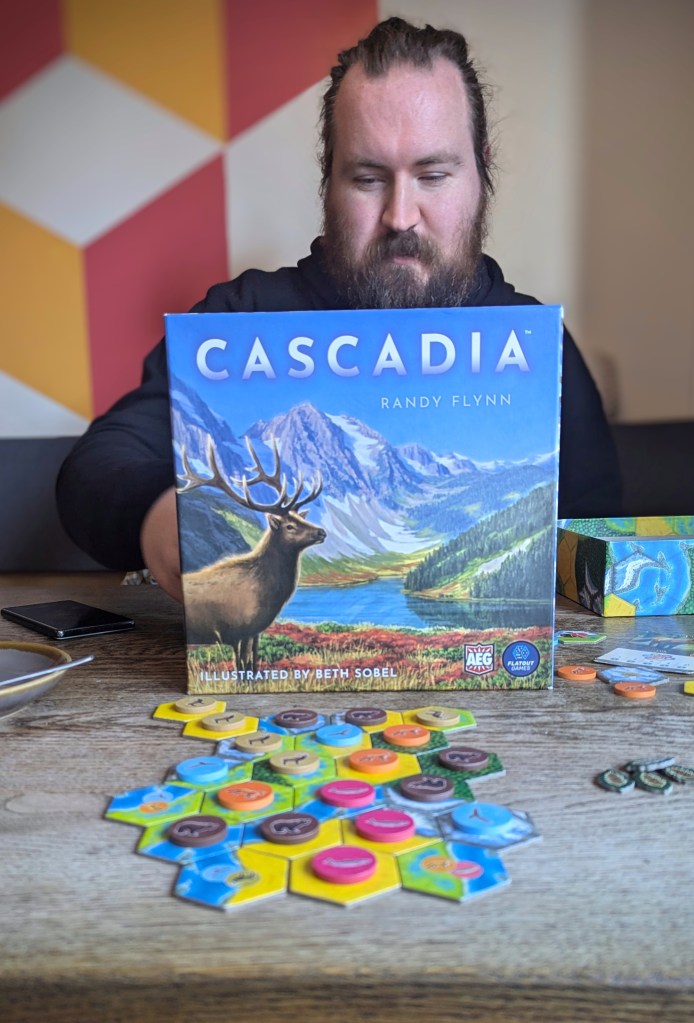
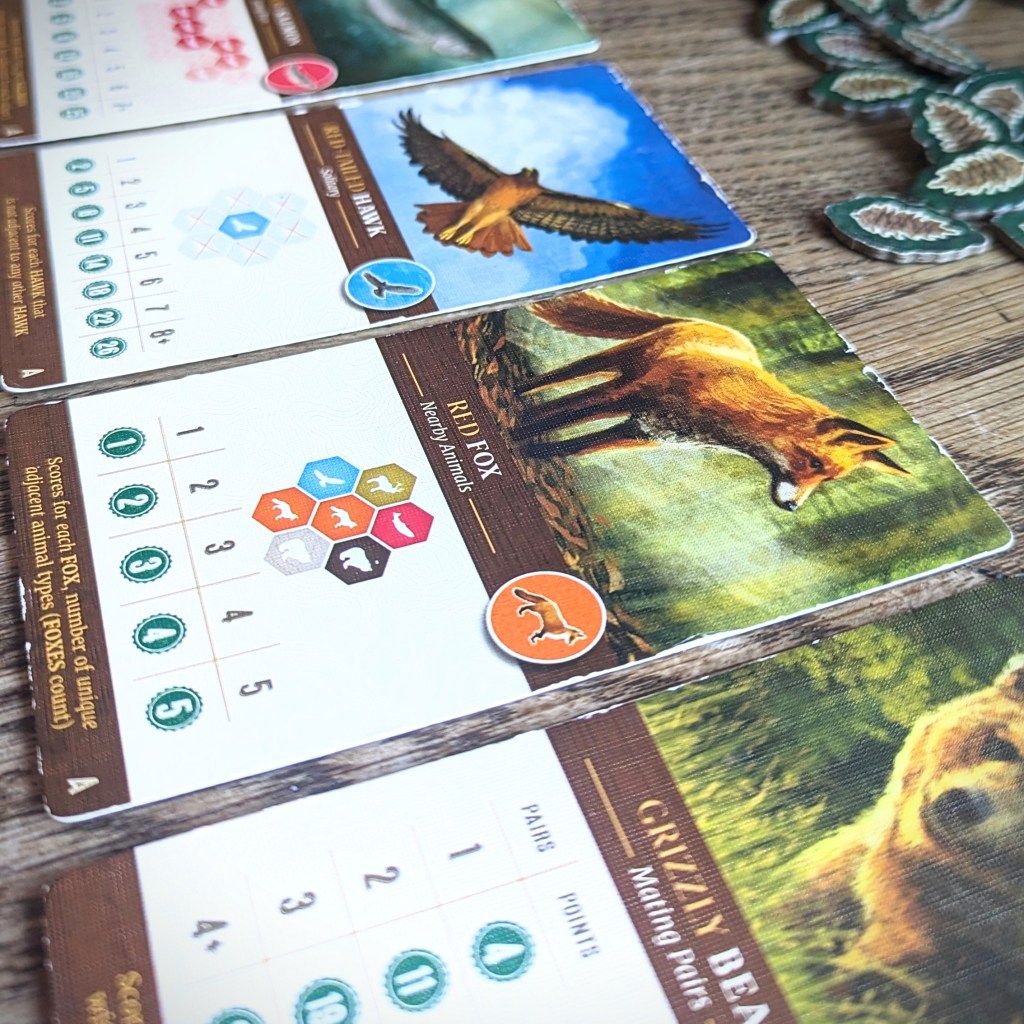
In Cascadia, players are competing to build the best Pacific Northwest environment. Gameplay is relatively straightforward: on your turn, you draft a paired habitat tile (showing 1 or 2 different terrains) and wildlife (animal) token from a central pool and place them into your personal environment, trying to meet the placement requirements of Wildlife Scoring Cards.
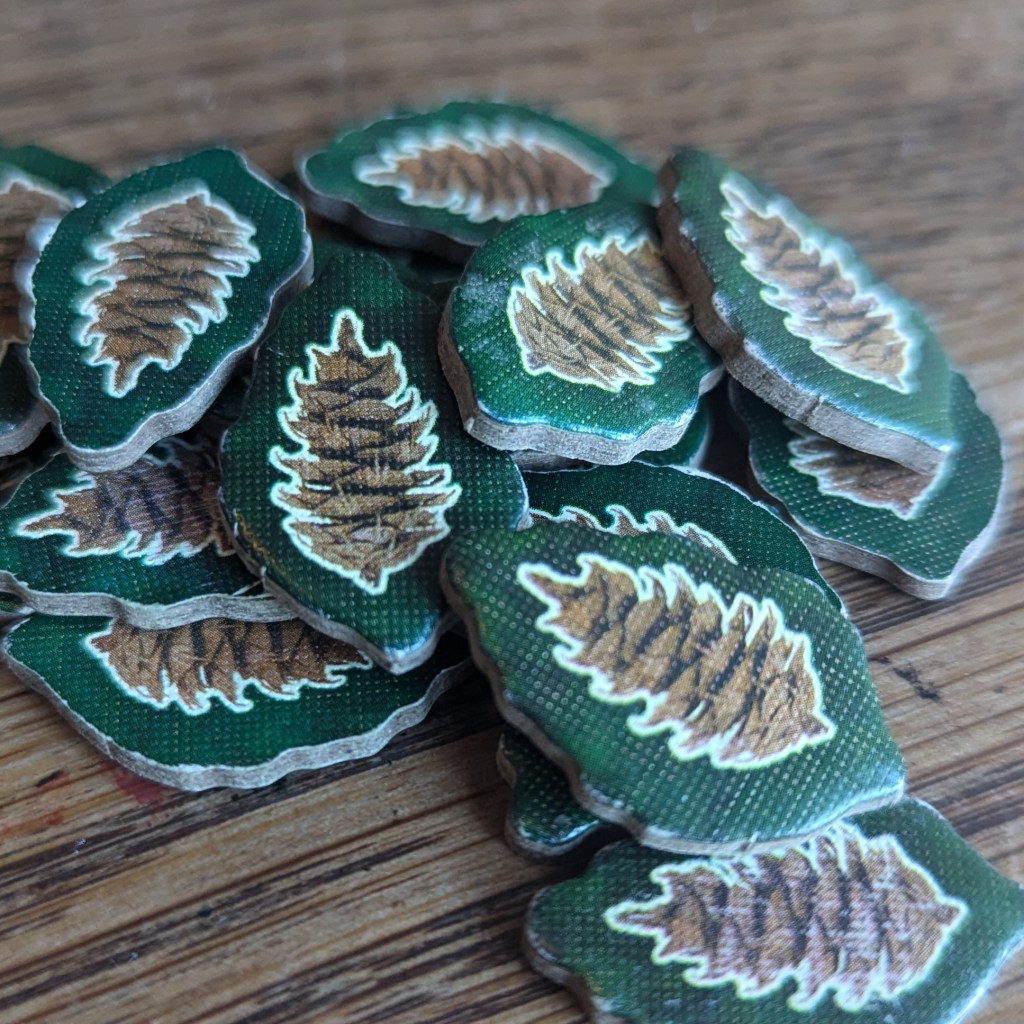
You can place habitat tiles however you like, as long as at least one side is touching another tile already in your environment. They don’t even have to match! Then you can place a wildlife token on any free tile with the matching token icon – it doesn’t have to be the tile you’ve just placed in the same turn. If the tile you place your wildlife on has a leaf symbol, you get a nature token. These can be spent to refresh the wildlife tokens on display if you don’t like the current options.
At the end of the game, players score points for the Wildlife Scoring Cards, habitat corridors (points for the size of each terrain type found on the tiles), who has the biggest habitat corridors for each terrain, and leftover nature tokens. Whoever scores the most points has the most thriving environment in Cascadia!

Our first impressions
- YES! We really enjoyed our game of Cascadia – and now we can see why so many people love it! The gameplay was easy to pick-up and our playthrough was very smooth and relaxing. It combines a lot of gaming elements we love: tile laying, pattern building, and nature.
- The ability to refresh wildlife tokens, either when there are too many of the same type or by spending nature tokens, was great for keeping the game ticking over without someone getting too stuck.
Cascadia combines a lot of gaming elements we love: tile laying, pattern building, and nature.
- In some ways I personally thought our game ran too smoothly, being able to make the wildlife patterns we needed with little difficulty. I think this was partly because we played with the recommended Wildlife Scoring Cards for a first game – it would be good to try the other scoring cards to see if they’re more challenging.

Cascadia versus Harmonies – are they the same?
While Cascadia and Harmonies are both abstract games about building habitats and placing animals, that concept is where the similarities end.
- In Cascadia, you lay habitat tiles in a 2D layout in a way that lets you place specific animals in specific patterns – patterns that are the same for the whole game. Whereas in Harmonies you’re using coloured habitat tokens – to build 3D patterns and place ‘animal; cubes, and the patterns change throughout the game as you complete and draft new pattern cards.
- Habitat scoring in Cascadia is simply based on the size of the biggest habitats; in Harmonies, each habitat has different scoring requirements.
Cascadia feels smooth & cozy. Harmonies is more of a brain-burner.
- You’re less likely to struggle in Cascadia because it’s easier to get the wildlife tokens you want; Harmonies is trickier because you’re confined to playing within your personal board, and may be forced to use tokens you don’t need and play them in places you didn’t want to play them.
Overall, Cascadia feels smooth & cozy. Harmonies is more of a brain-burner.

Final thoughts
Cascadia definitely met the expectations you all set! I’m so glad we managed to try it. I want to play it again to get a fuller feel of what it’s like with different Wildlife cards and player counts.
Are Cascadia and Harmonies similar? In theme but not in gameplay. Would there be space for both in our collection? Hmmm….not sure. Even though they are different it still feels like they would be filling the same spot on the shelf. Which one would we prefer to own? There was something about Cascadia Matt liked more – possibly that it has more realistic looking habitats and animals (rather than abstract tokens and cubes). I’m leaning more towards the complex puzzliness of Harmonies, but I’d like to play Cascadia more (and play Harmonies IRL) before passing final judgement.
If you’re a fan of Cascadia, I recommend trying AQUA: Biodiversity in the Oceans, which is a more similar game in my opinion.


I love Cascadia! I personally enjoy is solo with the scenarios. It gets harder as you progress through the different cards. Thanks for the review!
LikeLiked by 1 person
I really want to play more Cascadia… Maybe one day it will get on BGA! Then we can have a game!
LikeLike
For sure! I’d love that.
LikeLike