
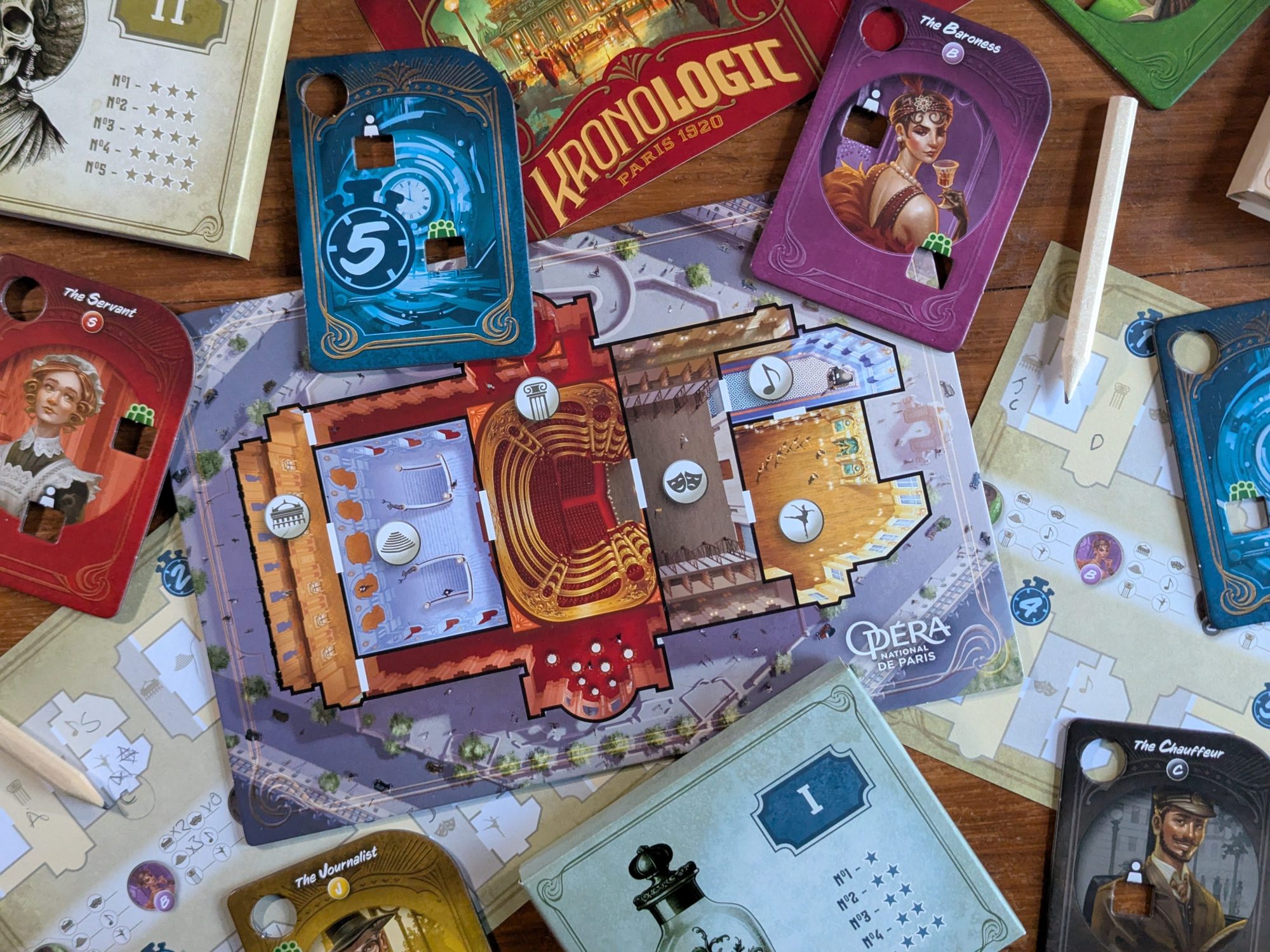
In a past life, Lauren and I were regular patrons of the theatre, enjoying many a show. But in all our time as theatre goers we were oblivious to the rampant crime that clearly goes on (with the exception of when we saw Cluedo on stage!) .
Today, we’re travelling back to the Roaring Twenties to visit the prestigious Opera National de Paris, but not to admire the stagecraft… They need our sleuthing skills to solve a series of crimes. Drama! Intrigue!.
Note: the photos and details in this review use the first investigation in the box, so no major spoilers!
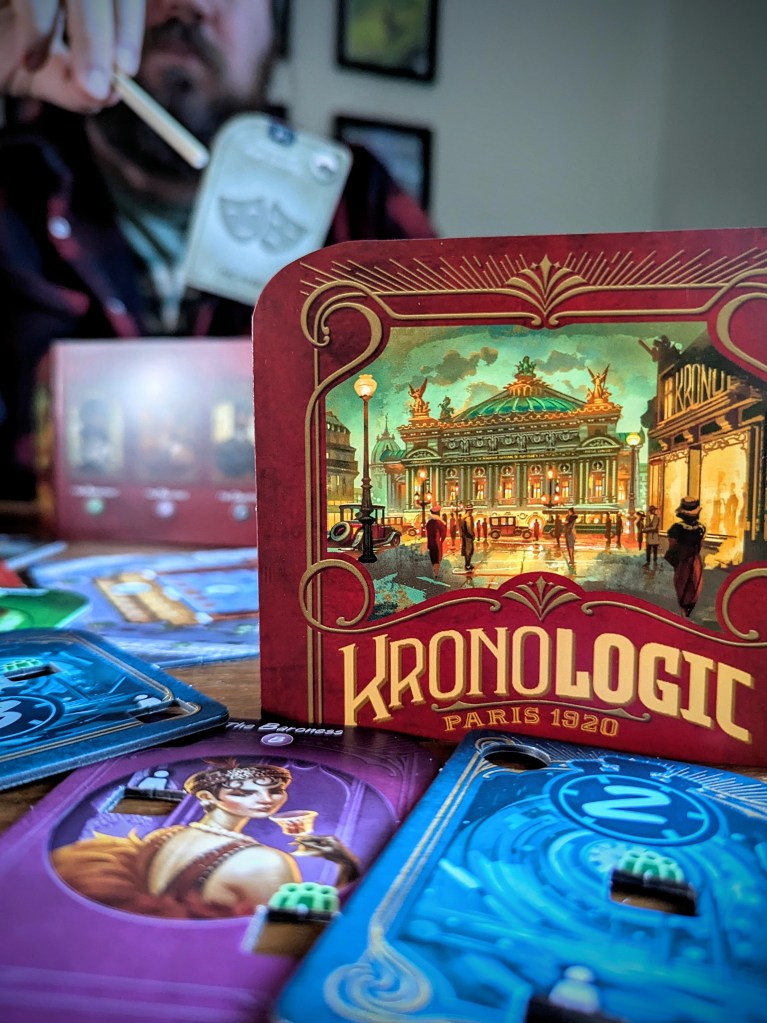
Key Stats:
1 to 4 players
10+ years
30 minutes
Publisher: Super Meeple, Origame (distributed by Hachette Boardgames UK)
Designer: Fabien Gridel, Yoann Levet
Art: Arch Apolar, Yann Valéani
Theme/category: Deduction, Mystery, Puzzle, Crime
Key mechanics: Deduction
Gameplay overview:
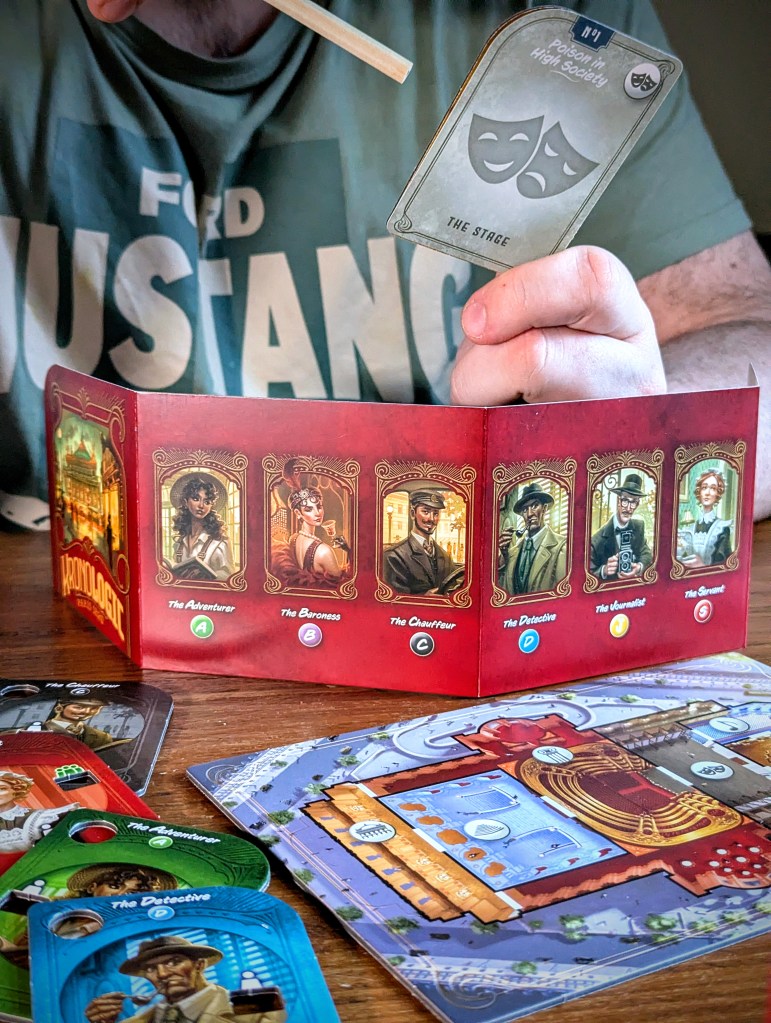
In Kronologic, players are competing investigators in the midst of a mystery. On your turn, you’ll pick a location in the Opera House and investigate either how many characters were there at a specific TIME, or how many times a specific CHARACTER visited that location. Each time, you’ll share that information with the other players, but you’ll also get an extra tidbit to keep to yourself. Record your findings behind a secret screen and solve the mystery first to win!
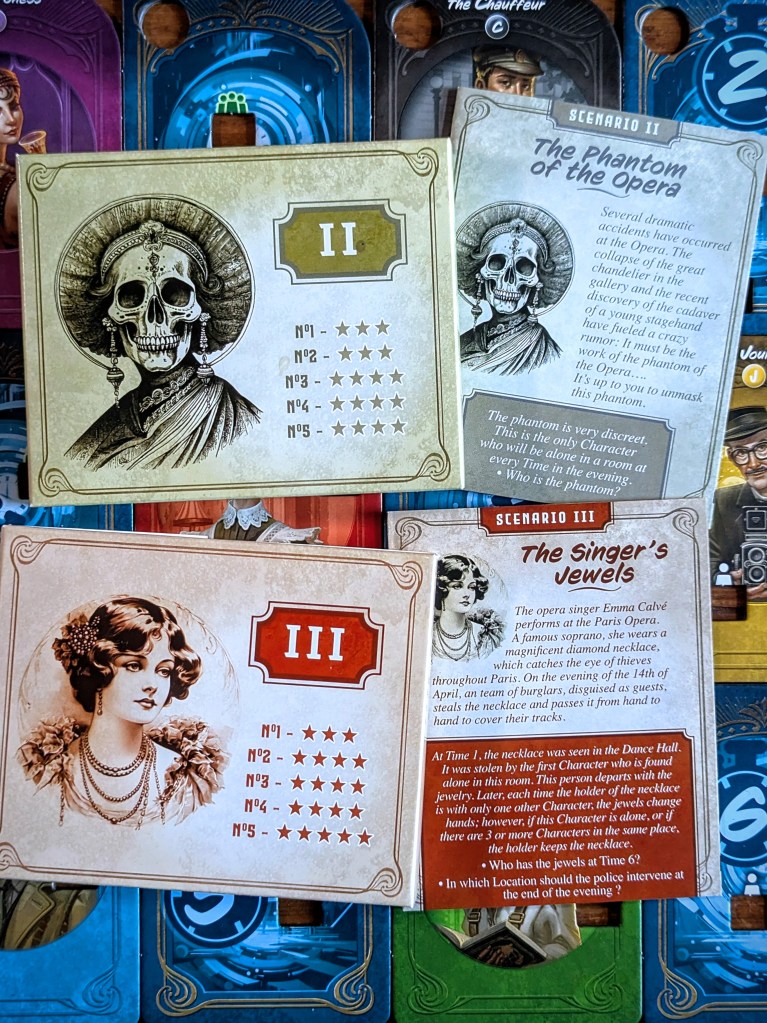
Kronologic 1920 has 15 investigations of varying difficulty, spread evenly over 3 different scenario boxes:
- Scenario box 1: Poison in High Society – solving a murder
- Scenario box 2: The Phantom of the Opera – identifying a phantom
- Scenario box 3: The Singers Jewels – rumbling a heist.
We’d recommend working through the investigations in order. (There’s also additional print and play content available on Hachette’s Website.)
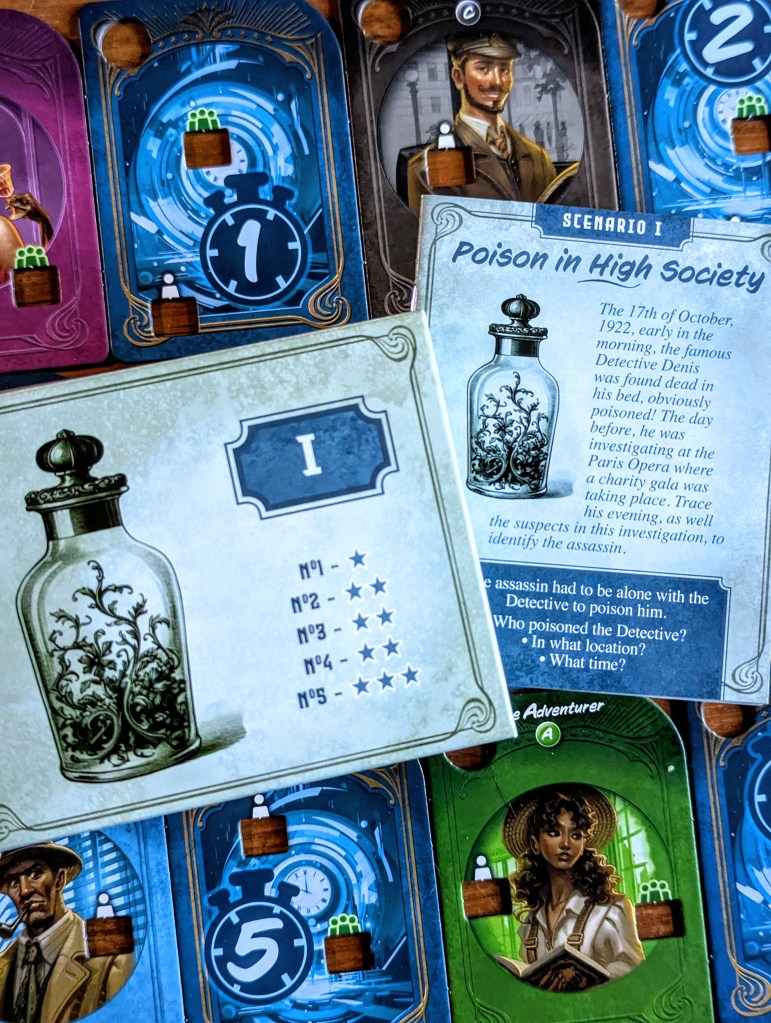
Once you’ve chosen your scenario and investigation, set up the game as outlined in the investigation booklet. This tells you what questions you need to solve, where the characters are at TIME 1, and any investigation-specific rules. In Poison in High Society for example, the detective has been found dead in his bed, poisoned at the Opera the night before! Your aim is to identify the assassin, who was the only character who had alone time with the detective, and confirm the location and time the poisoning took place.
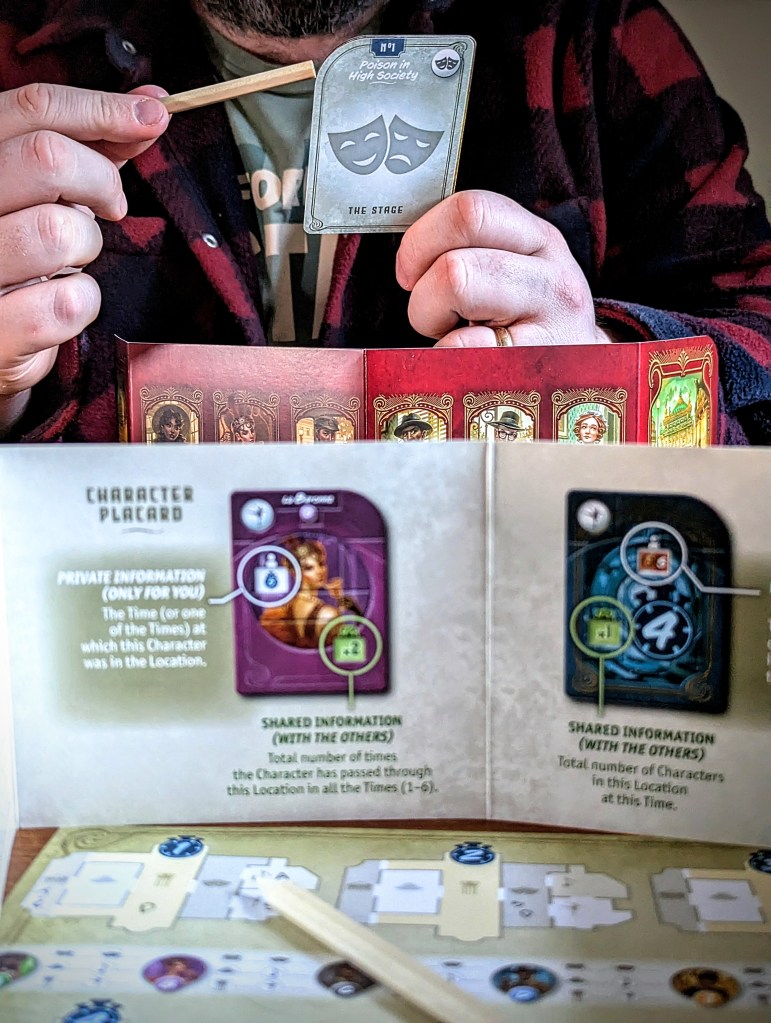
To investigate a location, you choose the relevant location card and place it under a specific Character or Time placard (there are 6 of each). This will show you two different piecesof information:
- A character card reveals how many times a person went to a location (shared information) and a specific time that character went to that location (private).
- A Time placard reveals how many characters were at the location at the chosen time (shared) and a specific character who was there at that time (private).
Player take turns to investigate locations, recording information on their personal note sheets, which are hidden behind screens, until someone announces that they’ve solved the investigation. They then secretly write down their guess on their sheet (as does anyone else who also wants to try and guess), before checking it against the solution in the Scenario booklet.
If they get it right, they win! They can reveal the solution to the group, or the group can continue playing. But if they get it wrong they are eliminated and other players continue until someone reaches the solution, or everyone is stumped.
Our thoughts
We’ve played through all 3 Scenario boxes for Kronologic Paris. And despite not winning regularly, I really enjoyed it, its the perfect step up from Cluedo. With a gentle ramping up from the first game to the last, it is a great entry into the Kronologic games and modern deduction games in general. Whilst the deduction puzzle is harder than Cluedo, I appreciated the simplicity of Kronologic mechanically.
I was surprised by the variance of games within the Kronologic Paris 1920 box which really highlights how versatile the Kronologic system is. Whilst each game used the same characters and setting each game is unique, and each scenario felt fresh. I thought the step up in difficulty was paced nicely, and thought that the later games where characters were left off the starting set up added a nice element of complexity to the puzzles.
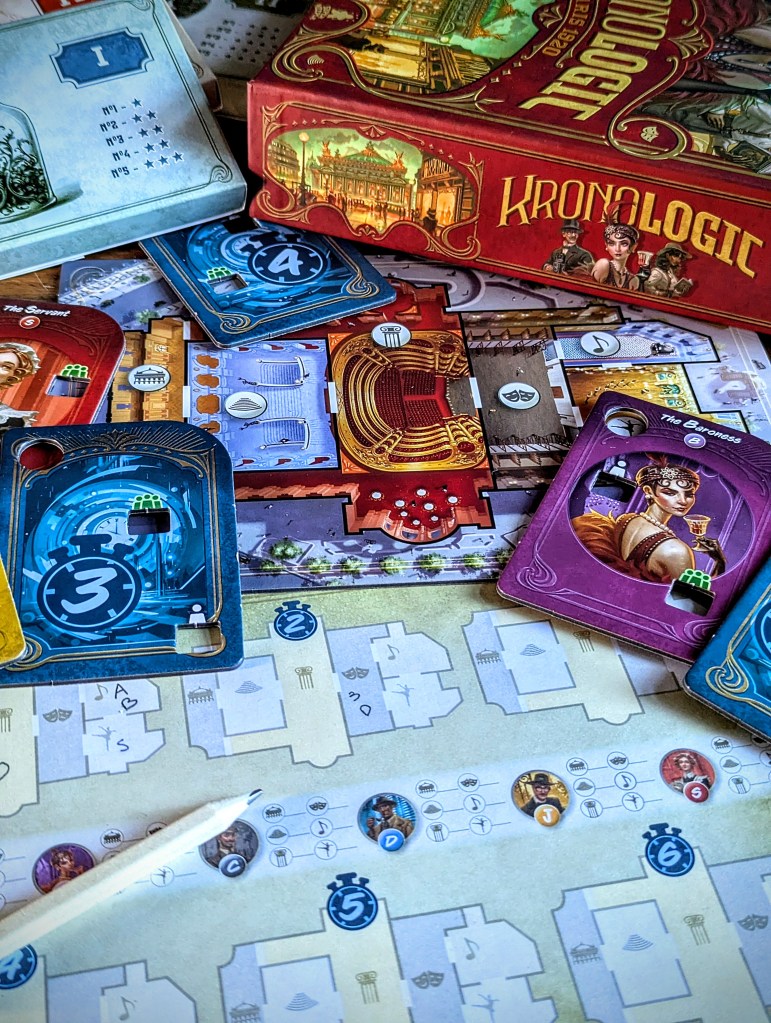
The production of the components and other game pieces including the cards and placards felt really good quality, and we loved the artwork or other design touches that were spread across the components. Although the mini gameboard did feel a bit superfluous, as the theatre layout was printed on each player’s note sheet, I don’t think we actually used the board in any of our games. The pencils on the other hand were brilliant. It was great not to have to go routing around the house in search of pencils as some came in the box.
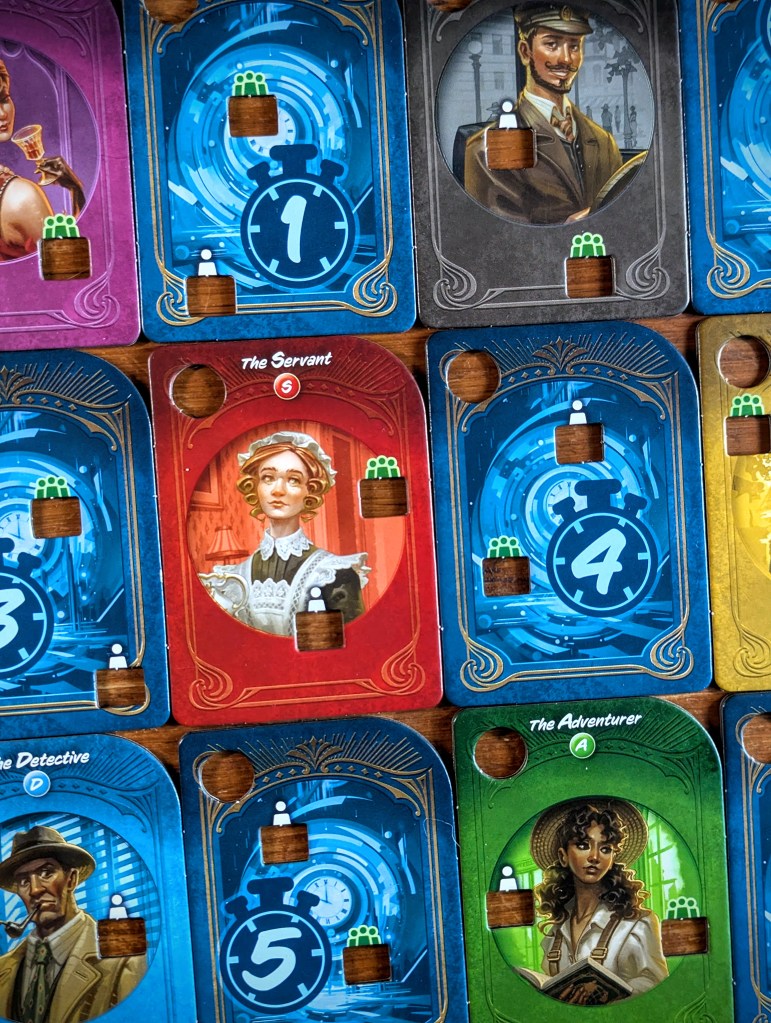
The innovative way the Time and Character Placards overlay the location cards to reveal the necessary information for you to deduce the answer to the scenarios is really impressive (and will be familiar to anyone who has played Turing Machine), and as i said earlier allows the gameplay itself to be mechanically simple.
Some players will have an almost inherent skill for deduction and will likely have an advantage over other players, which may frustrate other players especially if it means they never get the satisfaction of completing a puzzle! In my games with Lauren, who seems to have an instinctive ability for deduction games, I did find myself trying to balance gaining more evidence to assist with deduction and getting a solution faster than Lauren. This didn’t always pay off and sometimes I had made an error in my deduction because I was too wary about letting Lauren have more time.
Not all information is equal, and this can mean that someone stumbles onto key information early doors, and therefore has the advantage. I know, because I tried to, it can be hard to deduce the same information another way, making it favourable to just copy what they asked when you realise they have key information. This does feel like a less satisfying approach to take as a player.
What we like:
- Great step up for those that like the idea of Cluedo but want to take it to the next step
- Innovative method of revealing clues/information which is similar to the system used in Turing Machine by the same designers.
- 3 different types of ‘scenario’ added a nice level of variation which kept the game fresh.
- The stepping stone way of increasing complexity throughout the scenarios and cases was a nice touch to help you build your deduction skills.
Considerations:
- It may feel less satisfying when you lose as you don’t ‘solve’ the puzzle yourself. This could be amplified if you’re playing with an inherent skill advantage, although it is also mitigated by the players luckily stumbling onto key information early doors.
- Your opponent may get some higher value information and it can be hard to establish what they know without just copying their choices.
Verdict:
Being fans of deduction games it’s no surprise that we loved Kronologic Paris 1920, we found the cases were very moreish and we played through the box in just a handful of sittings. It was genuinely hard to stop after just one or two cases. For anyone who loves the crime solving aspects of games like Cluedo but would like a more streamlined and dynamic game we recommend Kronologic Paris 1920.
If deduction games are your thing and you want some more suggestions head over to our reviews of Hooky from Rio Grande Games and Digit Code by Playte

 Our Board Game Life