
Advert: This game was loaned for review from Paper Fort Games through the UK Board Game Review Circle. All opinions are our own.
Under the sea! Under the sea! Darling it’s better down where it’s wetter, take it from me! Let’s take a deep dive into Fathom.
👥 2 to 4 players
⌛ 45 to 60 minutes
🧠 10+ years
Game overview:
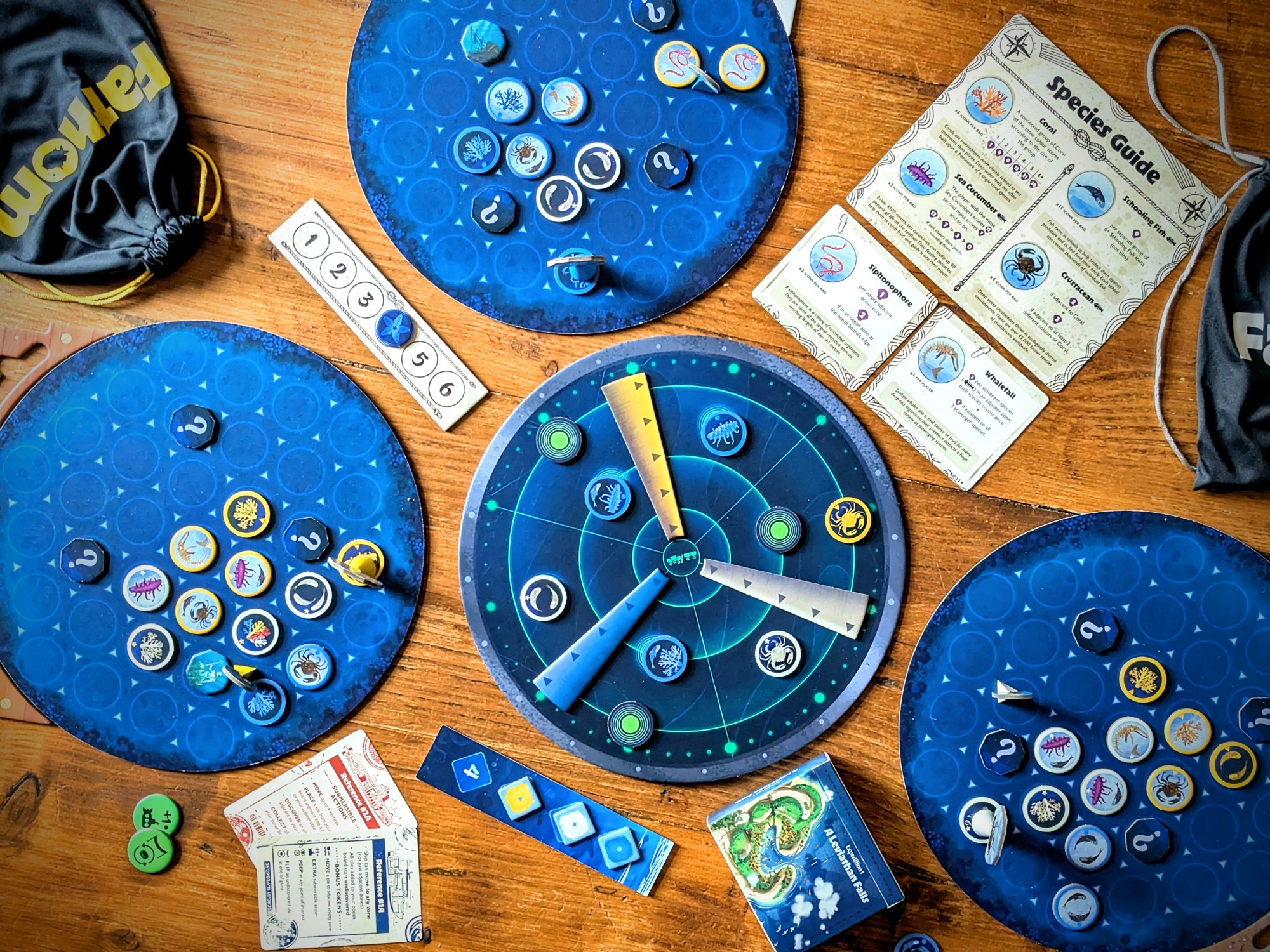
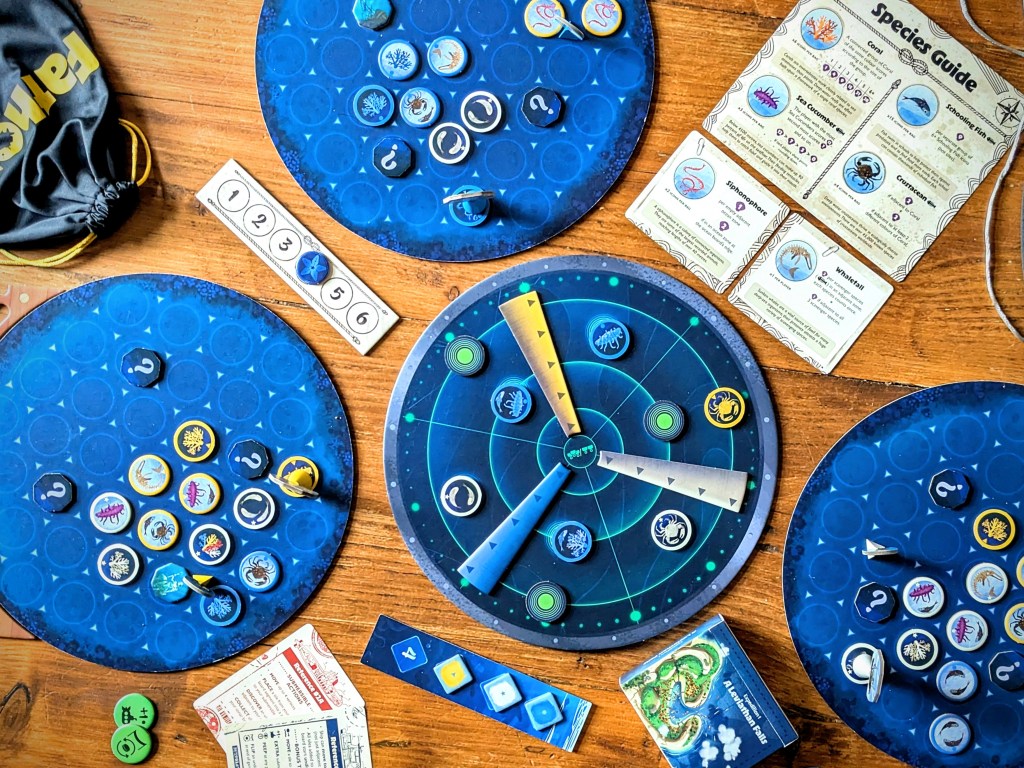
In Fathom, players are marine biologists traversing the ocean in the pursuit of wonderful scientific discoveries! Each round, players draw and place discovery tiles showing 1 or more ocean species on their personal ocean board, then use their ship or submersible to ‘discover’ the species (flip them over) so that they score points at the end of the game.
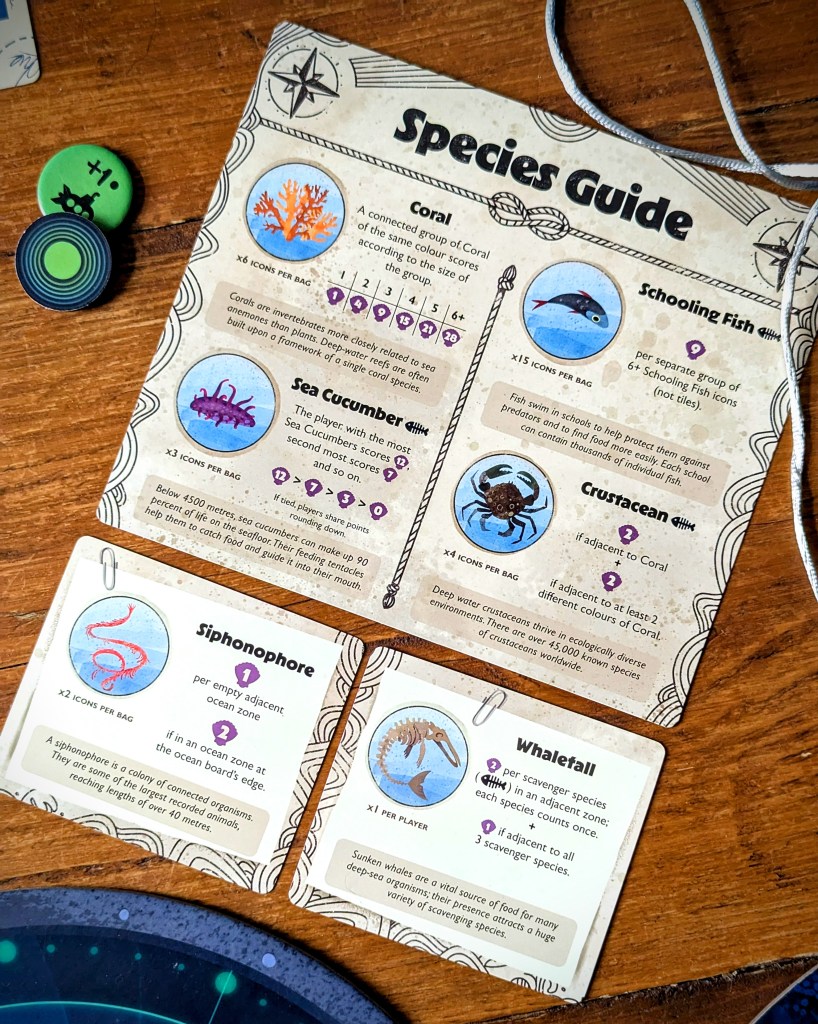
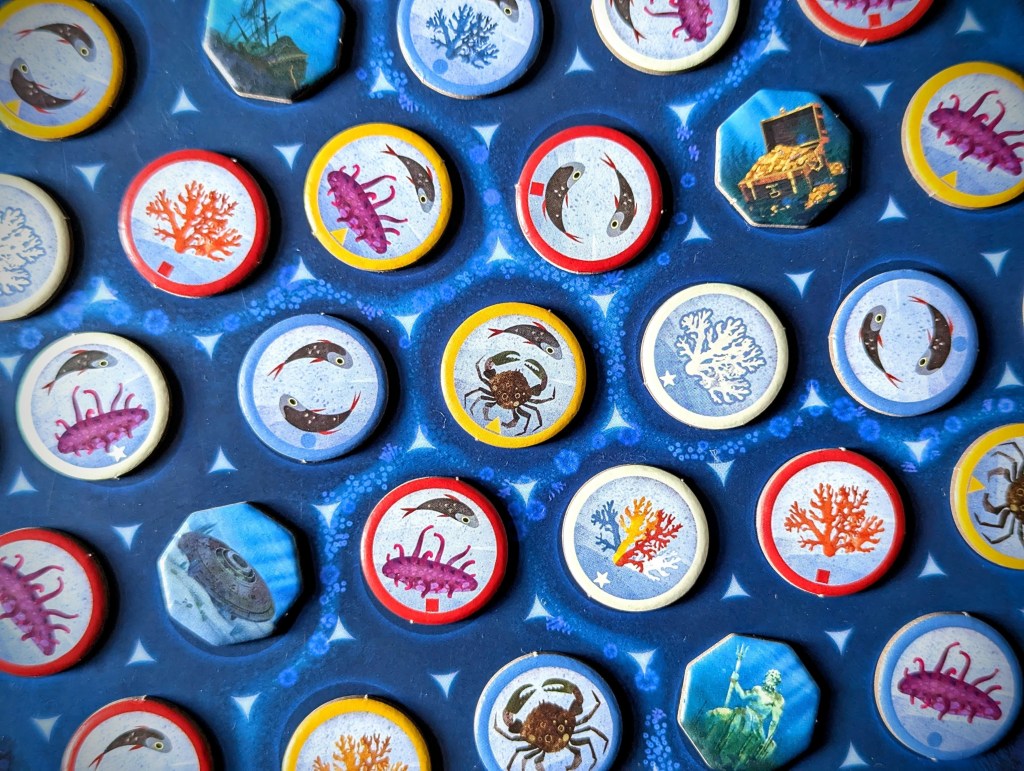
Each species has a different scoring criteria, e.g. schooling fish only score if they are grouped in 6 or more, crabs only score next to coral, and sea cucumbers score based on who has the most, second most, etc. Your submersible can also be used to flip and discover ‘points of interest’ tokens, like sunken treasure – their effects vary depending on the Expedition you’re playing but often they are worth points. After 6 rounds, the player with the most points from species and points of interest tokens wins.
To dive into more detail, the round is split into 3 phases:
- Ship phase: move your ship to a new location on your ocean board, swap player bags (yes you use each other’s bags!), draw 3 discovery tiles and place up to 2 under or adjacent to your ship. Any unplaced tiles go on a communal sonar board.
- Sonar phase: add bonus tokens on any empty spaces on the sonar board. Then, starting with the current first player, place your sonar beam so that the board is divided into equal segments (e.g. in a 3 player game, the board will be divided into thirds). This determines which discovery/bonus tiles you can take from the sonar board!
- Submersible phase: take up to 4 actions of your choice with your submersible on your ocean board. This includes moving, discovering adjacent discovery tiles/points of interest, placing a discovery tile from your section of the sonar board, or collecting bonus tokens (if collected, these give the player additional single-time effects to use, like extra actions or moving discovered tiles).
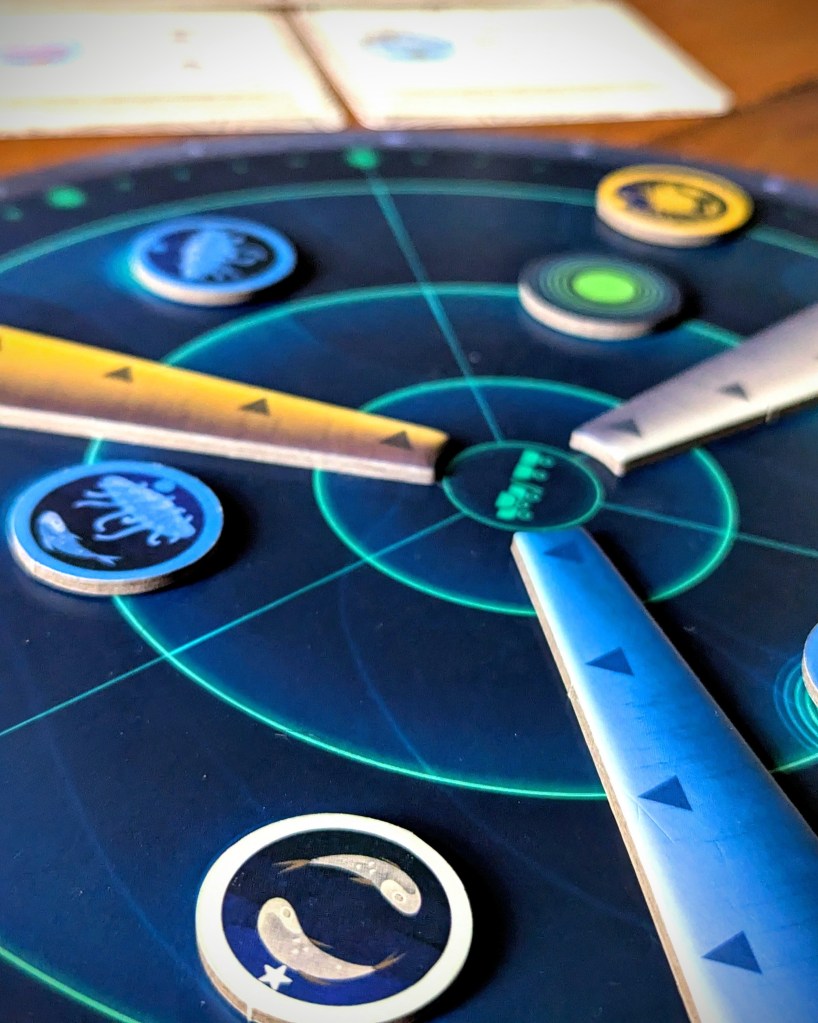
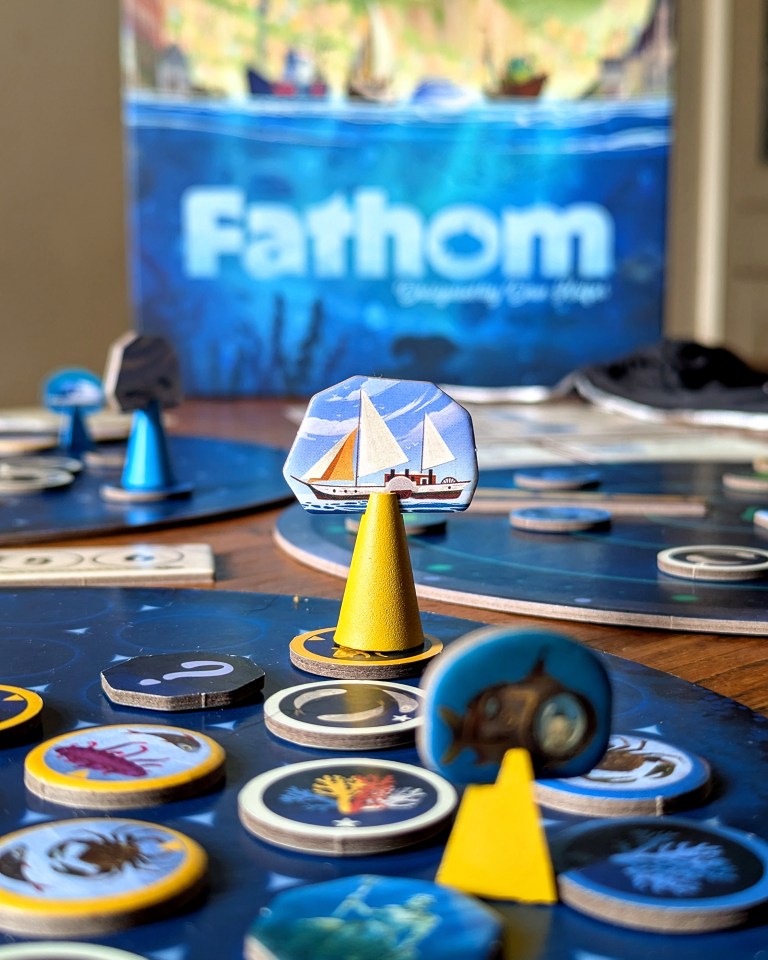
At the end of the submersible phase, first player responsibility passes to the next player and a new round begins.
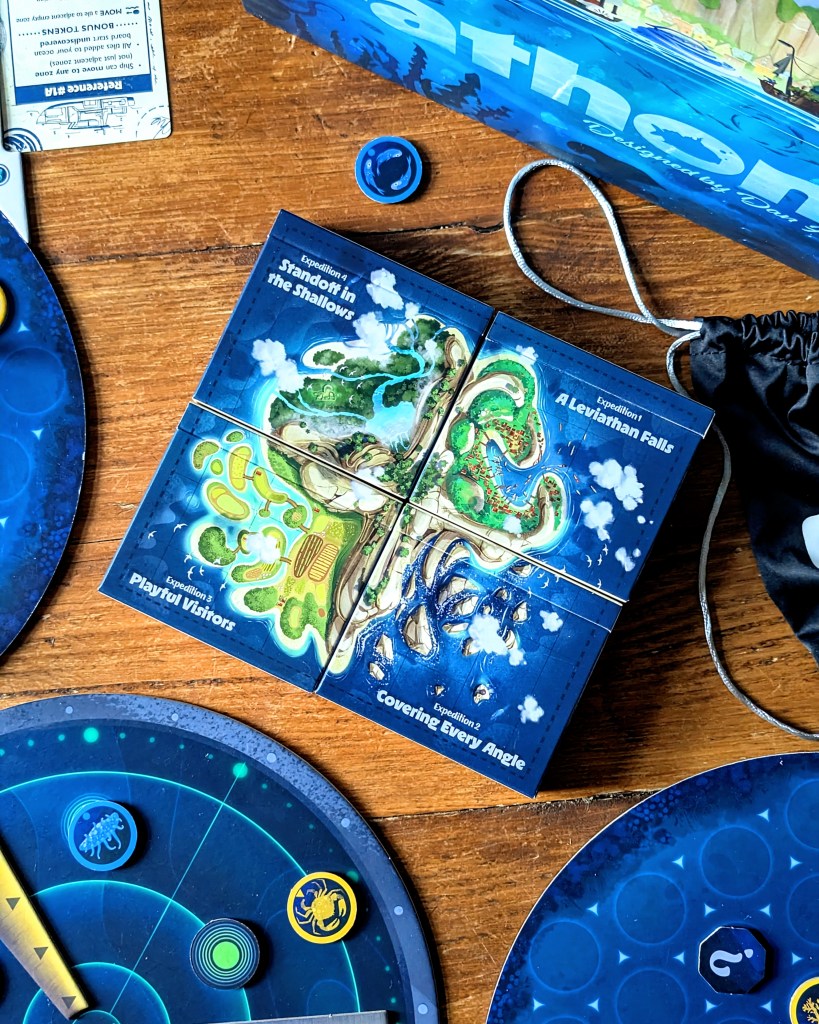
Each game is an Expedition, and there are 4 different Expeditions to choose from in the game, each increasing in complexity. They all use the same 4 ‘core species’ (coral, schooling fish, sea cucumber, crab), but each expedition adds its own variation to the game with its own species, rules and mechanics. The photos used in this main review are for Expedition 1, which includes 2 additional species with their own scoring requirements that aren’t too dissimilar to the core species. More info on each expedition is below (skip them if you don’t want spoilers!).
Expedition 1: A Leviathan Falls

There’s reports of a sunken whale a few miles offshore, and you’re not going to pass up the opportunity to investigate!
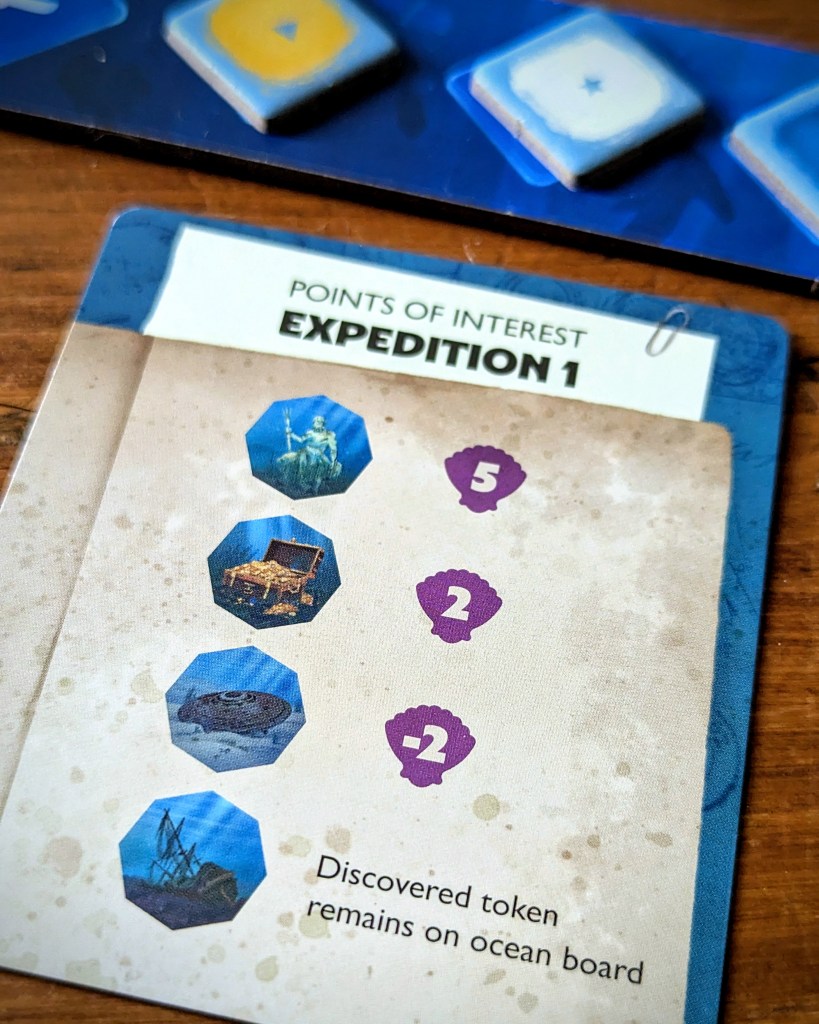
Each player has a Whalefall discovery tile that starts in the centre of your ocean board, and 2 siphonophore tiles added to their bag. These each have fairly straightforward scoring criteria similar to the core species, making this expedition a good introduction to the game. The points of interest range from -2 to 5 points with no additional effects and are removed from the board when discovered (with the exception of the shipwreck).
Expedition 2: Covering every angle
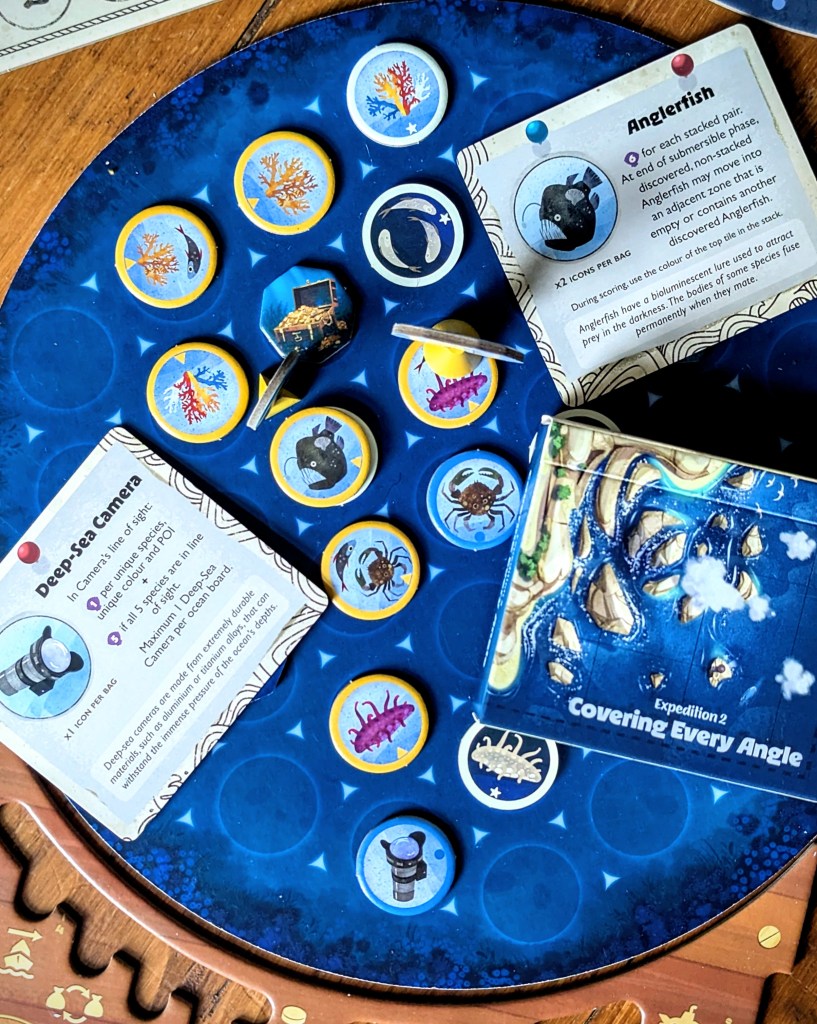
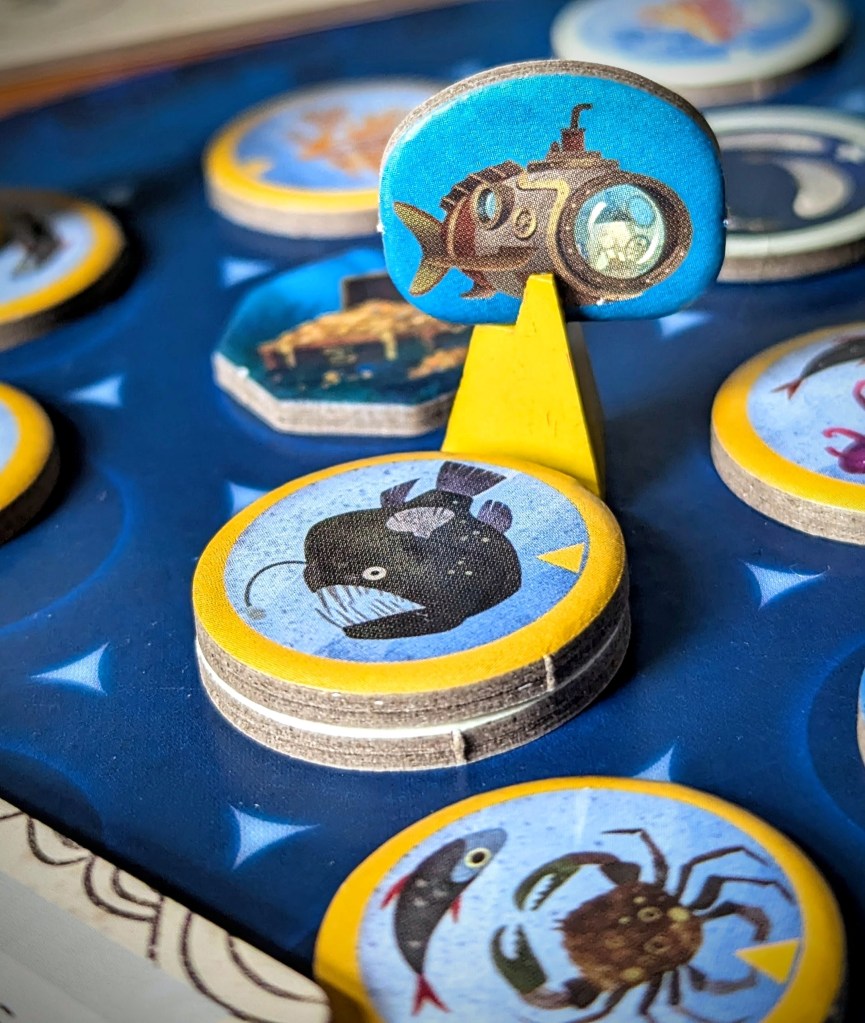
You’ve been asked to capture footage of the ever-elusive anglerfish! 2 are added to your token bag, along with 1 deep-sea camera tile. These again have their own scoring criteria, but they also add additional rules: discovered anglerfish can actually move 1 space each at the end of the round. This is because they only score if you manage to get 2 stacked on top of one another! The deep sea camera scores based on the species in its ‘line of sight’ on the board. The points of interest are worth between 1 and 4 points, but they ALL remain on the board when discovered.
Expedition 3: Playful visitors
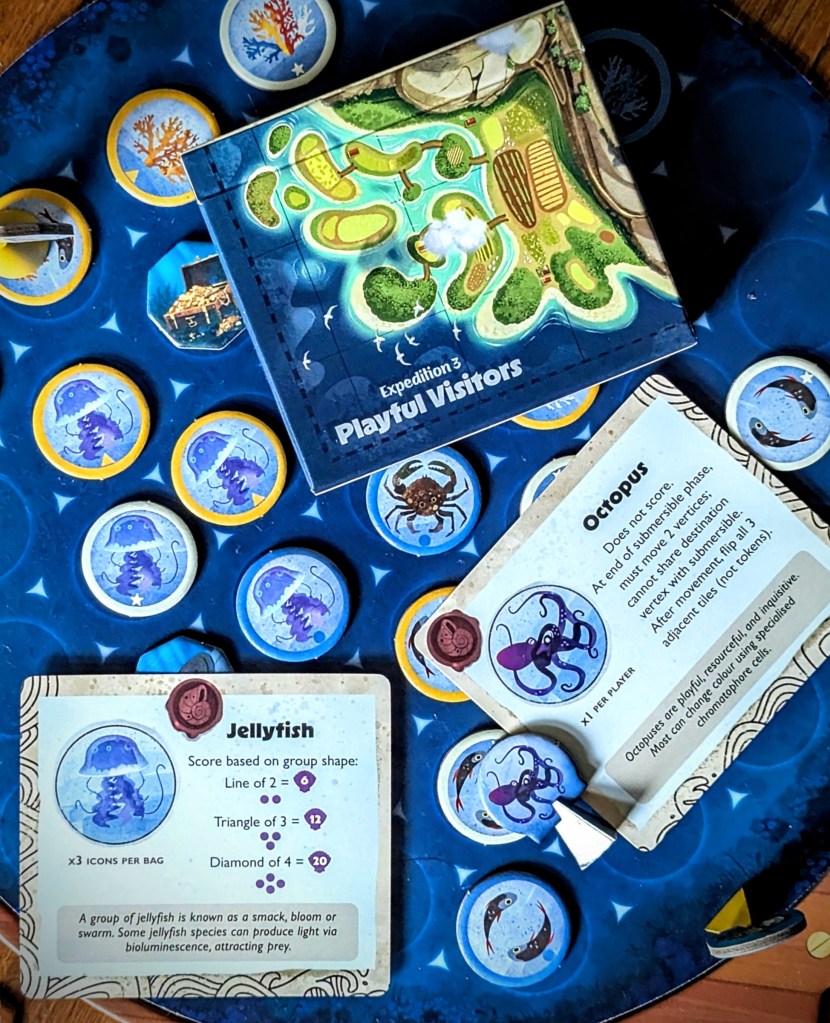
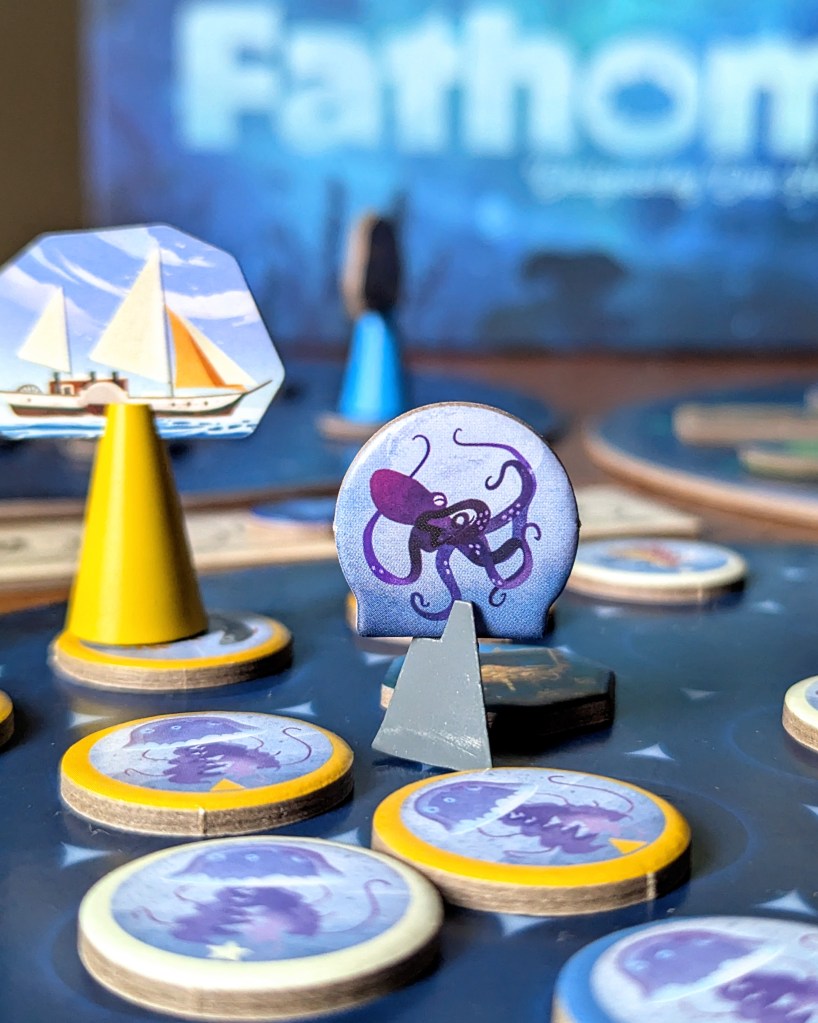
It’s springtime and the island has new nautical visitors! Each player starts with 3 jellyfish in their bag, which score points if they are placed together in specific formations (1 of the formations requires 4 jellyfish, which means you definitely need to get them from more than one player bag!).
Most intriguing of all is your new octopus friend, who is placed on your ocean board and at the end of each round moves along the vertices in a similar way to your submersible. But they are mischievous, because when they end their movement they flip any adjacent tiles – so discovered becomes undiscovered, but undiscovered becomes discovered! And in this expedition, rather than giving you points, most of the points of interest tokens affect the octopus (e.g. making it move more or less).
Expedition 4: Stand-off in the shallows
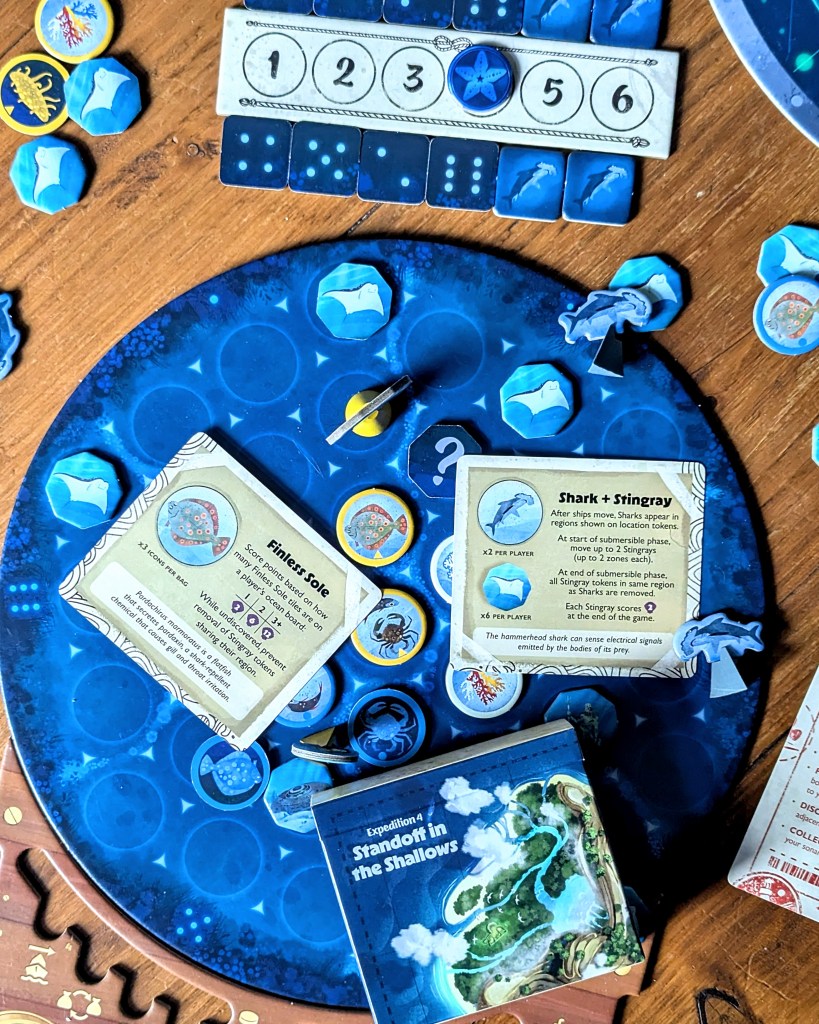
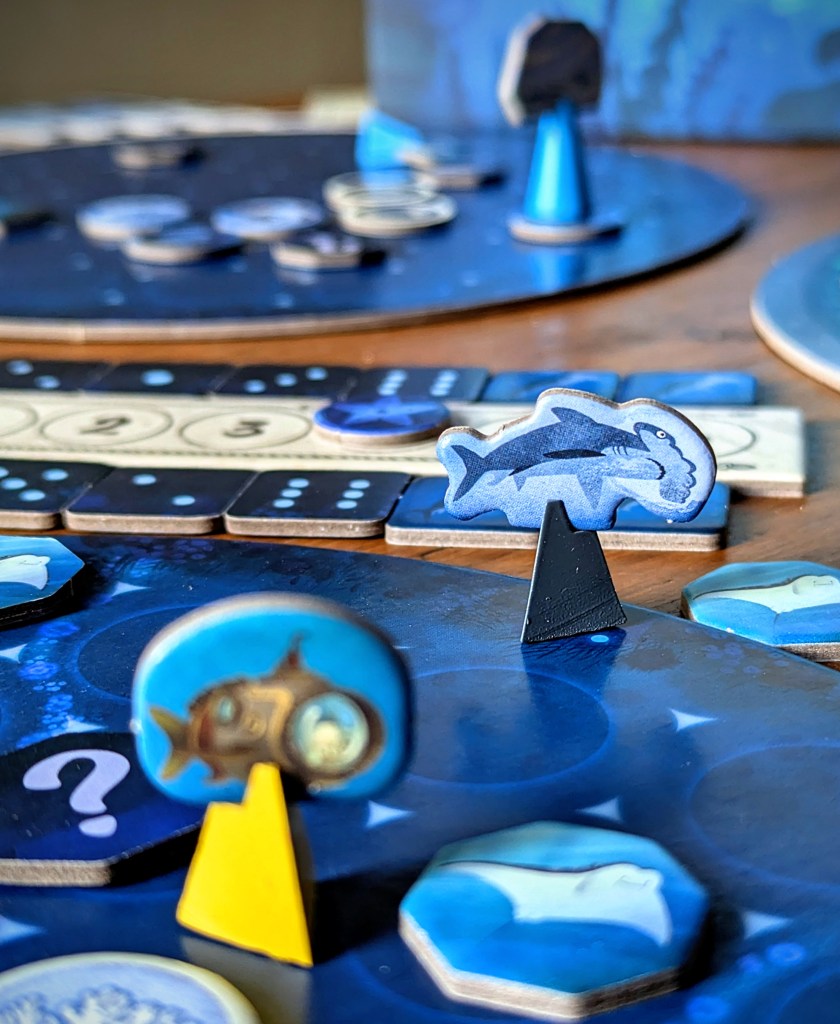
The stingrays have arrived! But so have the hammerhead sharks, looking for an easy meal. In Expedition 4, your ocean board is divided into 6 segments. You start with 6 stingrays on your board, but each round 2 sharks circle to new segments and eat any stingrays that are still in those segments at the end of the round. Fortunately during the submersible phase you can move up to 2 stingrays to try and save them from getting chomped, and any that make it to the end of the game give you points. This expedition also includes finless sole (3 tiles per bag) – these have an interesting perk of protecting stingrays that share the segment they are placed in, but only if the sole is undiscovered! So you have to balance using them to protect your rays, with flipping them to get points at the end of the game.
When discovered, 2 of the point of interest tokens act as teleporting spaces for adjacent stingrays, giving you more opportunity to whisk them away from sharky danger.
Our thoughts:
Fathom is somewhat deceptive, because it looks more complicated than it actually is (well it looked more complicated to me when I glimpsed it at UKGE!). It’s actually a fairly light, enjoyable tile placement game. For me, Fathom’s ‘depth’ instead comes from the designer Dan Helfer’s approach tying a fun nautical narrative to modular gameplay. Each Expedition has the same ‘bones’ with the core species, rule and set up, so each game feels familiar and easy to pick up. But the different species and rules also means each Expedition feels unique. And it opens up a world of possibilities for additional Expeditions to be released as expansions. I believe some are already in the works, and I can’t wait to see what’s next (different Islands maybe?).
I loved that each Expedition introduction, albeit brief, forms part of an overarching story that ties them all together. The first time we played each Expedition, we worked through them in order like an almost-campaign; after that we played whichever we fancied (and we both had our favourites!). I think there is potential for Expedition #1 to remain as the ‘introductory’ game that many players don’t return to as it’s simpler than the others. But it definitely has its place to help you learn the ropes, and younger players might use it more.
Although you’re mainly working on your own board, the bag swapping and shared sonar board add an interesting touch of player interaction. What other players pull out of the bag, what they choose to keep versus what they put on the sonar board, can influence your strategy or what species you end up prioritising. Some species score points based on colour diversity as well (e.g. crabs give bonus points for different coloured coral), so you aren’t just interested in your own bag. And getting to place your sonar beam first to get first dibs on the sonar board felt like the ultimate power move – whether you’re grabbing something you really want or blocking someone from what they really need. I also engaged in a bit of hate discarding: if there’s no empty spaces on the sonar board when you need to add unused discovery tiles, you discard a tile of your choice from the sonar – I would usually get rid of something another player really needed!
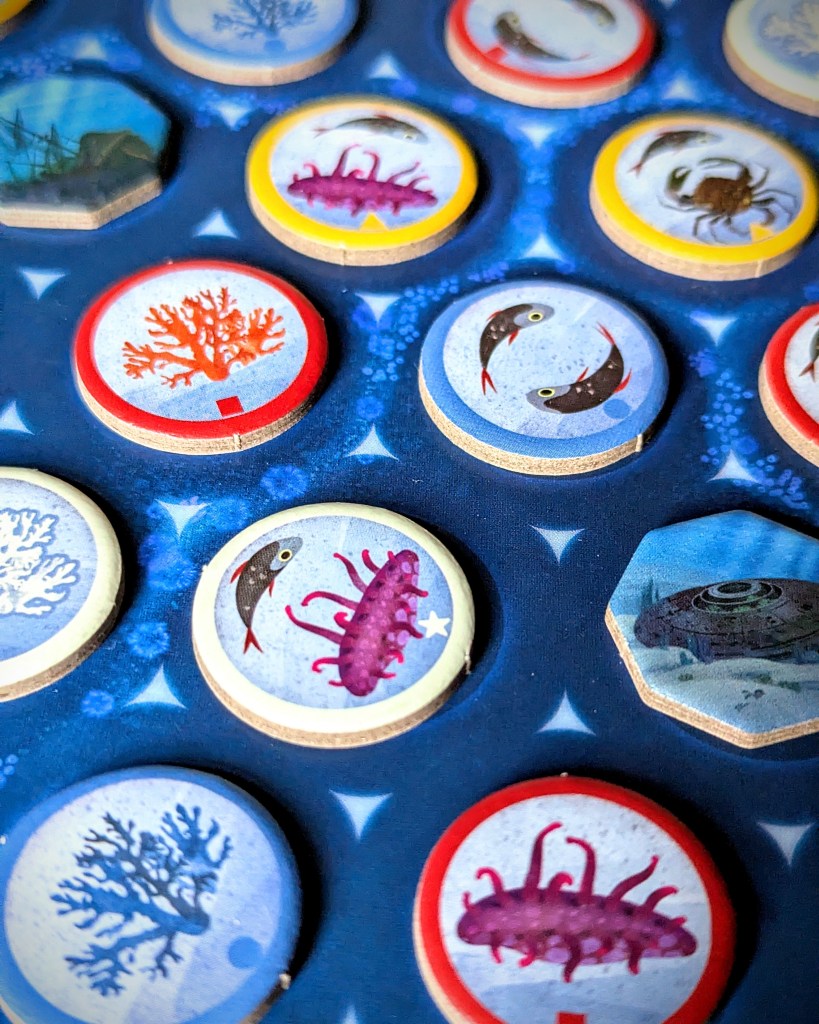
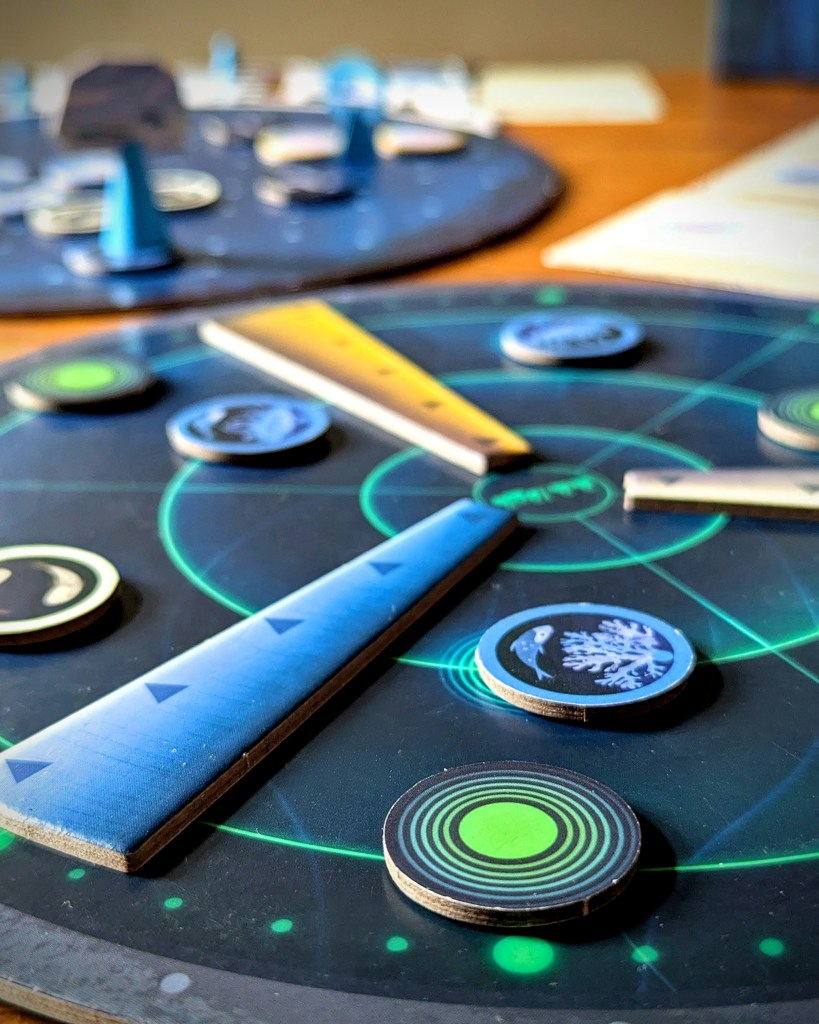
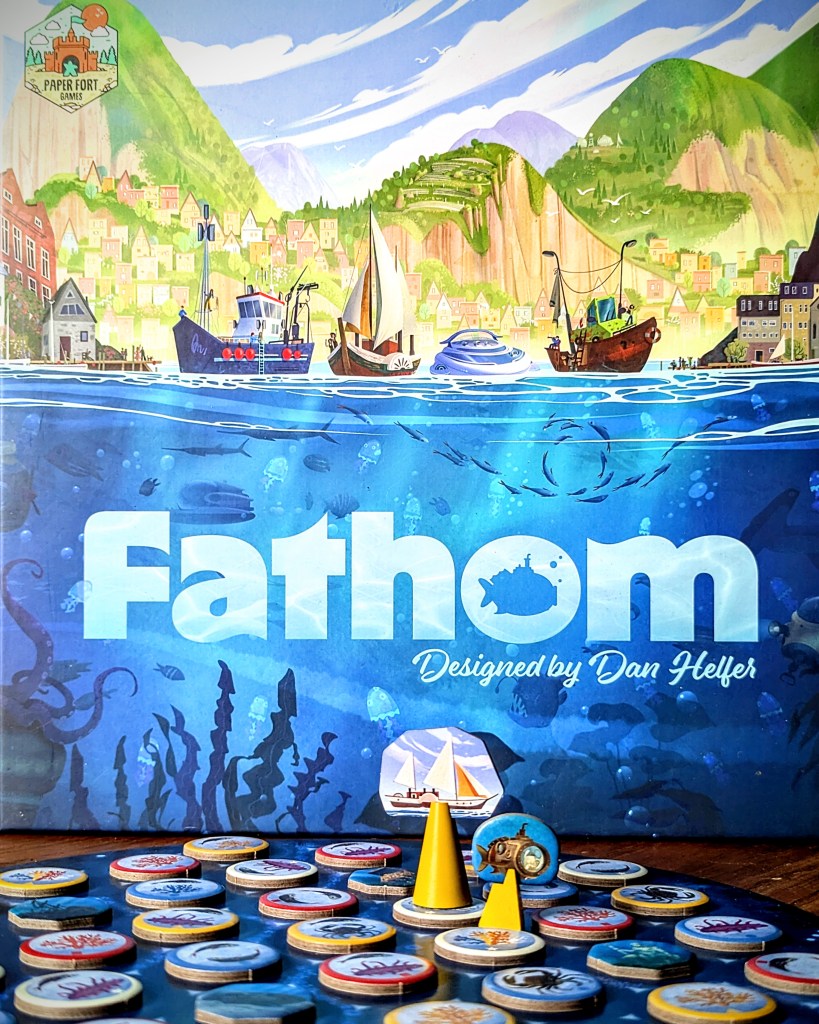
There are obviously lots of lovely thematic touches, from the art on the box to design of the components and how the species interacted. It feels very well thought out. I also appreciated that there were duplicate species reference cards, so players can have a copy in easy sight distance. There’s also different boat and submersible designs, which again are provided in duplicate (maybe to avoid arguments if two people want the same design? haha). I personally liked to try and match my boat and submersible with my player console.
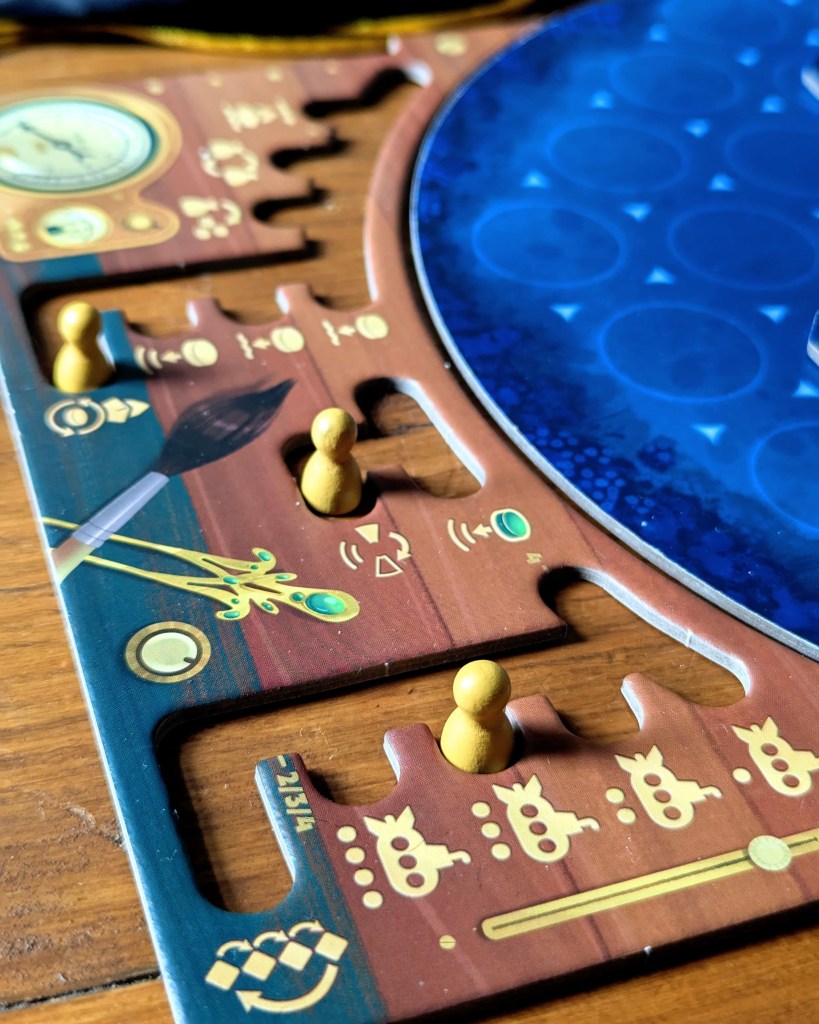
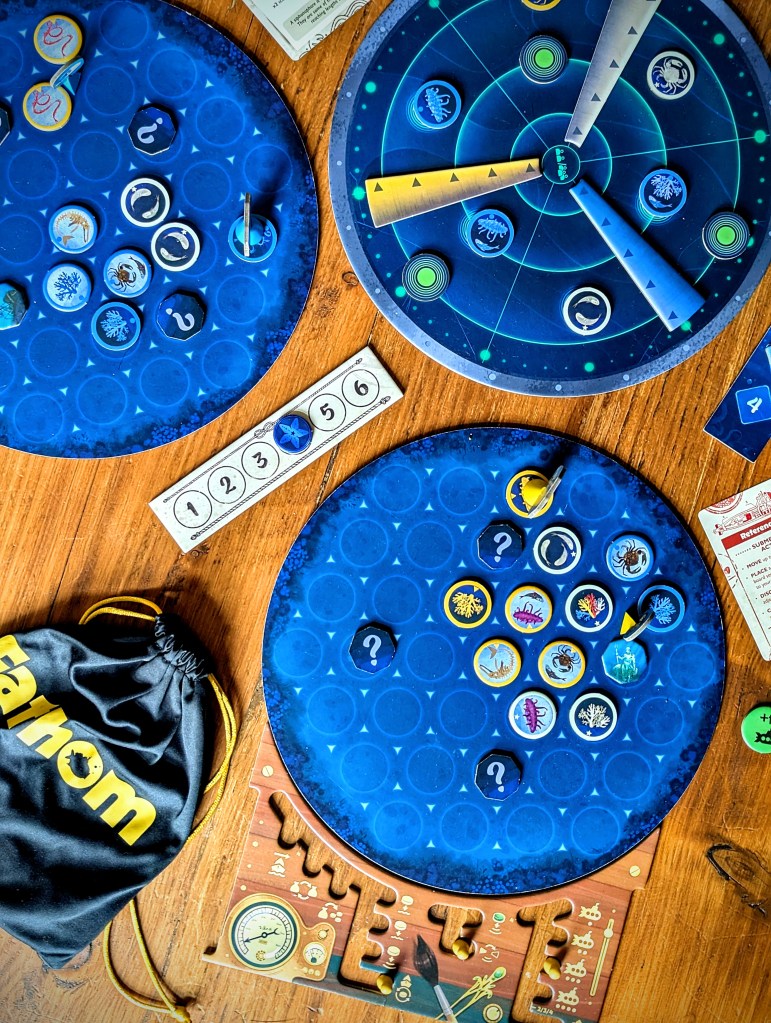
Speaking of the console: Each player has a console board that sits under their ocean board, and it shows a breakdown for each phase. The idea is that you use it to track yourself going through the motions, moving the console slider as you do each step. The problem is moving a toggle every time you do each action feels megafaffy. It can be a useful prompt when first learning the game, but we didn’t really use it beyond that. You could easily just play without it to save on table space, but I liked it for aesthetic purposes so still set it up. Maybe in future this could be another way to modify gameplay; Paperfort could release new boards that relate to specific special actions/upgrades for new Expeditions!
What we like
- Really enjoyable application of a marine theme to a light but puzzly tile placement game.
- Swapping tile bags and taking turns controlling the sonar board ups the player interaction and feels like you’re competing over making the best discoveries.
- Each Expedition introduces new mechanics and rules, with a light narrative that runs throughout as your ship travels around the island.
- The ‘core species’ combined with modular Expeditions make each expedition feel familiar but also unique. We can’t wait to see what future expeditions bring.
- Including duplicate objective cards was a nice touch.
Considerations
- The console board to track each step of a turn feels overkill and a bit of a wasted opportunity. I think an expansion replacing them with something more fun would be great.
Final verdict:
We had a lot of fun with Fathom! I really enjoyed working on my own board, while still having that little tussle over the sonar segments. I loved the theme and how it’s tied to the gameplay feels well thought out and intentional. It’s gone straight on my wishlist and I can’t wait to see where future expeditions take us!

 Our Board Game Life