
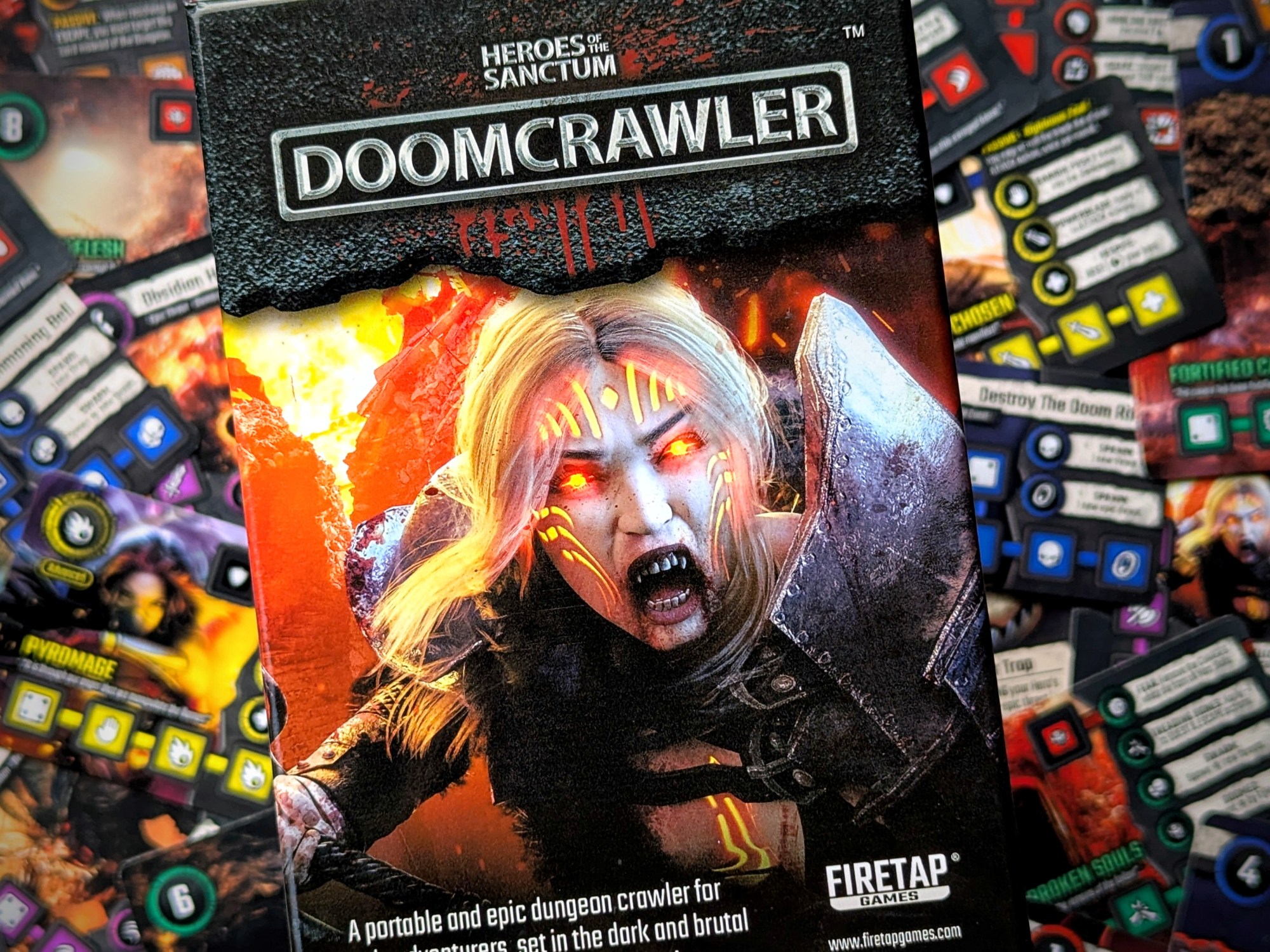
The Sanctum has called upon you, dear hero, to descend into the darkness of the Rift and fight the growing horrors within. But can you escape before the darkness pulls you down for good?
👥 1 player
⌛ 30 to 60 minutes
🧠 14 years+
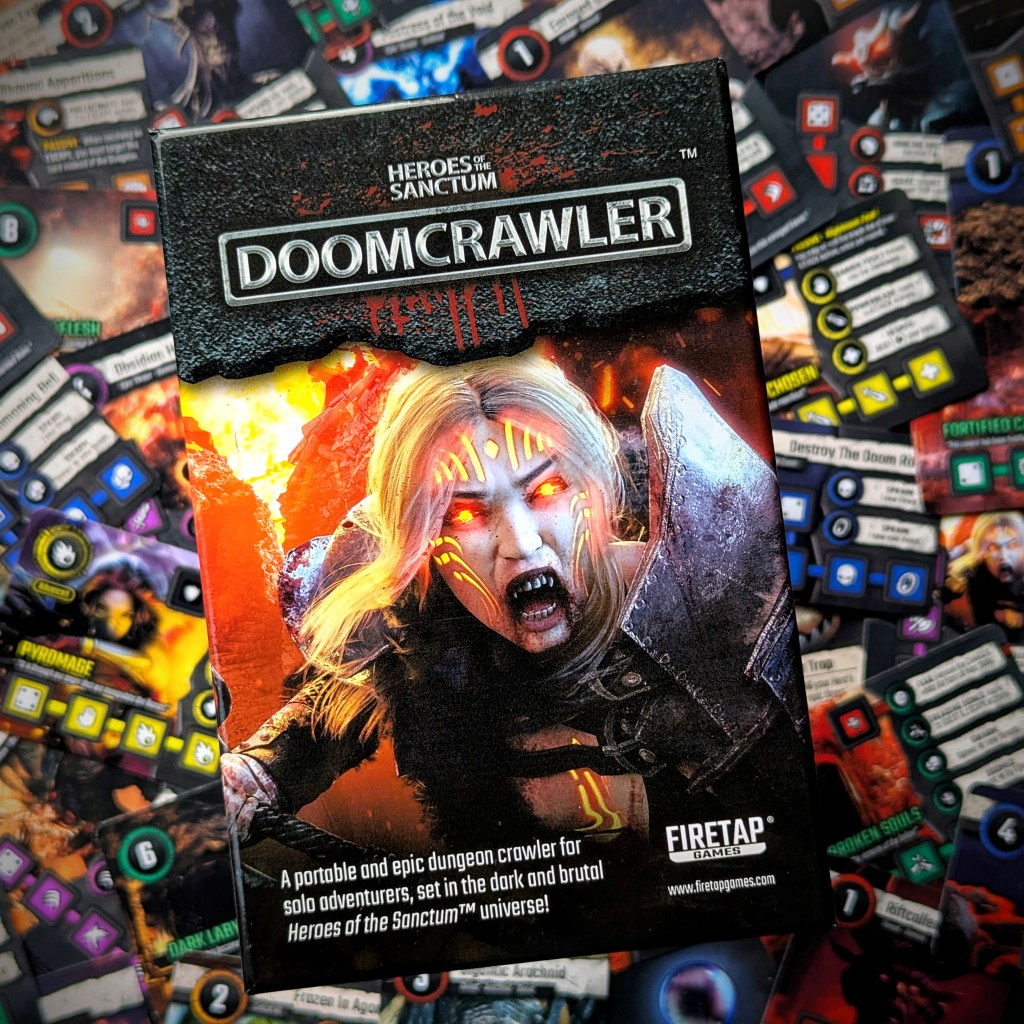
Gameplay overview:
Doomcrawler is set in the world of Heroes of the Sanctum, a previously released solo game. You play as a hero trying to escape dungeoness depths while fighting against the ever-emerging horrors from the Rift, a darkness caused by the Incursion.
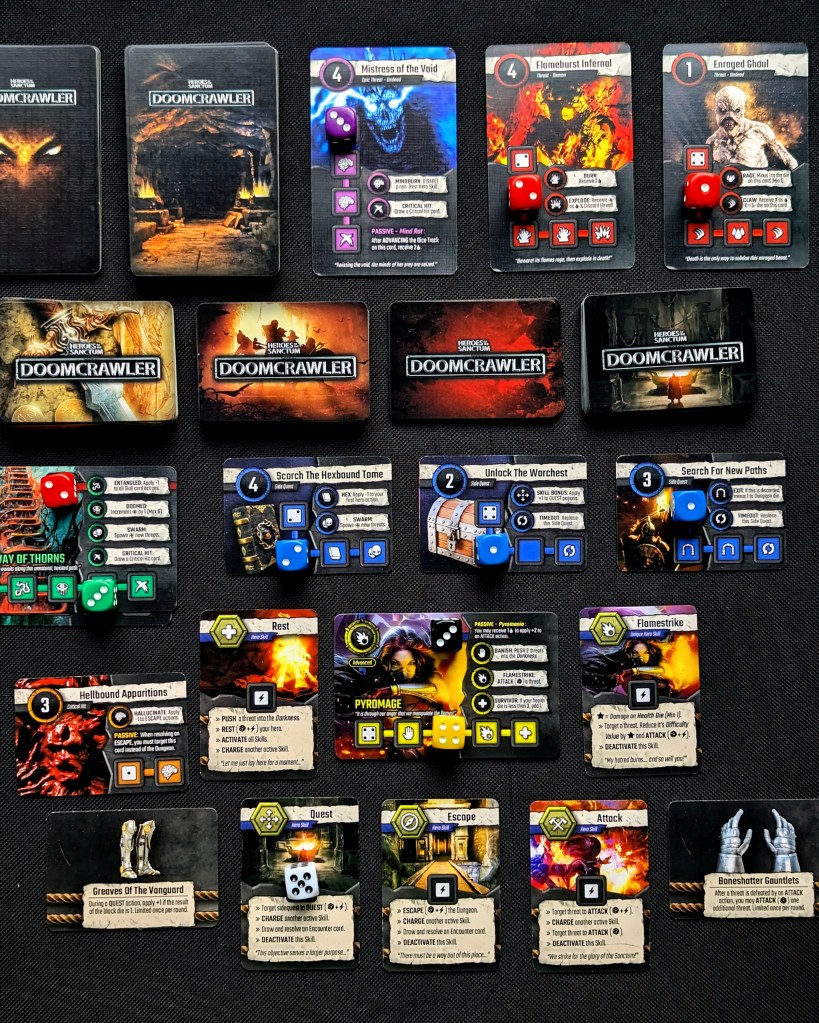
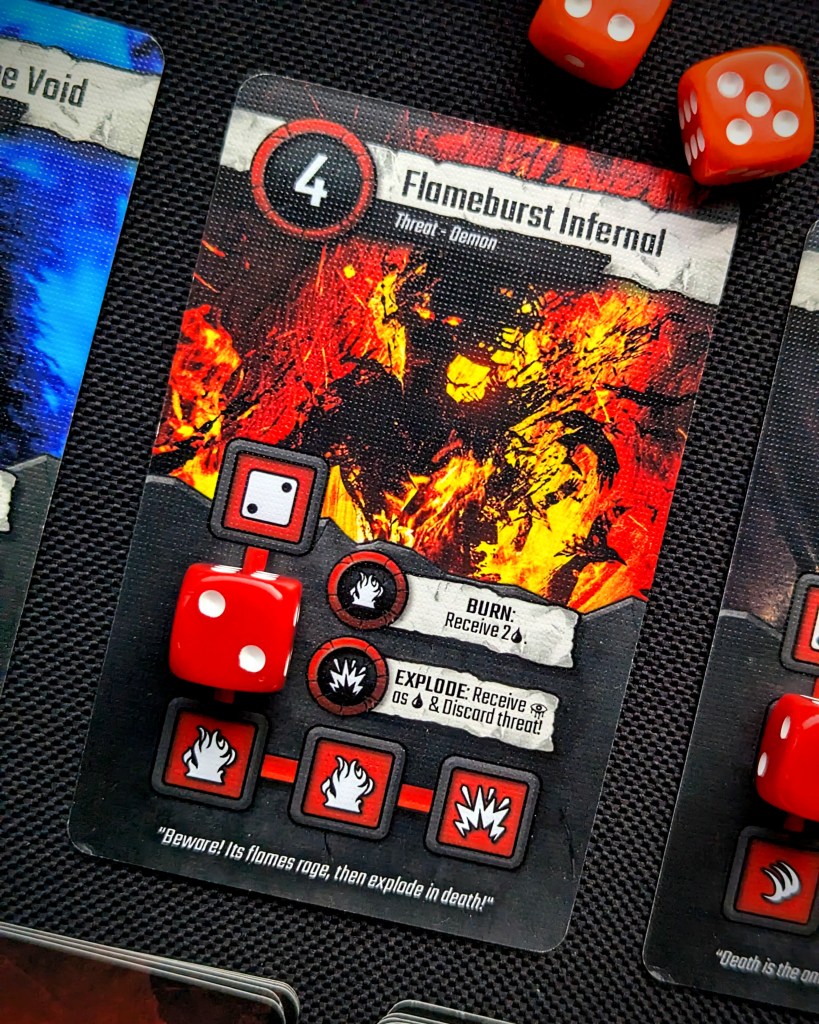
Hero, dungeon, side quest and threat (monster) cards all have dice tracks, with D6 dice representing the current ‘health’ of that card. Each round, dice move 1 space along their respective tracks, potentially triggering various helpful or horrific effects (such as discarding cards, inflicting damage, or applying skill modifiers).
A round has 2 phases:
- Hero phase. You push on in your journey and update your track. Then perform 2 actions of your choice from active action cards, like side questing, attacking threats, or attempting to escape the dungeon. After completing an action, it flips face down and can’t be used again until you choose a rest action (which also heals your health). At the end of the hero phase, you roll a D6 to get your defence value against the horrors that follow.
- Dungeon phase. The darkness strikes! Threats, side quests, and the dungeon update their tracks and resolve any triggered effects. Any damage sent your way is taken off your defence dice first, but when that runs out it hits you straight in the health points.
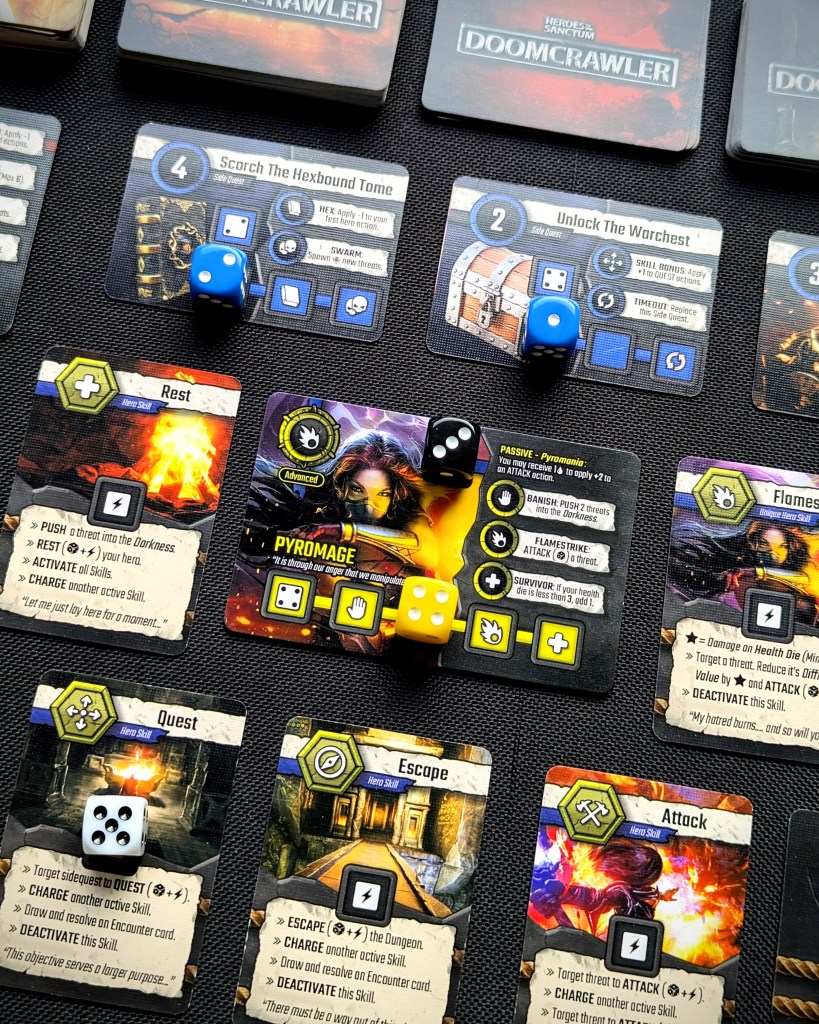

For actions to succeed, you need to roll a D6 and get a higher result than the target card’s strength. If the target’s health gets knocked down to 0, congratulations! You’ve defeated it and get to perform another D6 roll to see if you win any loot.
Whenever you side quest or try to escape a dungeon, you also bump into various encounters. So you draw and resolve narrative encounter cards, which can end in either fortune or disaster (usually the latter in our experience!).
If you’re unlucky enough to get a Critical Hit during the game, this is another card type with a (very short) dice track. Critical Hits always have terrible effects, and usually block you from another action until you resolve it (e.g. if you choose a side quest action, you have to target your critical hit instead).
The game continues until your hero manages to escape the last dungeon (yay!) or lose all their health and succumb to the Rift (better luck next time!).

What we liked:
- At first I wasn’t sure if Doomcrawler would be for me; it’s not my usual art style and I don’t play a lot of dungeon crawlers. But I had a really good time! It has a surprising amount of satisfying gameplay in a travel friendly box (I haven’t played the original Heroes of the Sanctum so can’t compare the two). It was perfect for my train trips for work. And the smaller cards save table space.
- I played Doomcrawler solo and also tried it as an unofficial co-op with Matt, and it works well as both. Matt also really enjoyed playing it with me; he did say he wouldn’t play it solo, but that’s because he isn’t really a solo gamer.
- You can modify the game length by selecting 1 to 3 dungeon cards in the set-up. One dungeon is perfect if you want a quickie, though it doesn’t give a lot of time for any growing tension from imminent threats (unless you’re very unlucky!).
- There are 4 heroes to choose from, with different playstyles and passive powers. The first time you beat an epic threat (it’s like a normal threat, but epicly worse) you flip your hero to their ‘advanced’ side, which has more health and a slightly better dice track.
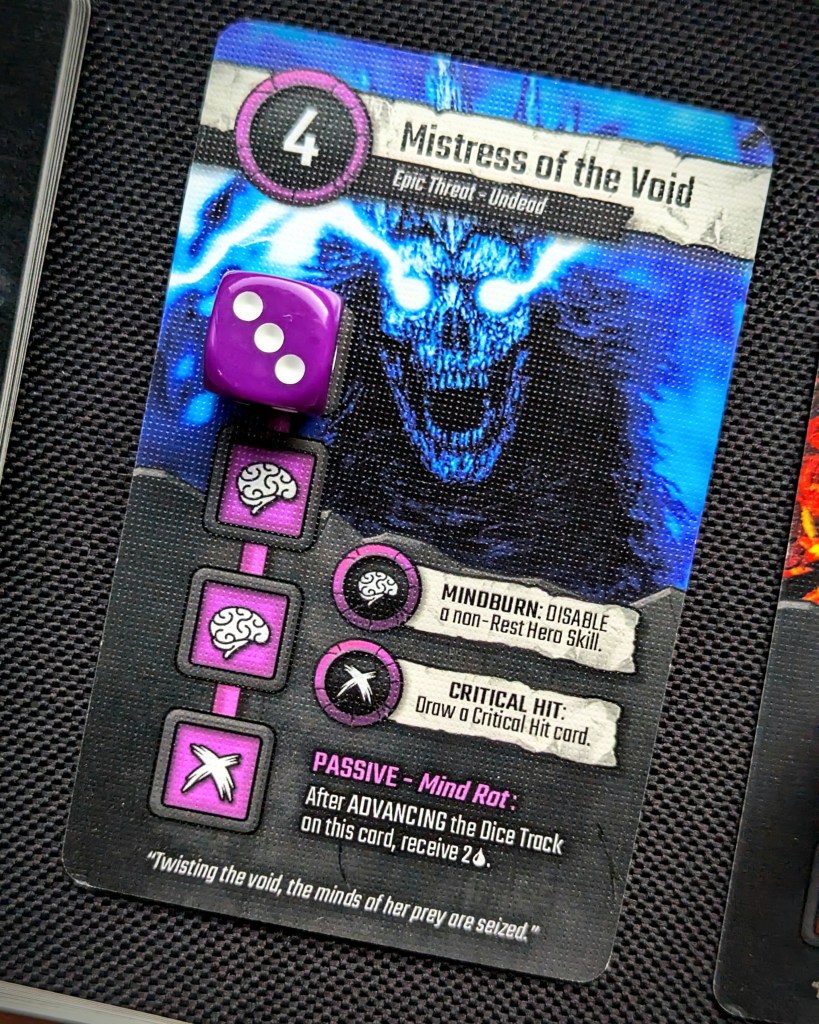
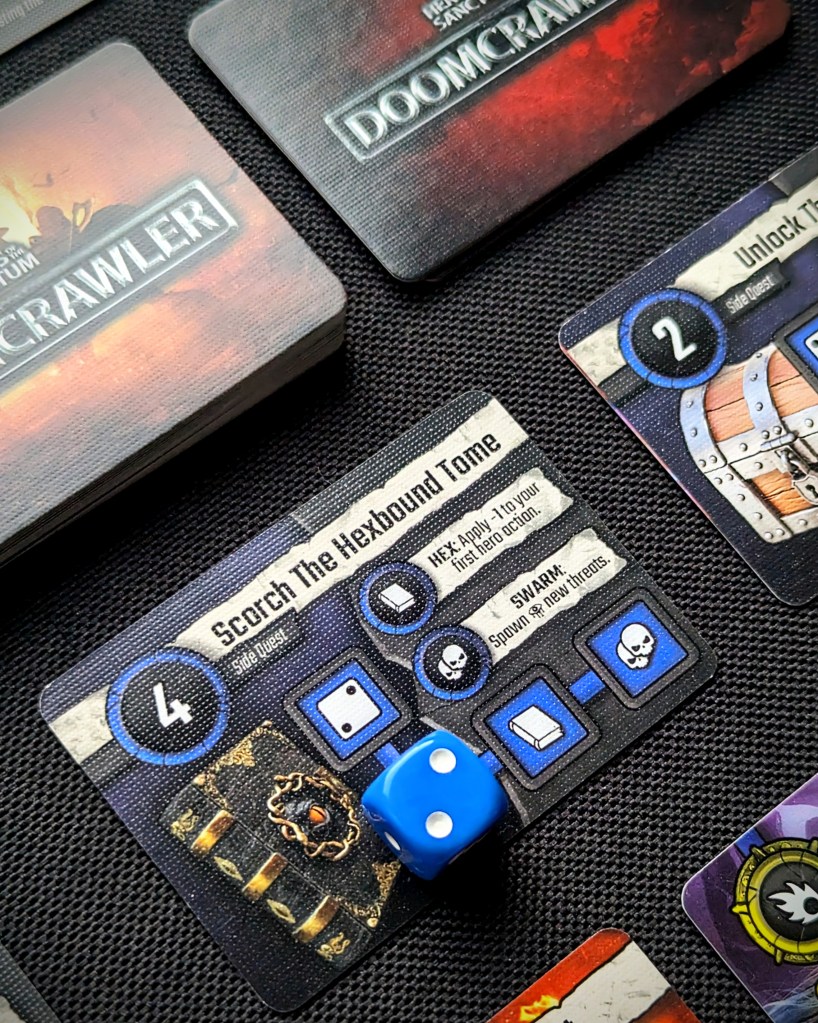
- Some dice tracks, encounter cards and the rest action let you ‘push’ threats into darkness. This essentially means they can’t attack (or be attacked) for a round, which was a pretty handy way to help manage their shenanigans.
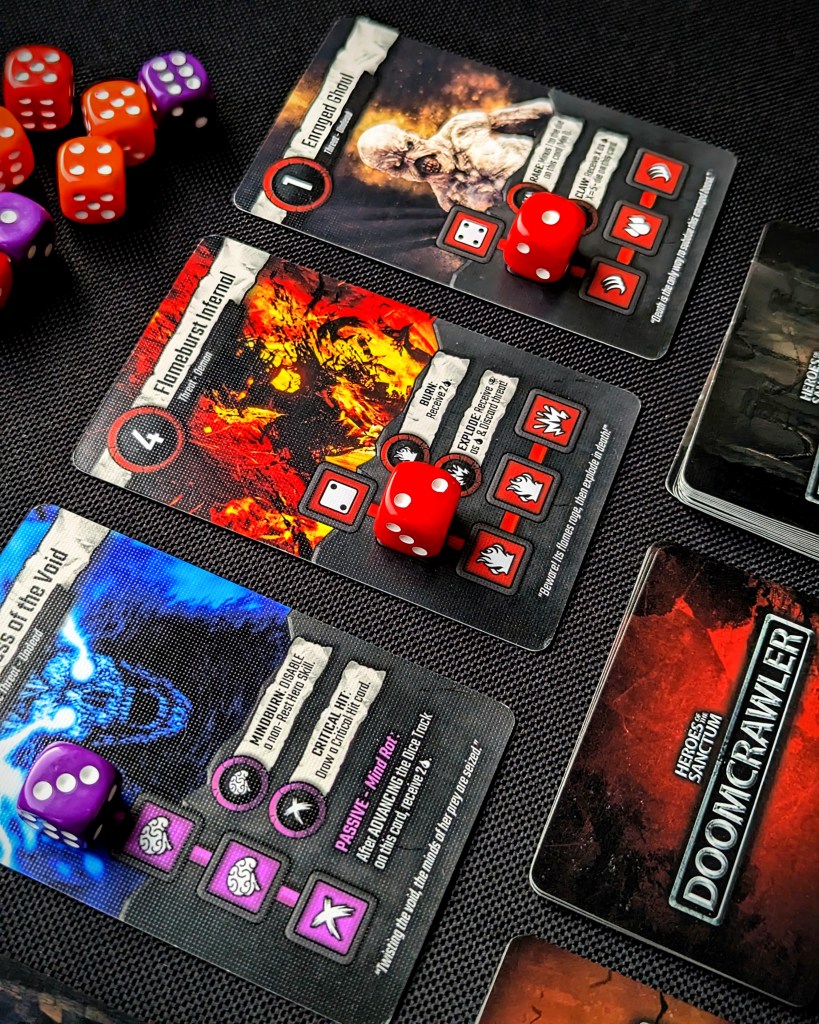
- Although not my preferred art style, the threats (and epic threats) were really cool and their designs very much portrayed horror. This art, combined with the narrative of the encounter cards, made the game that little more immersive.
- The different dice track cards are colour-coded (although it’s not necessarily needed to tell the cards apart). I would say that the back of the small cards had very similar designs and were a bit trickier to tell apart at first.
Considerations:
- The rulebook is quite confusing, with some information not where you would expect it to be or as clear as it should be. Important rules can easily be missed (and were, in our case!).
- It can be quite tricky to keep track of attack / strength modifiers that can show up across various cards, so it would be useful if there was something to make them clearer (e.g. tokens, or central trackers).
- The theme and artwork is very dark so isn’t suitable for everyone.

Final verdict:
I wasn’t sure what to expect with Doomcrawler, but I was pleasantly surprised by how much I enjoyed it! Both as solo and as co-op. It’s definitely a game I would take for overnight work trips. And after playing Doomcrawler I’m now intrigued to check out the original Heroes of the Sanctum!
Doomcrawler was included in Firetap Games’ recent Kickstarter, where late pledges are still available. Doomcrawler is included in various bundles, but the publisher has also said if you go through on the £1 pledge you would have the option to purchase Doomcrawler on its own.

 Our Board Game Life