
Advert: We received a loaned copy of the game from Ludoliminal / 25th Century Games via the UK Board Game Review Circle. All opinions are ours and our reviews are always honest.
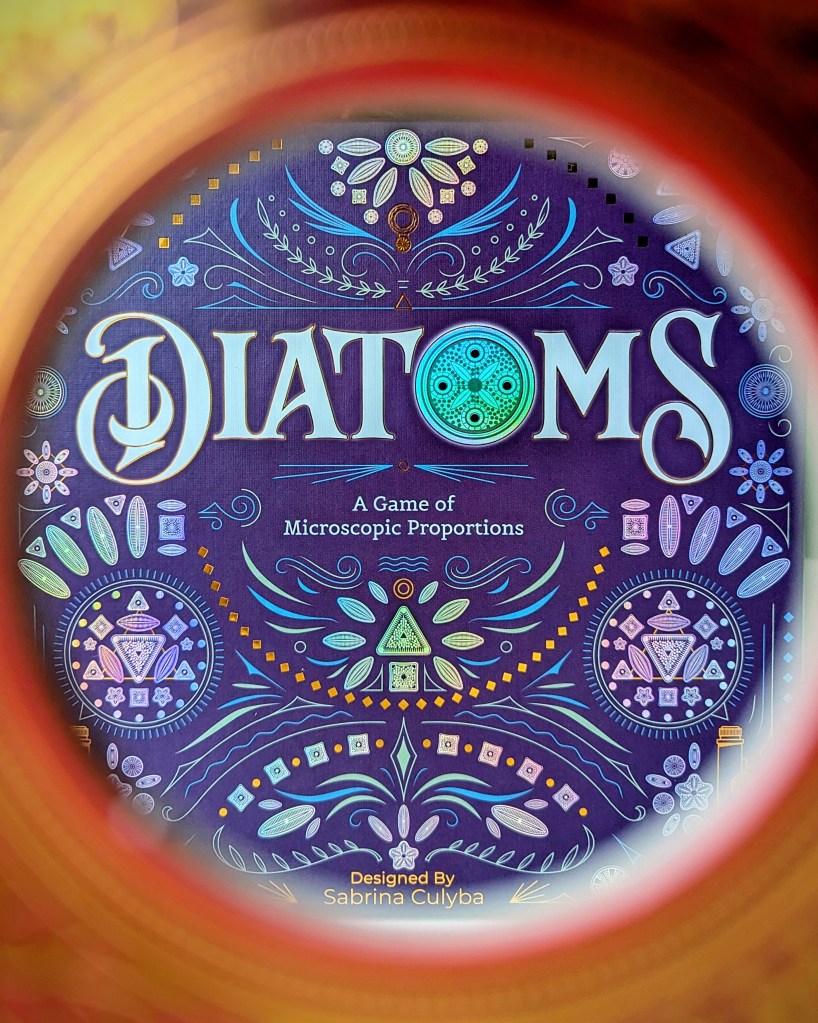
Diatoms: tiny unicellular microalgae with a beautiful glasslike appearance and found absolutely everywhere. The Victorians liked them so much, they used them to create microscopic mosaics to show off to their friends – and now you can too! Let’s put Diatoms under the microscope.
👥 1 to 4 players
⌛ 30 to 45 minutes
🧠 8 years+
Gameplay overview:
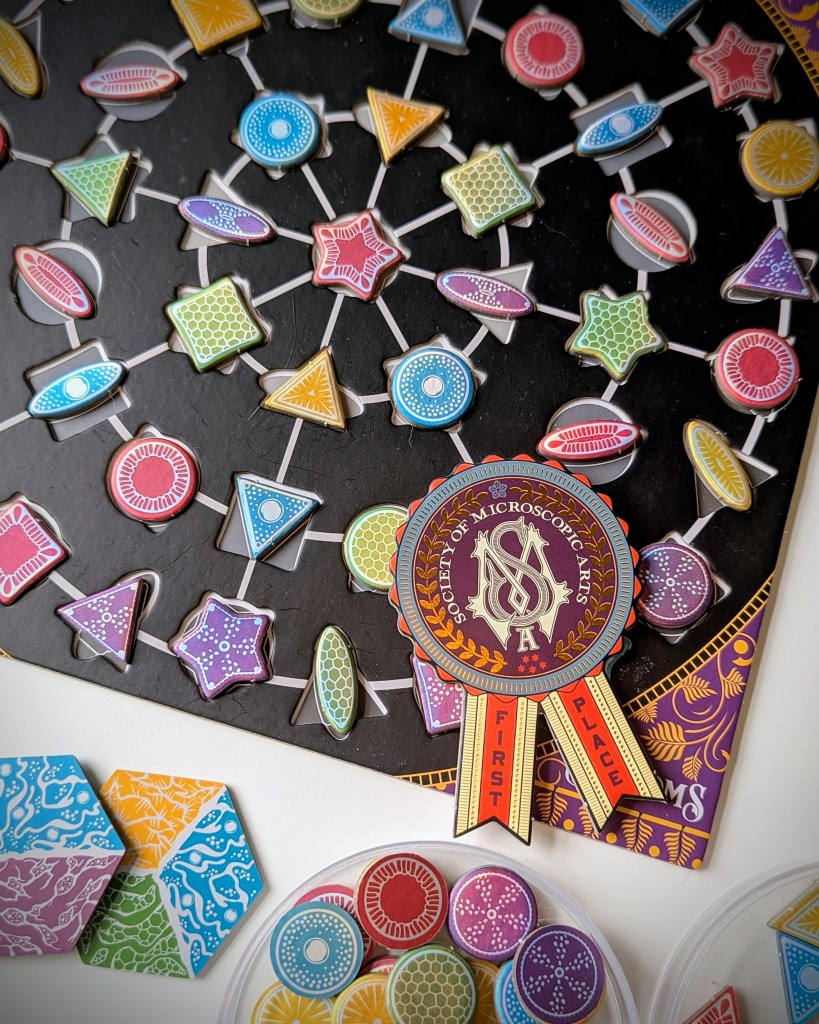
In the game Diatoms, players take on the role of diatom artists creating mosaics for the Society of Microscopic Arts. You collect diatoms of different colours and shapes by creating sampling points with water tiles, and then place collected diatoms in your personal board to create a beautiful mosaic. Score points for matching colours, different shapes and co-ordinating symmetries. You can also play with a guest judge, who will score points based on their particular preferences.

On your turn, you:
- Place a water tile, from either the two in your hand or the top of the tile stacks. Sides placed against other tiles must match in colour (unless it’s empty white empty water)
- Collect diatoms. If you create an intersection of three tiles together you’ve created a ‘sample point’, and collect the relevant size/colour diatoms. For example, if you create a sample point that has 3 purple segments and 1 yellow segment, you collect a purple triangle and yellow circle. If you create multiple intersections when you place your tile, you collect diatoms from all of them!
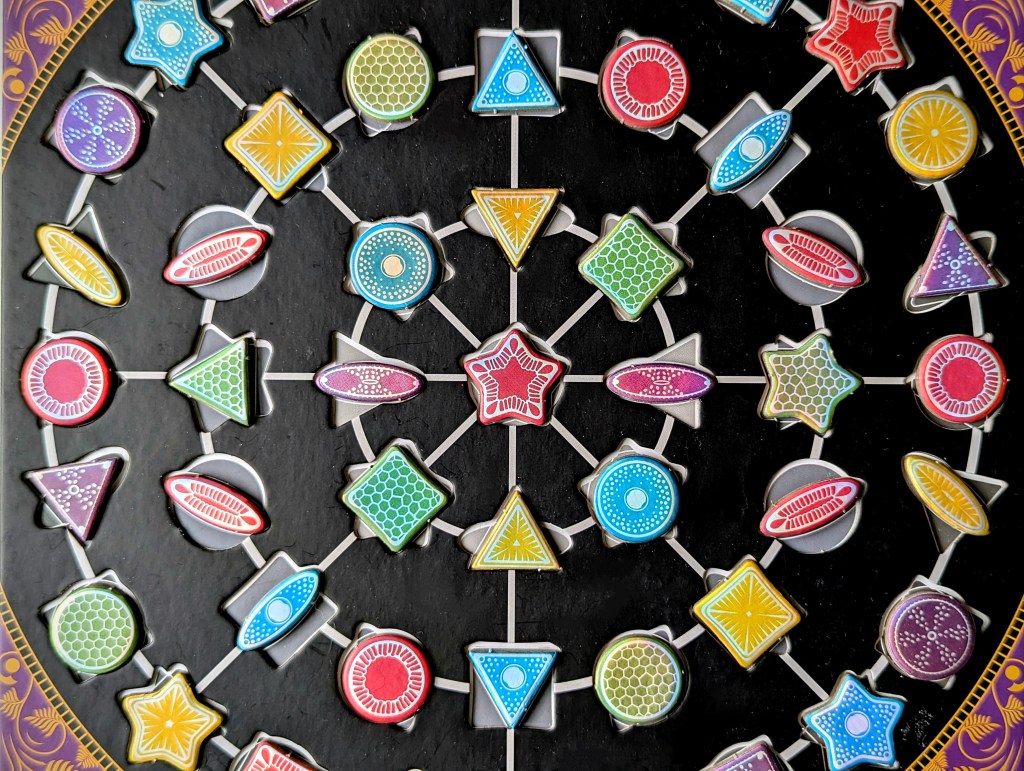
- Place the diatoms anywhere on your personal board, keeping scoring criteria in mind. Each space is designed to hold one of two shapes. Once you’ve placed a diatom, it can’t be moved for the rest of the game.
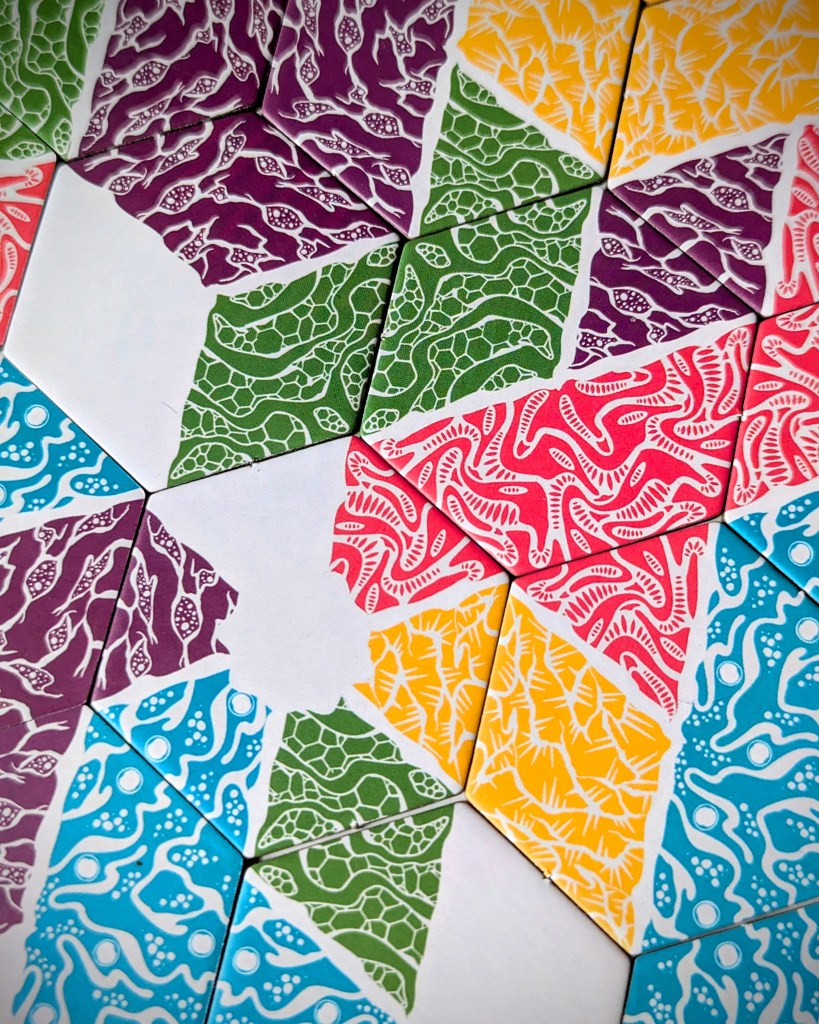
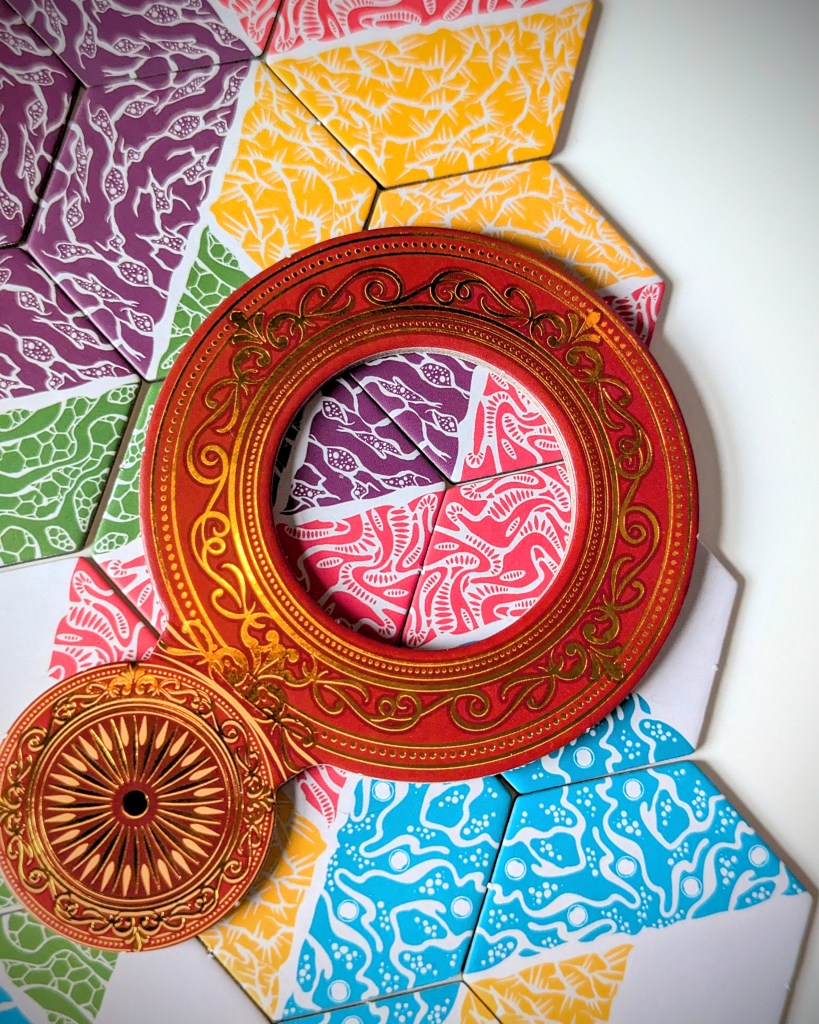
If you manage to create an intersection that is 6 of one colour, you get to choose the diatoms that would add up to six (e.g. a star and a circle, two triangles, a square and an oblong). When the last water tile has been placed the game ends and points are added up for number of matching colours, number of different shapes, and symmetrical colours/shapes on the 4 main horizontal/vertical/diagonal lines.
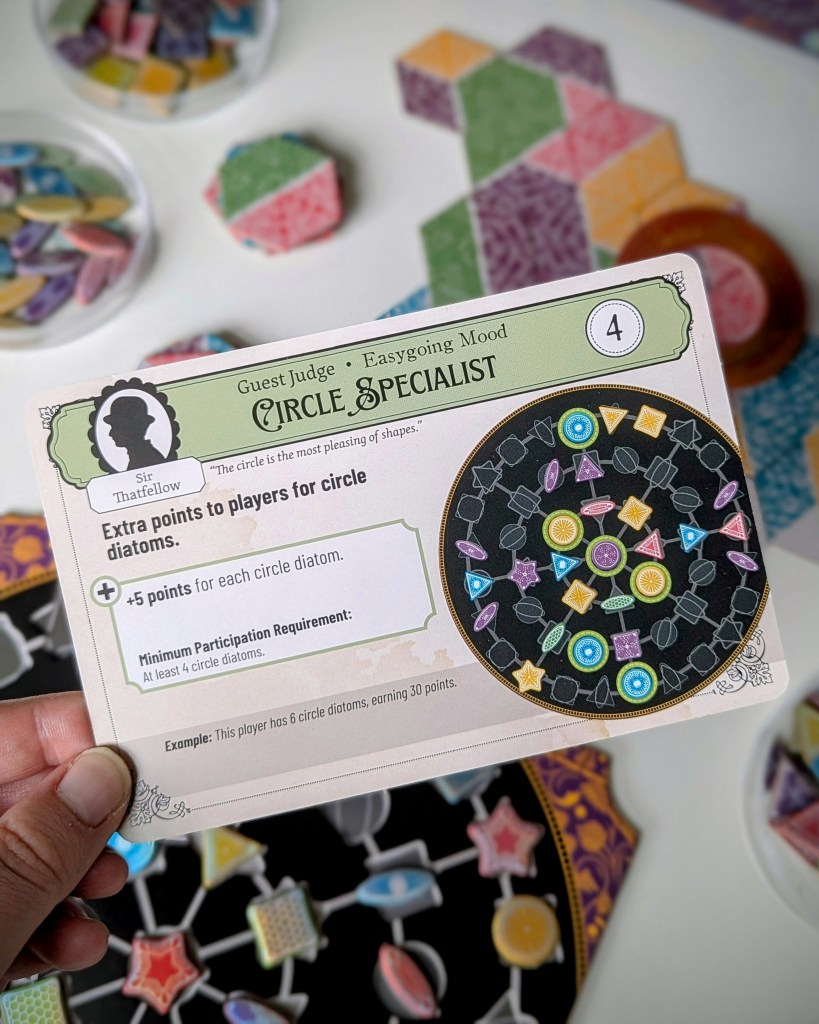
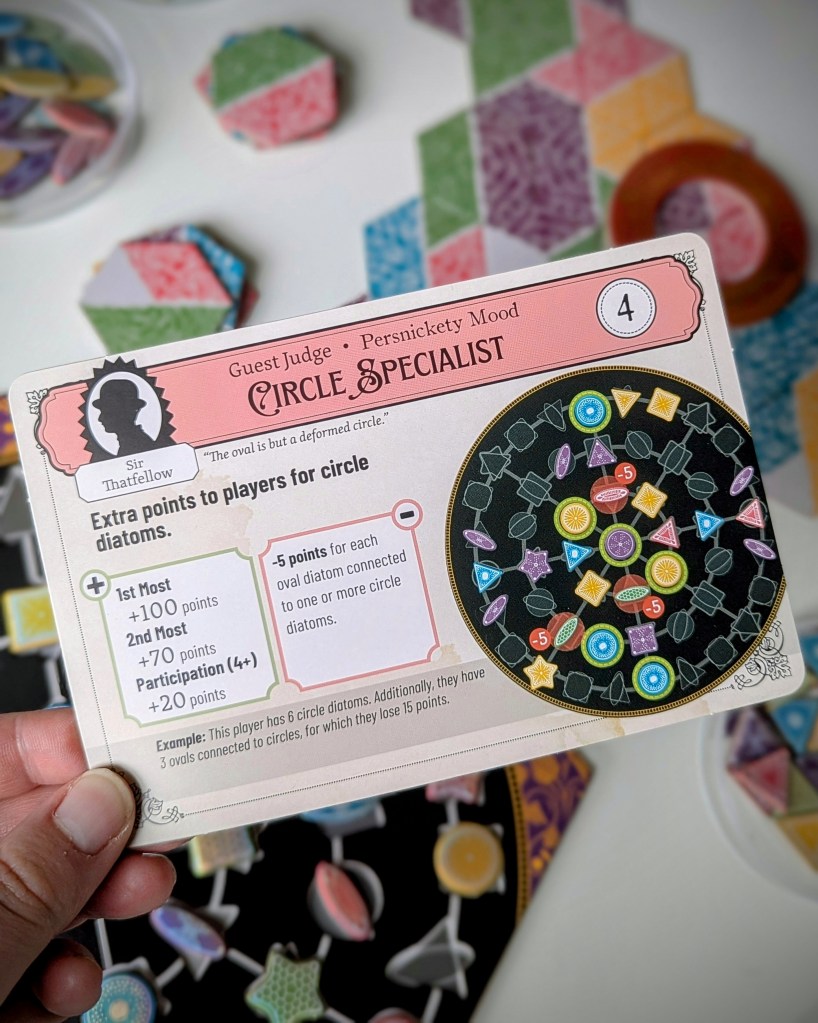
When you play with a guest judge, you can choose their easygoing mood, which gives points if you make them judge happy, or the persnickety side, which still awards points but can also deduct them if you do something the judge doesn’t like.
Solo mode
Diatoms has its own puzzly solo mode, where the player has to complete a mosaic that matches a specific commission card. Rules for collection and placement are the same as multiplayer, with the exception that you can only place diatoms onto your board if they follow the rules set out by the commission card. This can be anything from just specifying which spaces need to be filled, up to specifying the colour, shape, colour AND shape, or even that certain spaces should all match.


If you end up collecting diatoms you can’t place (this is unavoidable!), then they are ‘cast off’ into empty petri dishes. Waste too many diatoms and you fail the commission!
The commissions start off simple, like the one in the photo, but each one gets progressively difficult. And rather than scoring, you mark your progress on a career log.
Our thoughts:
I’ve been watching this game for months before its release! I have a biology background and diatoms were one of the first things I learned about during my undergrad degree (and one of the only things I remember from that year!), so I was drawn in by the theme straight away. And then I saw the shiny diatoms. And then I saw it’s puzzly tile placement! It ticks a lot of boxes!
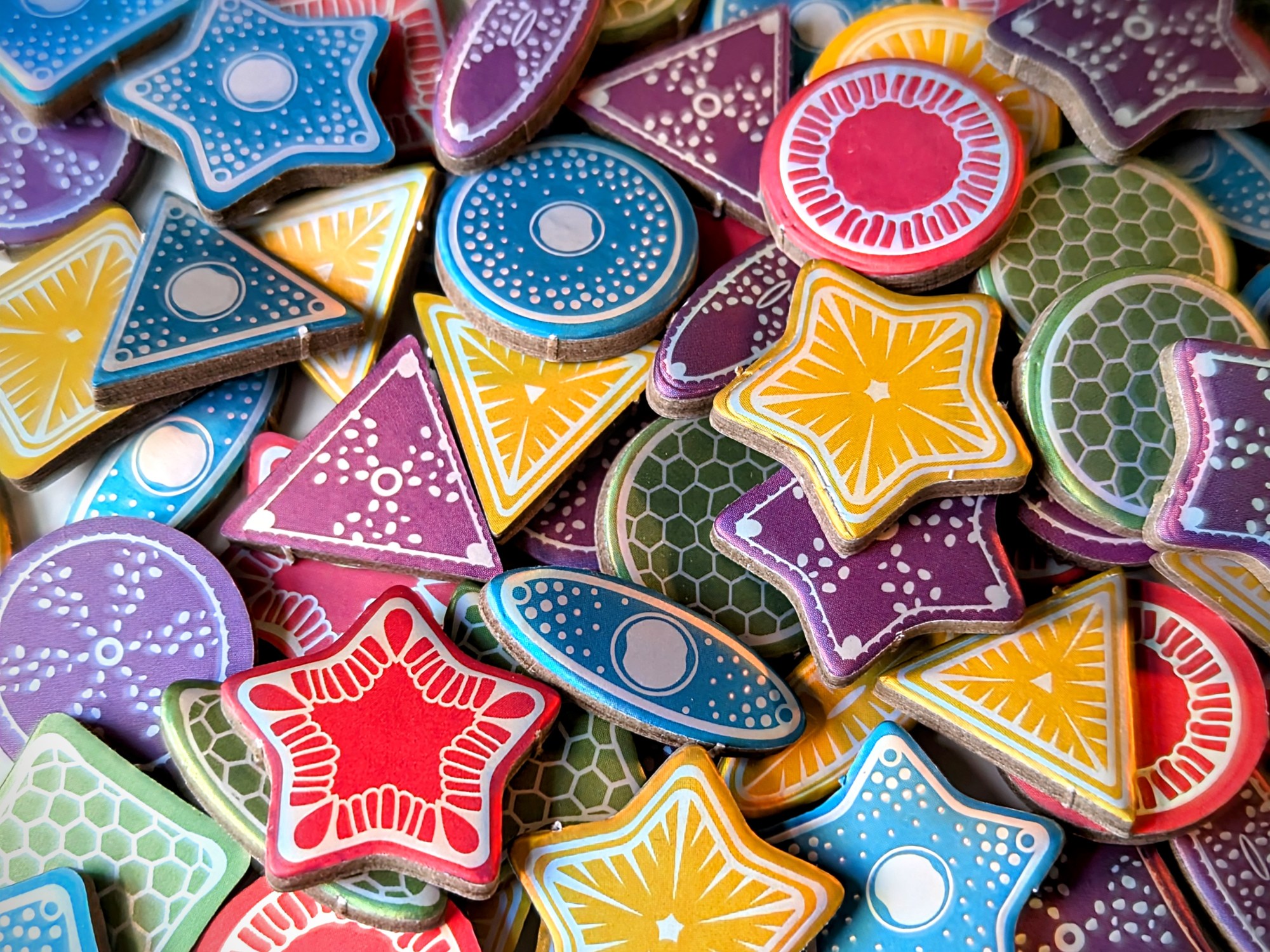
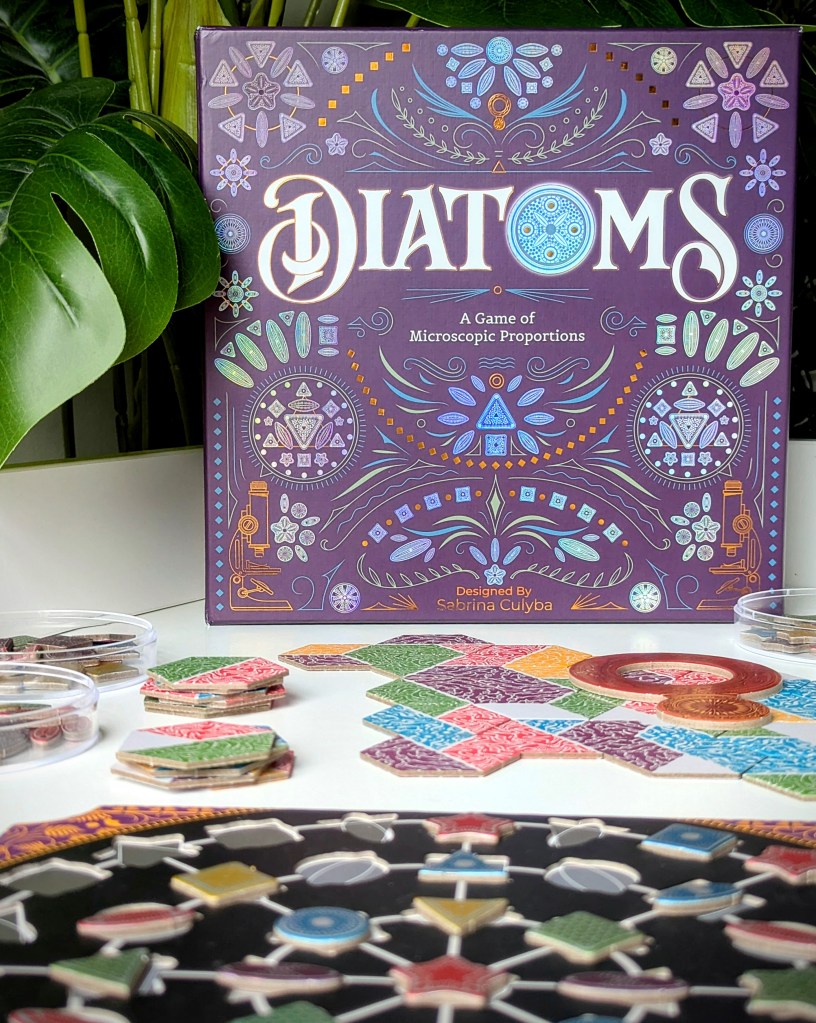
The first thing you notice when you open the box is the amazing production and design that has gone into this game. The personal boards are dual layered with perfect spaces to fit 2 of the 5 diatom types. And each player gets their own ‘field notes’, which is a clever, thematic take on a player aid. The diatoms themselves come in petri dishes and have a shiny, almost bioilluminescent look. And there is foiled decor everywhere, even on the box itself.
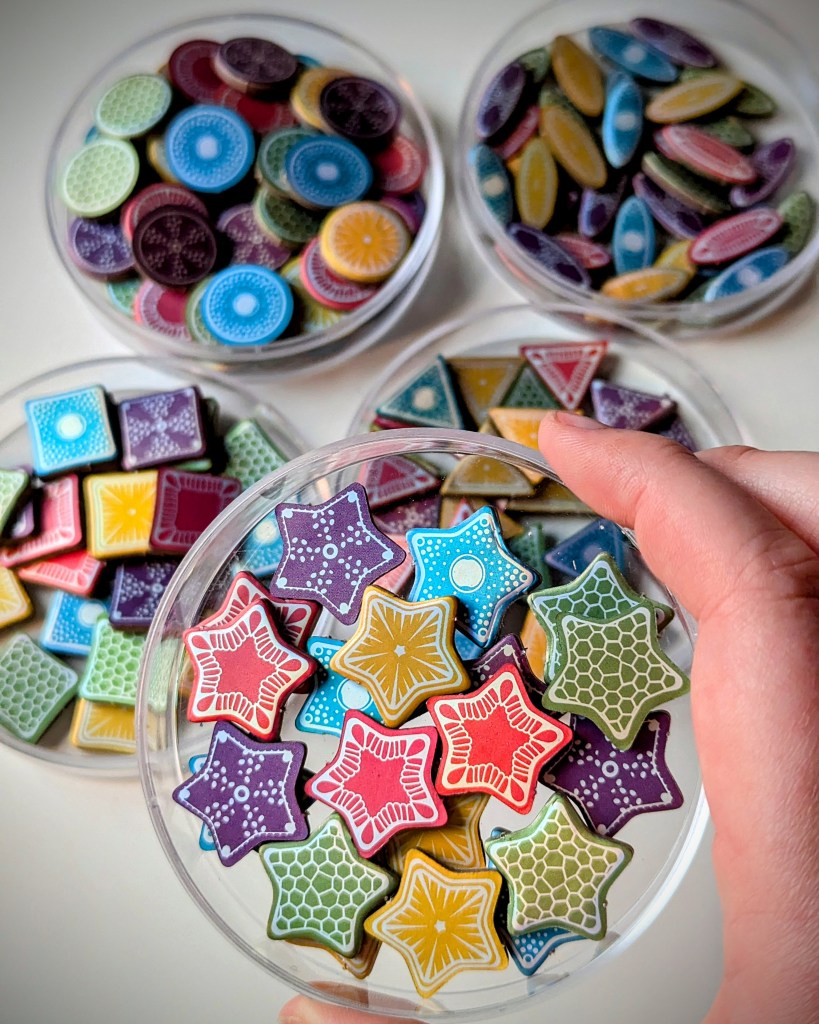
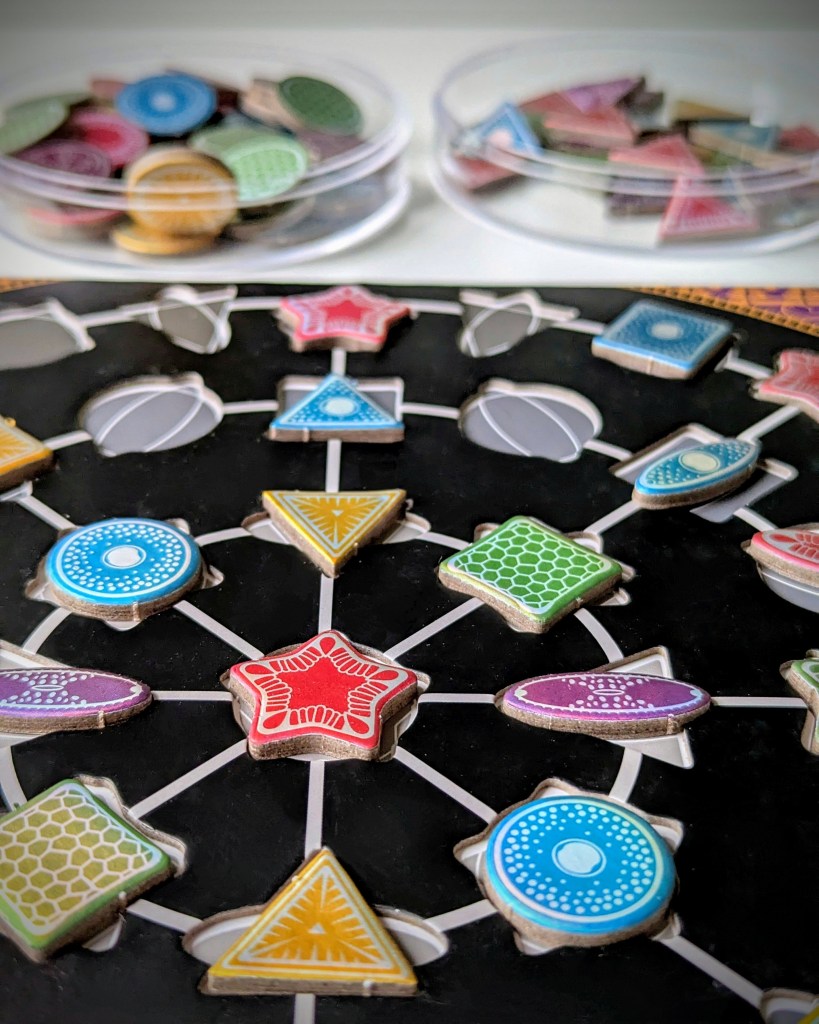
I was drawn in by the theme straight away. And then I saw the shiny diatoms. And then I saw it’s puzzly tile placement! It ticks a lot of boxes!
The gameplay is a two step puzzle: first you’re optimally placing a water tile to collect diatoms, then you’re deciding where is best to place those diatoms on your board. But you need to think backwards, looking at which diatoms you need for your display first and then seeing if you can place a water tile to get them. It’s very satisfying when you place a water tile that creates multiple intersections, getting lots of diatoms in one go. And we liked how you got to decide the breakdown of diatoms you collected when you sample an intersection of all one colour (totalling 6), or when a diatom wasn’t available.
There is little player interaction in Diatoms. You’re placing water tiles in a central area, so there is an opportunity to try and block other play from certain areas or avoid giving them ways to collect from multiple intersections. And you can choose shapes/colours your opponents need. But mainly, we found we were just doing our own thing and concentrating on our pretty little puzzles. Maybe more hate placement/drafting would come into it the more you play, or with more players.
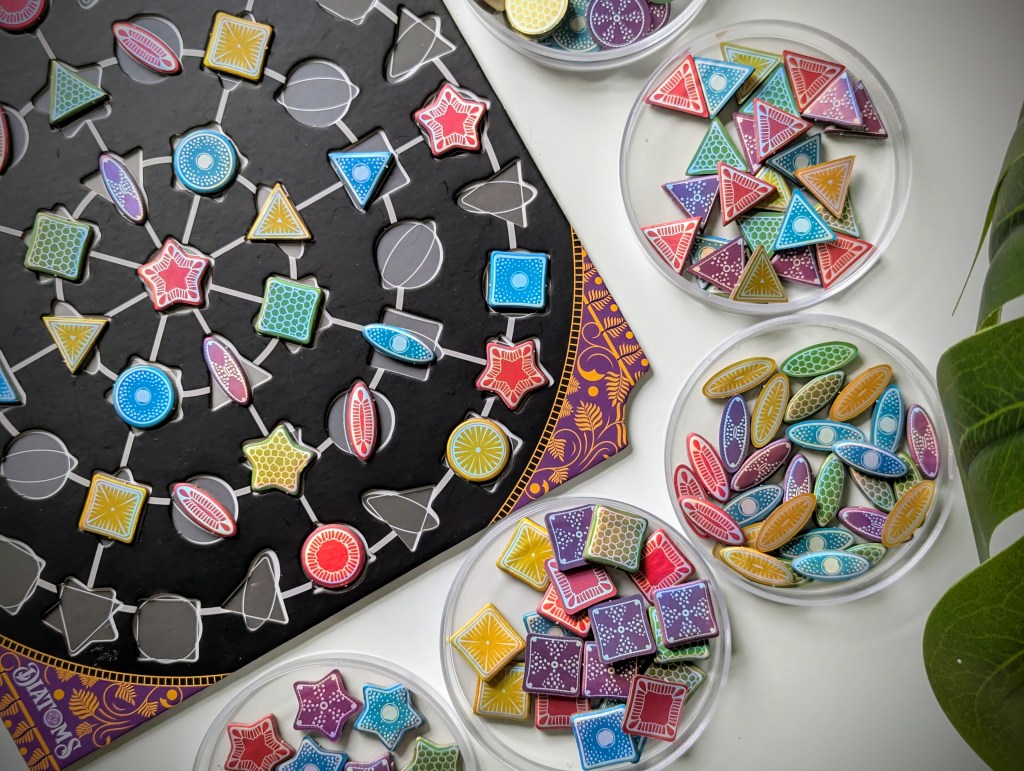
The Diatoms solo mode really shines – maybe even more than the multiplayer mode! I completed the first couple of commissions, which were relatively simple but I did have a sneaky peak of what was to come and they get really tricky! Even Matt is interested in the puzzly solo mode, and it’s not usually his thing.
The Diatoms solo mode really shines – maybe even more than the multiplayer mode!
Initially the game sounds more complicated than it is, mainly because of the multiple scoring criteria. But the field notes help with that, as do the incredible score sheets (which I forgot to photograph – whoops!). The sheets spell out the different ways to score points step by step and are laid out in a way that makes totting up super simple. I never thought I’d get so excited over score sheets, but here we are! The guest judges are also a great way to keep the scoring and game fresh, and we liked that you could choose how nice/mean their scoring criteria would be.
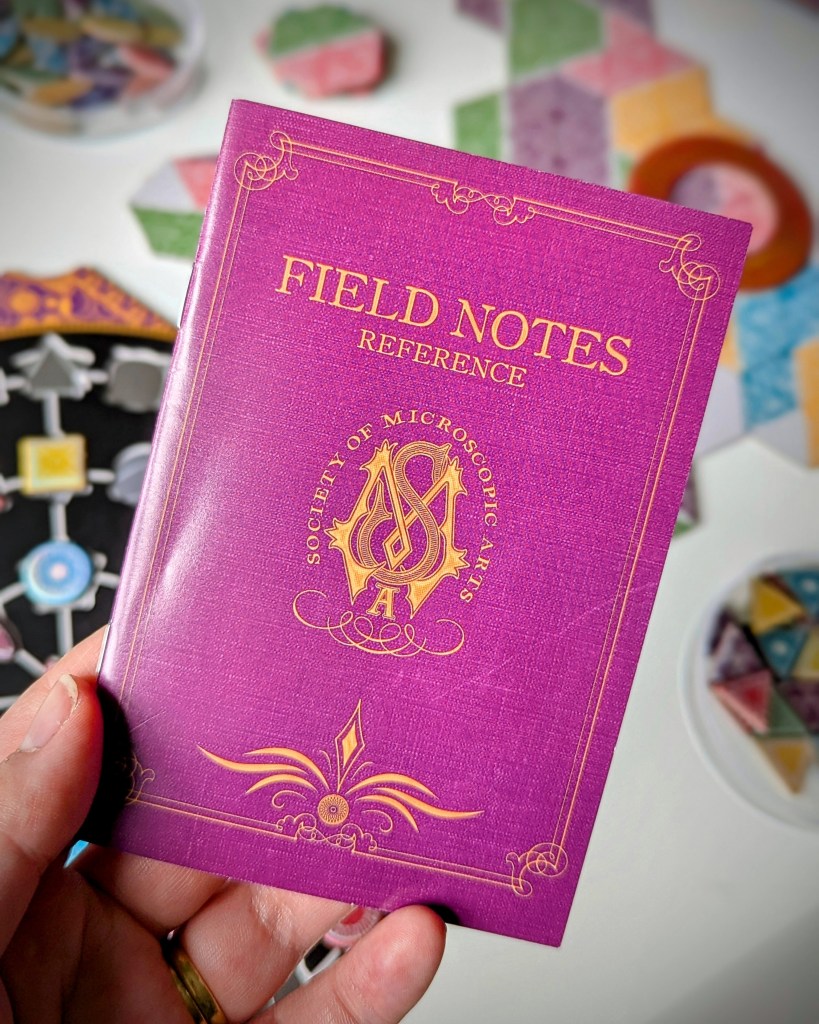
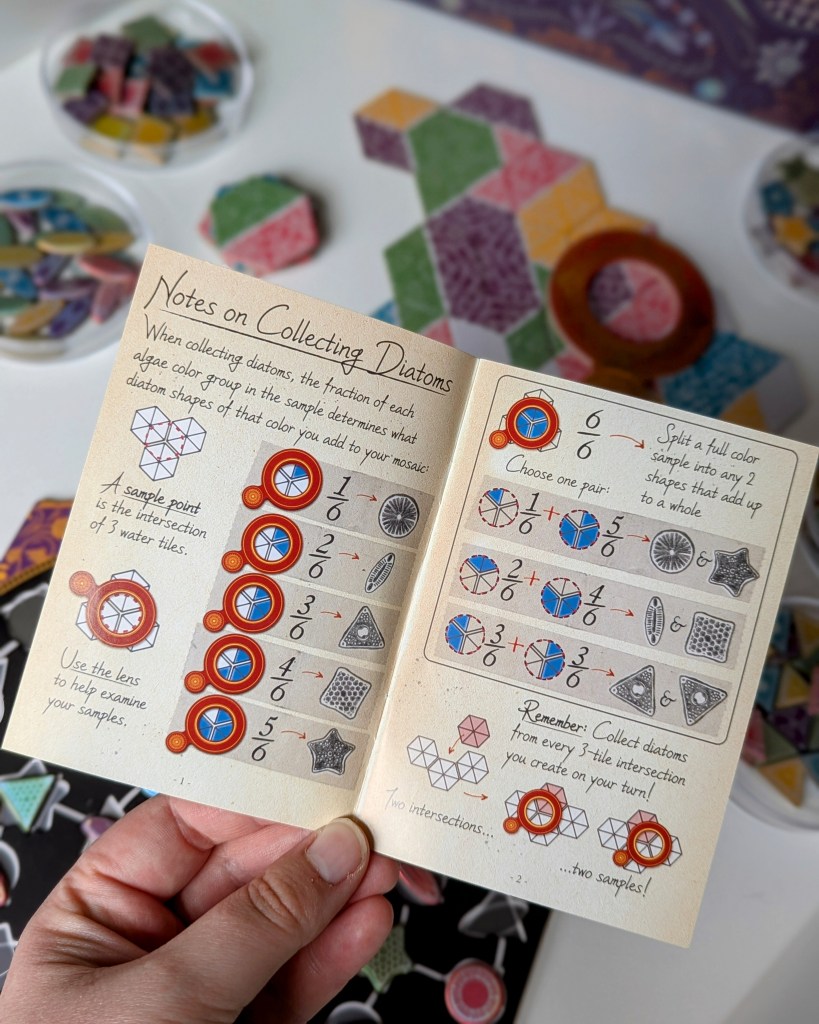
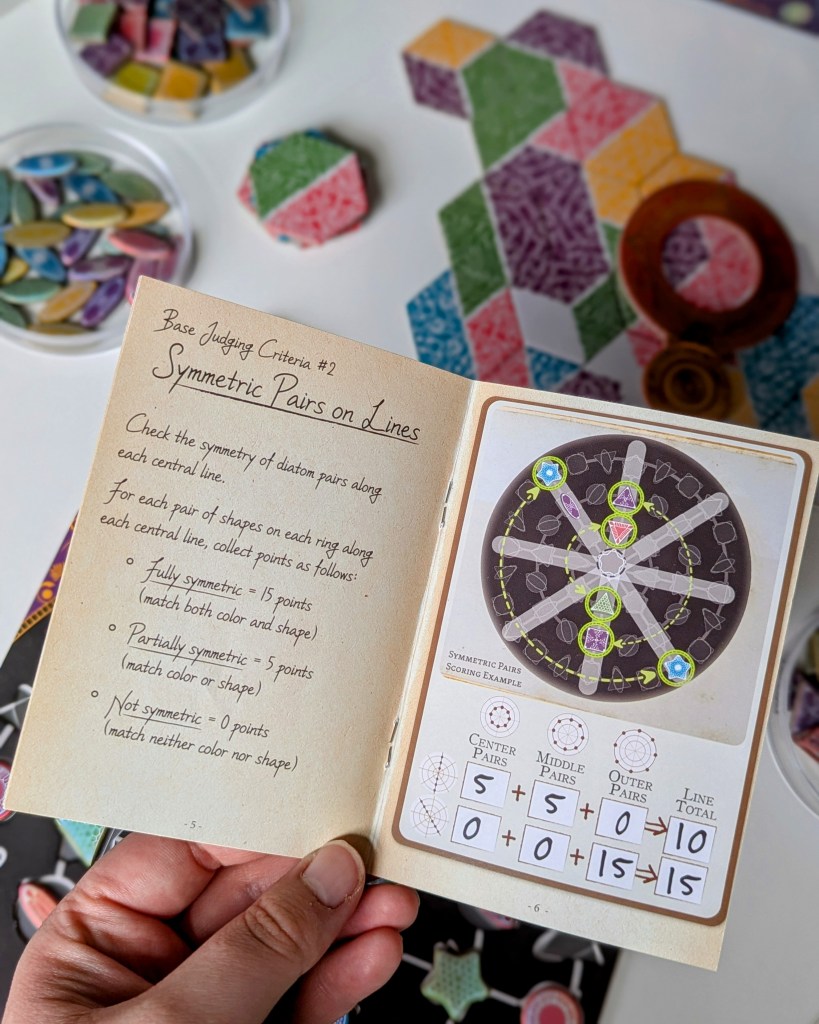
The rulebook also explains the game well, although I would personally prefer the game set-up to be at the start, before the basics of the gameplay, so it’s easier to find (I’m more likely to want to check that in future than the basics).
What we like:
- Fascinating and unique theme that appeals to my nerdy nature.
- Amazing production with beautifully thought out design, especially the shiny diatoms.
- Lots of puzzliness to enjoy, from the sample collecting to the diatom placing.
- Variability by adding in a guest judge and deciding how mean they will be.
- Wonderful solo mode that may just be my favourite part of the game.
- Good, clear rulebook, innovative ‘field notes’ player aids and an awesome score sheet that break down the multiple stages of scoring wonderfully.
Considerations:
- It’s essentially multiplayer solitaire – not an issue for us but not a play style for everyone. There might be more player interference at higher player counts.
- Scoring breakdown sounds more complicated than it is, but working through the field notes and score sheet help get your head around it.
Final verdict:
Completing your own microscopic art is so satisfying…
As a biology nerd and puzzle lover, I knew I would love Diatoms from the first time I laid my eyes on it. It’s a unique and beautiful theme with cozy puzzle gameplay. Completing your own microscopic art is so satisfying – the closest I’ve had to this feeling is with Sagrada, another favourite of mine. If puzzly games are your thing, I really recommend checking Diatoms out.
Bonus nerdy content!
If this has piqued your interest in the world of diatoms, I’ve found a fascinating micro-documentary from 2014 (less than 5 minutes) about a modern day diatom artist, Klaus Kemp. And it includes some examples of his beautiful work:

 Our Board Game Life