
Advert: This game was gifted by Playte Games. All opinions are ours and our reviews are always honest.
Beep boop beep boop! It’s time to do some code cracking, my fellow puzzle lovers! Let’s dive into Digit Code.
👥 2 to 5 players
⌛ 20 minutes
🧠 8 years+
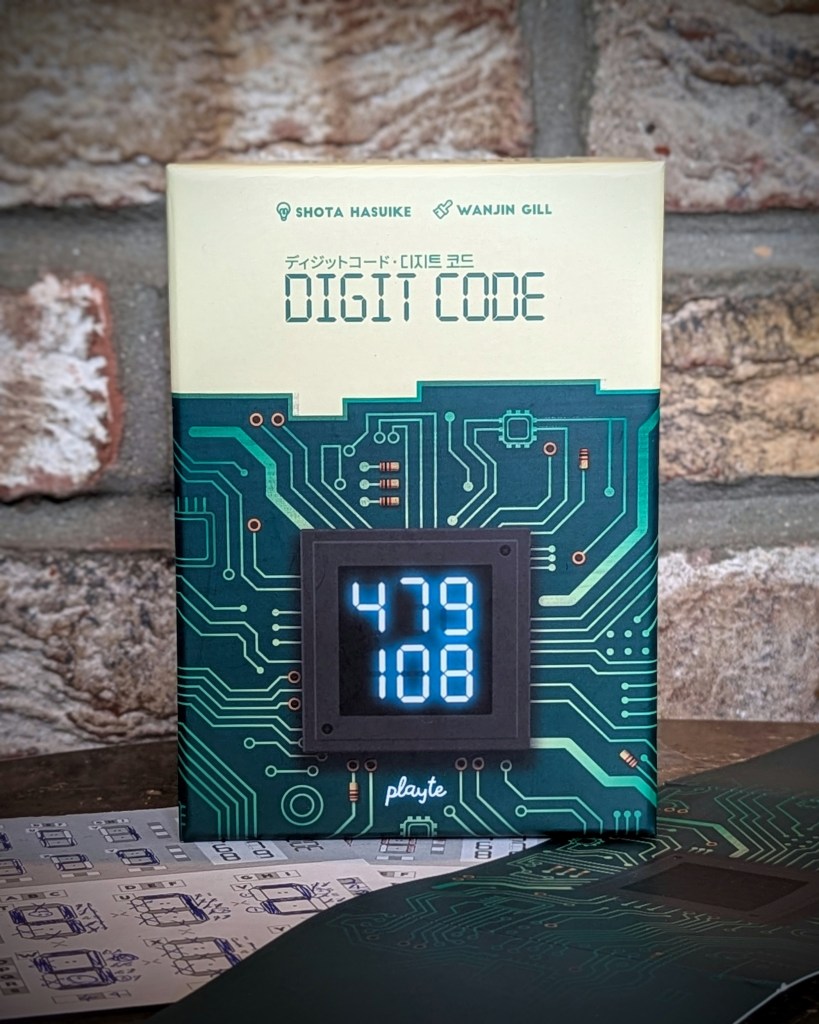
Gameplay overview:
In a 2-player game, each player secretly sets a 6-digit code (hidden behind a screen). Your job, should you choose to accept it, is to deduce your opponents code before they deduce yours, by asking them a specific set of questions.
But you don’t need to be good with numbers to decipher this code!
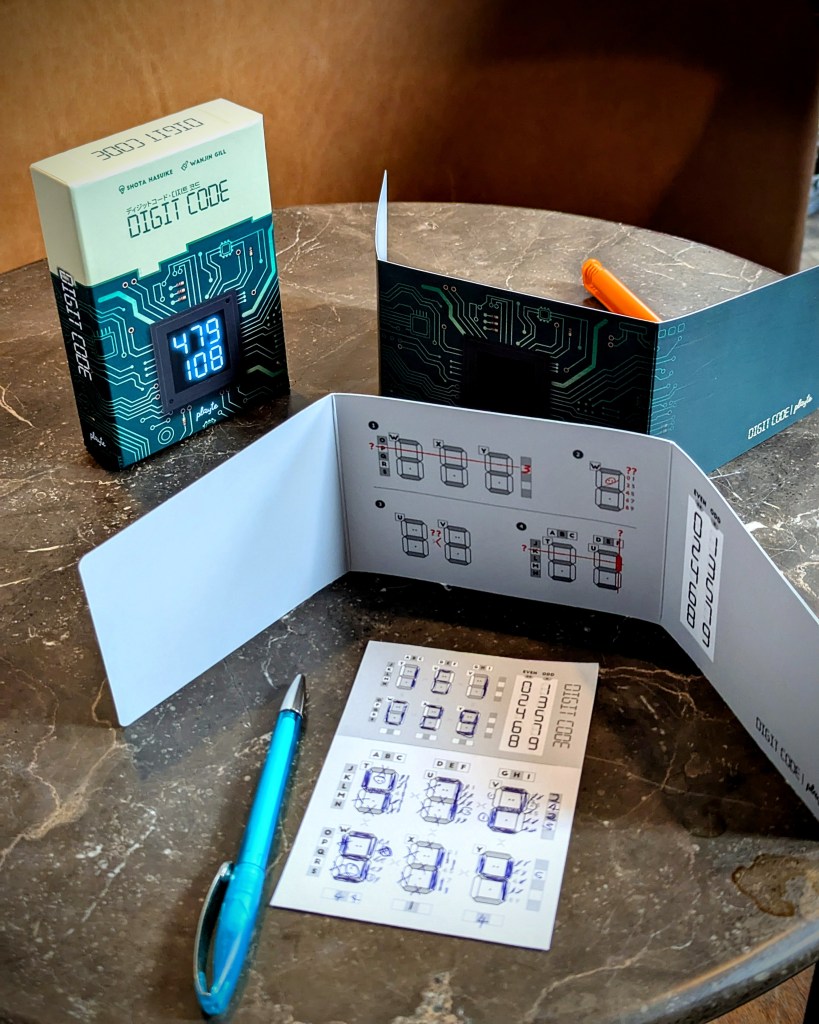
The numbers are in segmented format (the kind you see on a digital clock) in two rows of three. And the segments are separated into columns (labelled A to I) and rows (labelled J to N), with each number also having its own letter (T to Y).
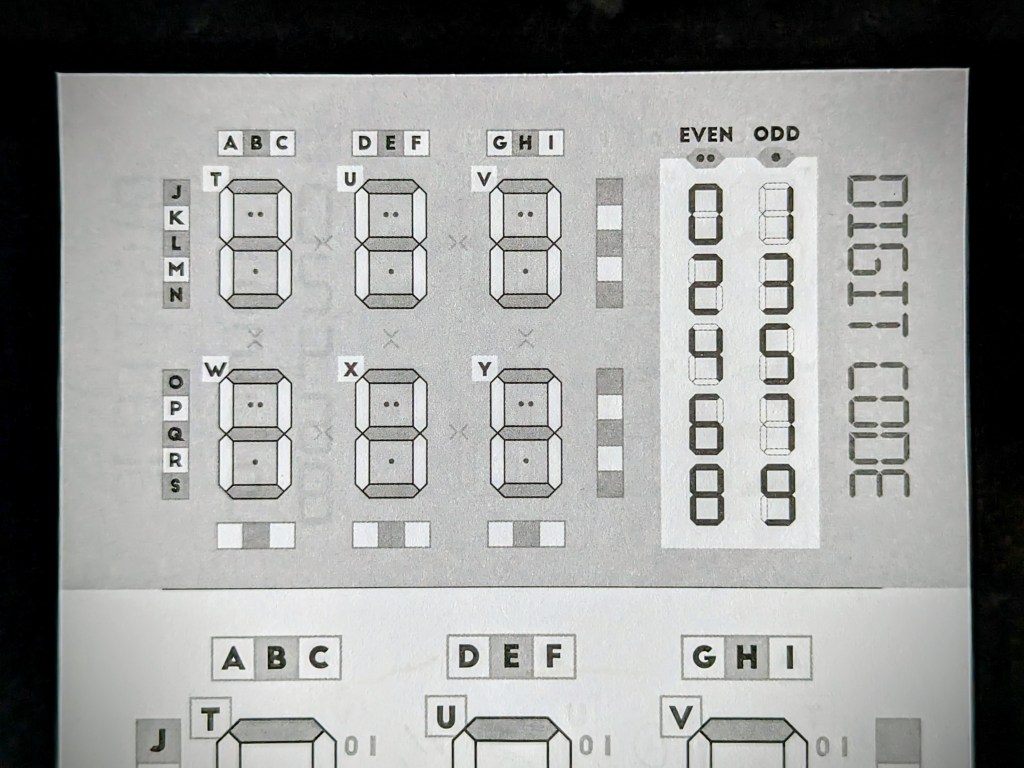
On your turn you can ask one of the following four questions:
- How many spaces in (this letter) row/column are filled?
- Is the number in (this letter) position odd or even?
- Which one is larger, (this letter) or (this letter)? (This can only be asked for two adjacent numbers)
- Is the space (column letter, row letter) filled?
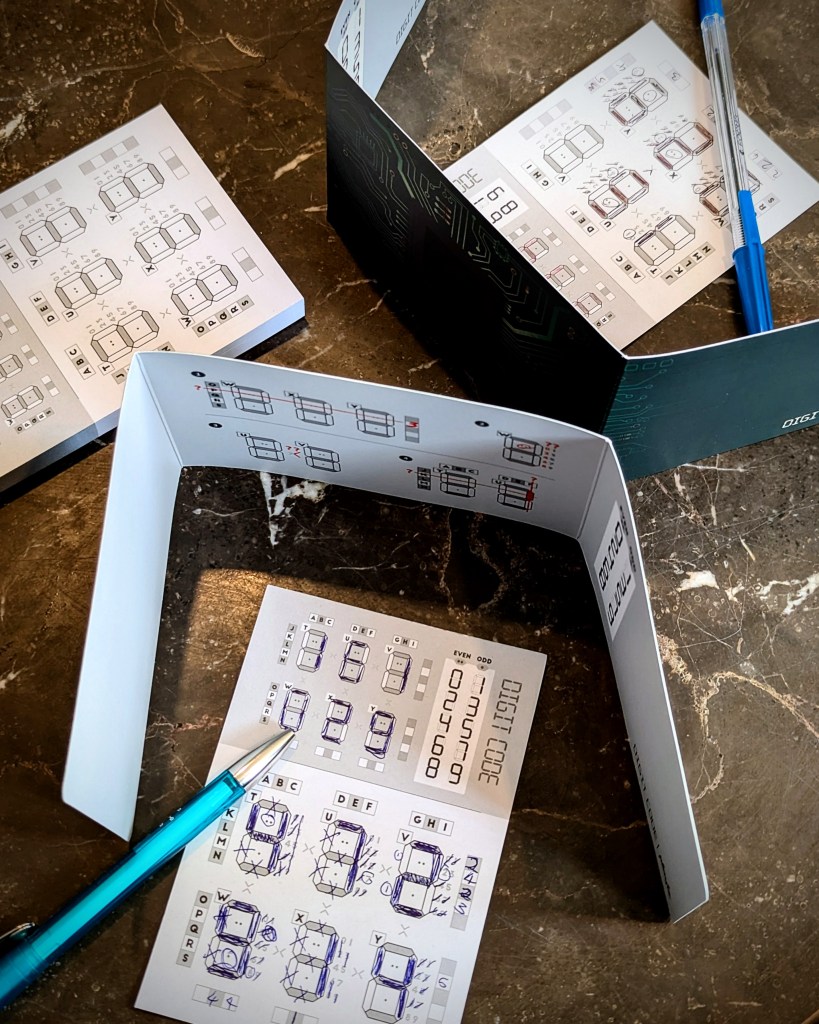
On your first turn, you ask each of these questions once each to get you going. But after that can only ask one question a turn, so choose wisely! Based on the answers you’re given, you have to try and deduce which segments are filled, which aren’t, and what the actual numbers are.
When you’re ready to guess, you can use a turn to ask the opposing player if you’re correct. If you are, you win! But if not, the game keeps going. Get the code wrong twice and you lose!
In a game with 3 players or more, one player is the code setter while the remaining players take turns to ask questions. The first person to crack the code wins.
Our thoughts:
Digit Code first caught my eye because I’m a big fan of deduction puzzles, so I’m always keen to try games that capture that puzzly essence. And it didn’t disappoint – Digit Code is a perfect tea time teaser that we enjoyed at the coffee shop. It’s a quick game fix that still gets the cogs turning. There’s a little downtime between turns while you’re waiting for them to puzzle it out, but it’s not a major issue (and you can plan your questions while you wait).
Even though you’re limited to ask certain questions, there’s still a lot of decision making involved in how and when you ask them, trying to plan future questions to deduce which segments are shaded and which aren’t. And ultimately, the digits they represent.
Digit Code is a perfect tea time teaser that we enjoyed at the coffee shop
Although advertised as 2 to 5 players, we do think that Digit Code is really only a 2-player game – which is what we’d want it for, so we’re happy with that. The rules for 3+ players just wouldn’t work: In a 3+ player game all the code guessers will hear the same questions and answers, so they will all have the exact same information – and I just don’t think this would work. In other games, you might all hear the questions, but you don’t necessarily all see the answer (e.g. where only the asker is given some new information), or there is always some information still hidden (like when you have some of the information private in your own hand). Everyone knowing everything just makes it a race for who puts the info together quickest without making a mistake, which doesn’t sound very satisfying to me. It might work as a 3 player cooperative experience, where one sets the code and the other 2 work together to solve it.
What we like:
- Logical deduction for 2 players (our usual player count)
- Quick but still brain burny and scratches that puzzle itch.
- Perfect portable puzzle game to take to the coffee shop or fit in over a lunch break.
Considerations:
- We don’t think the 3+ player rules would work well.
- There is some downtime between turns as the players process the new information.
Final verdict:
As a puzzle lover and deduction fan, Digit Code is right up my street. If you’re familiar with Hooky (and if you’re not, read our recent Hooky review here!), Digit Code feels like its lighter numerical-based sister. But, unlike Hooky, Digit Code can be played with 2 players and fits into a 30 minute lunch break. Both have a similar vibe but fit different game sesh scenarios, so I’m glad we have both on my puzzle-loving shelf.
Playte Games will be at UKGE on the Revelation Games stand 3-745. You can preorder their games at revelation-games.sumupstore.com/products

 Our Board Game Life
One thought on “Digit Code – Review”