
Advert: This game was gifted by Playte Games. All opinions are ours and our reviews are always honest.
RUN, FOREST, RUN!
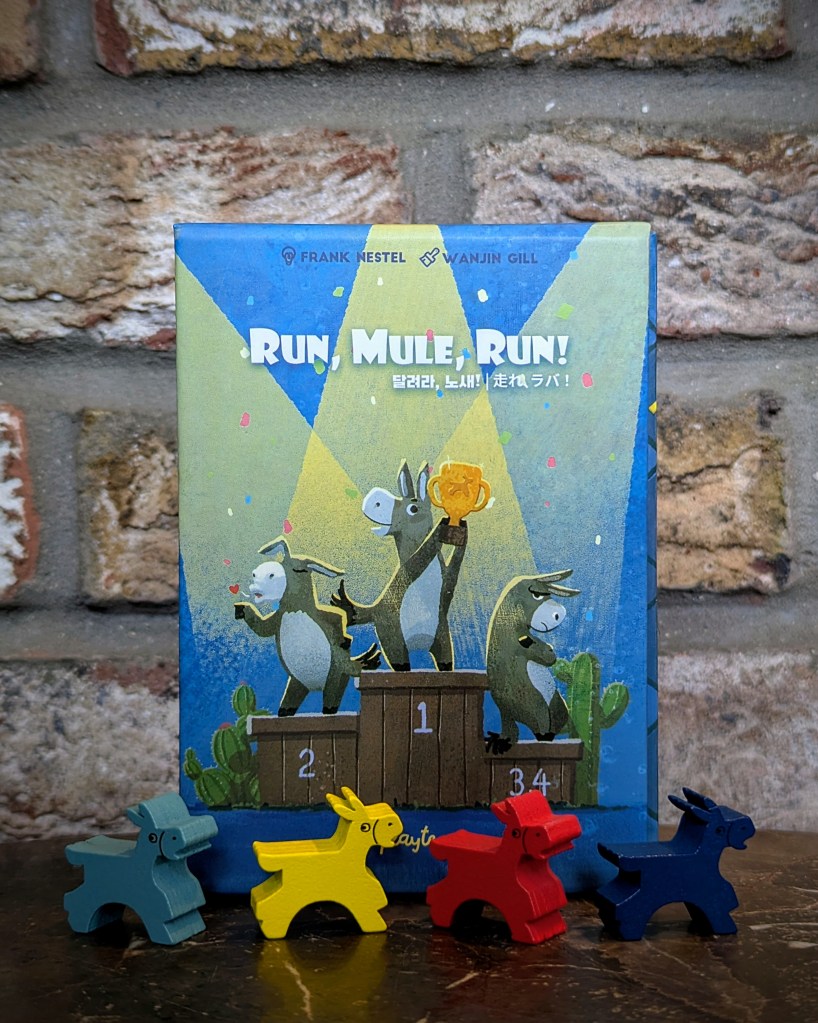
Wait no, that’s not right…today it’s Run, Mule, Run! that we’re reviewing today! Let’s jump straight into it.
👥 2 to 6 players
⌛ 15 minutes
🧠 8 years+
Gameplay overview:
Run, Mule, Run! is a 4-mule race where players compete to get the coloured mule they want to win across the finish line. Instead of each player owning a particular colour, who they want to win is determined by the secret betting cards in each players’ hand, which show different winning positions for the mules.
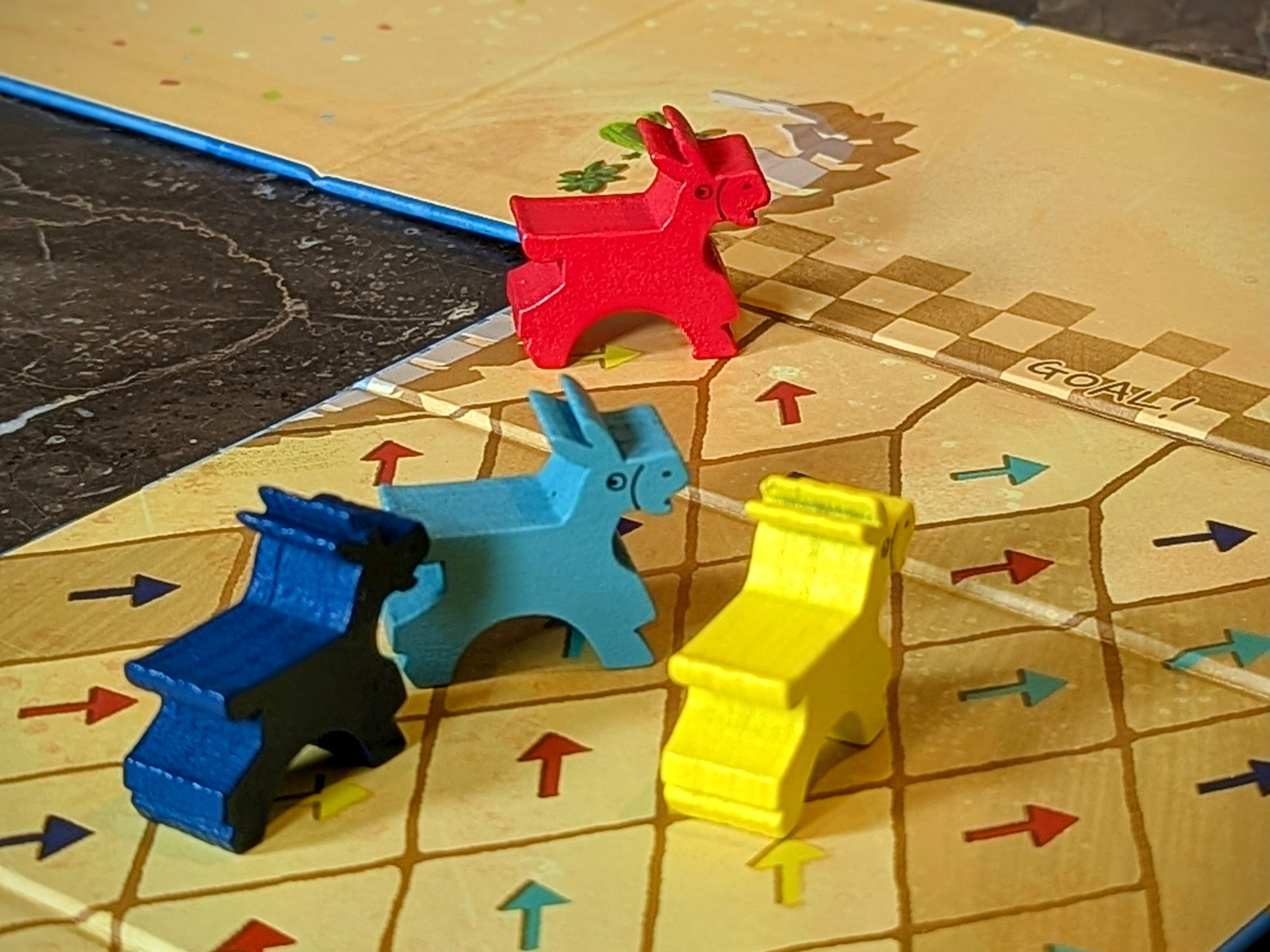
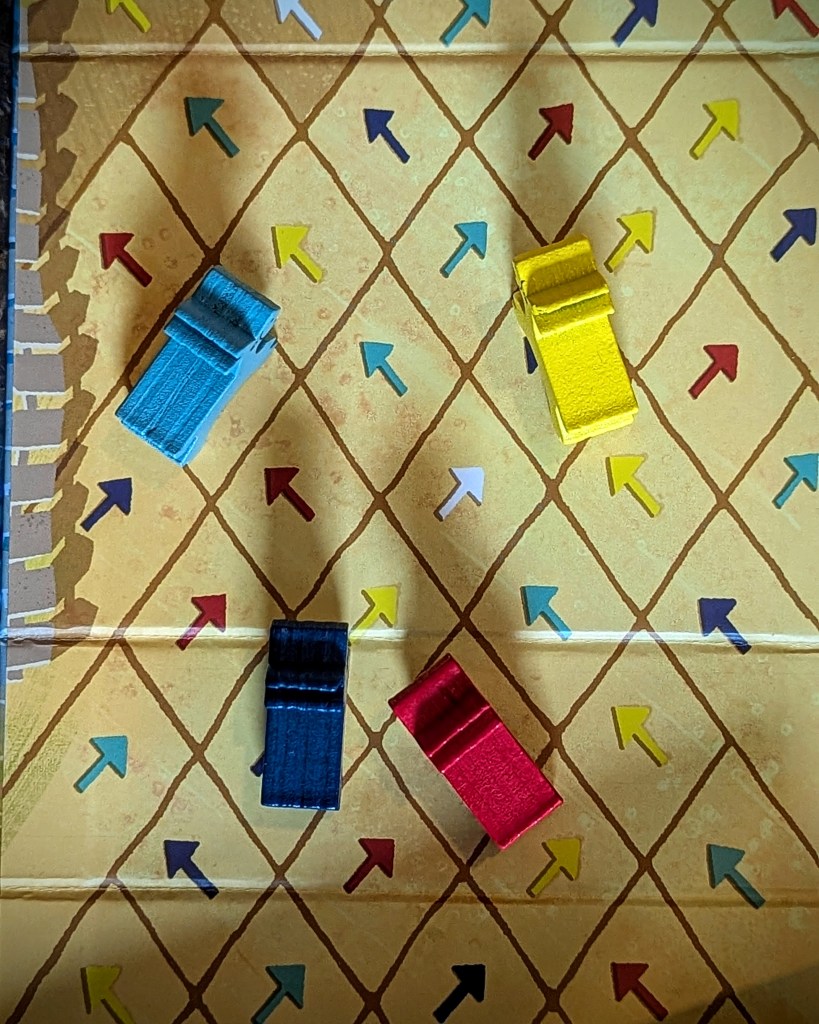
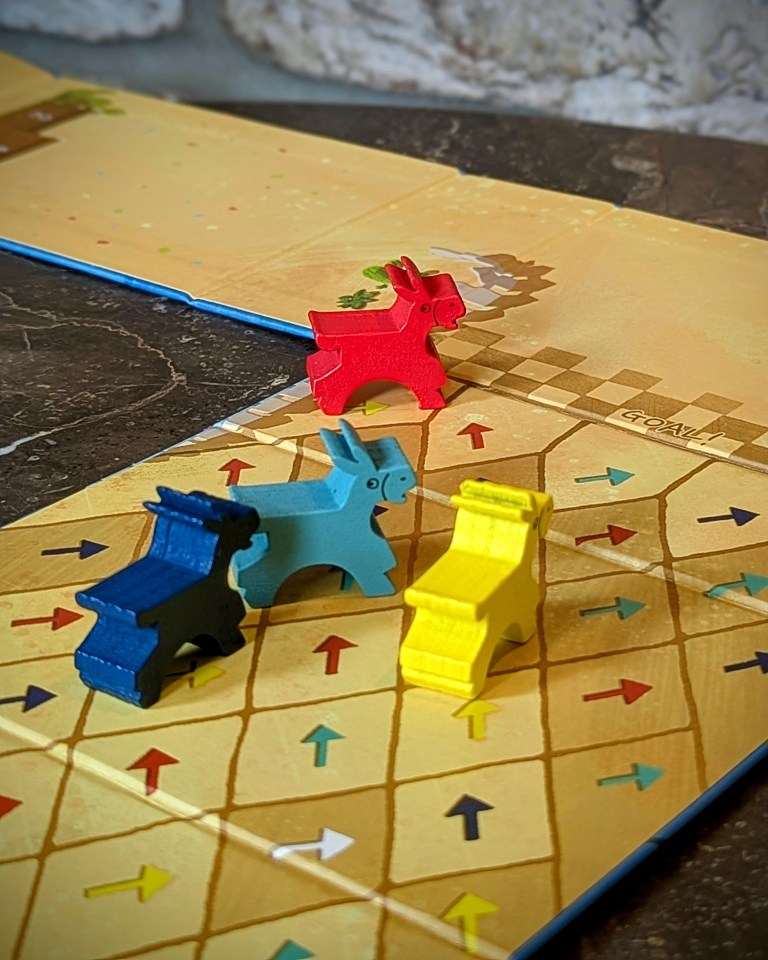
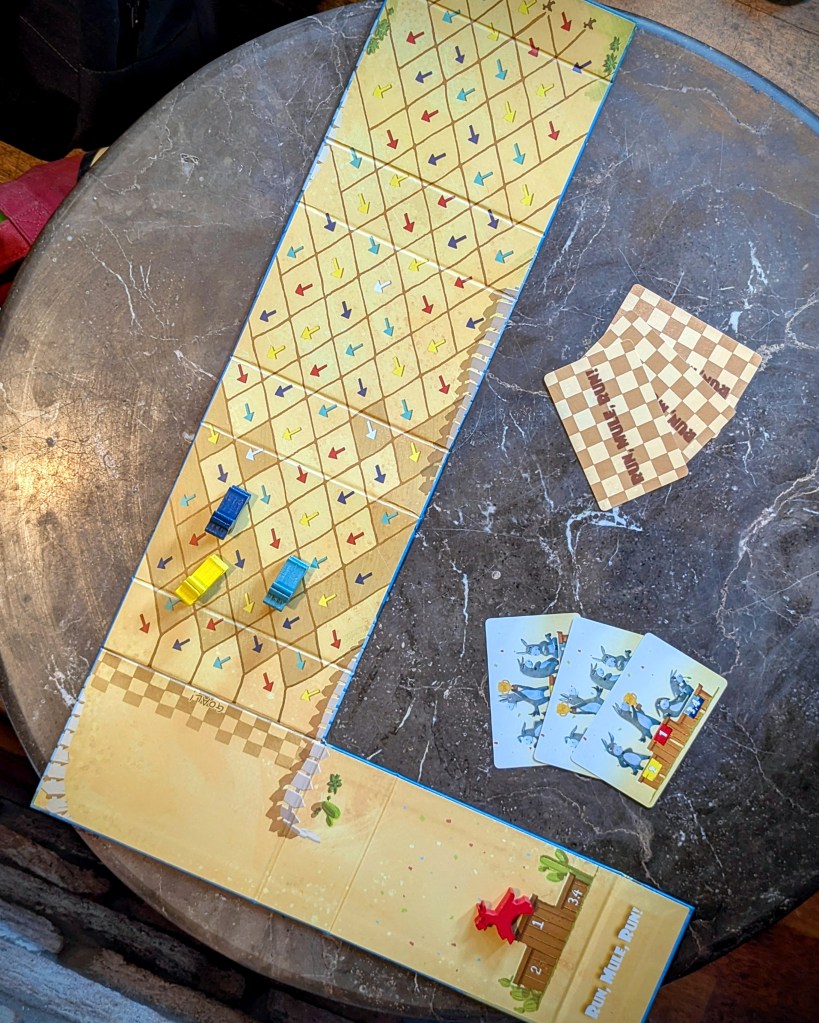
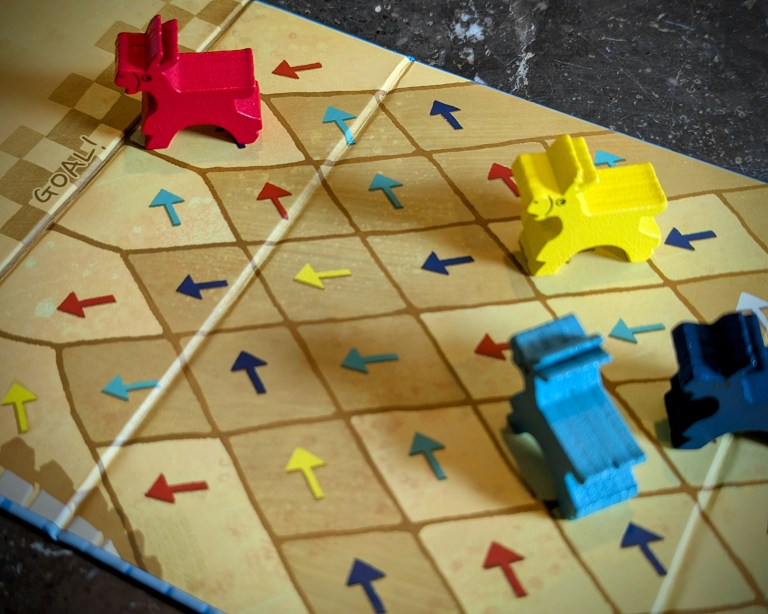
Each space on the board has a coloured arrow on it. On your turn, you can move any mule of your choice one space forward on the board – usually this is a choice of two spaces. This triggers a chain of movement: on the mule’s new space is a coloured arrow, telling you what mule to move next and in what direction. This mule is now on a new space, which tells you another colour mule to move. This continues until either a mule lands on an arrow of its own colour, or if a mule is blocking another mule’s movement.
Some spaces have white arrows – in this case you move the mule that is furthest behind. There’s also some darker spaces (called mud spaces). If a mule is on a mud space and you start your turn by moving this mule, you can choose to move it backwards instead of forwards. All the other chain movements go forwards like normal.
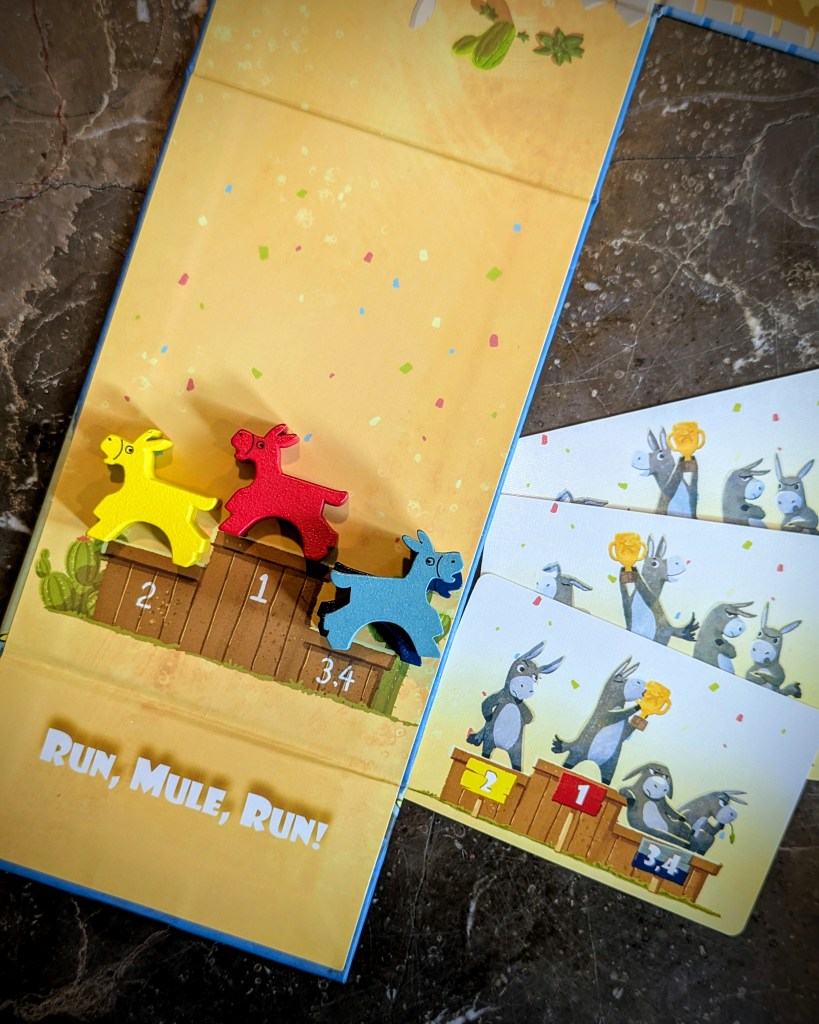
The game ends when 2 mules have crossed the finish lane. Then, players pick the best betting card from their hand and tot up points based on how closely their card matches race results:
- Matching the mule at 1st position is 3 points
- Matching 2nd position gets 1 point
- Having the 1st and 2nd mules switched is 2 points
- No points are awarded for position 3 and 4.
The player with the best score wins!
Our thoughts:
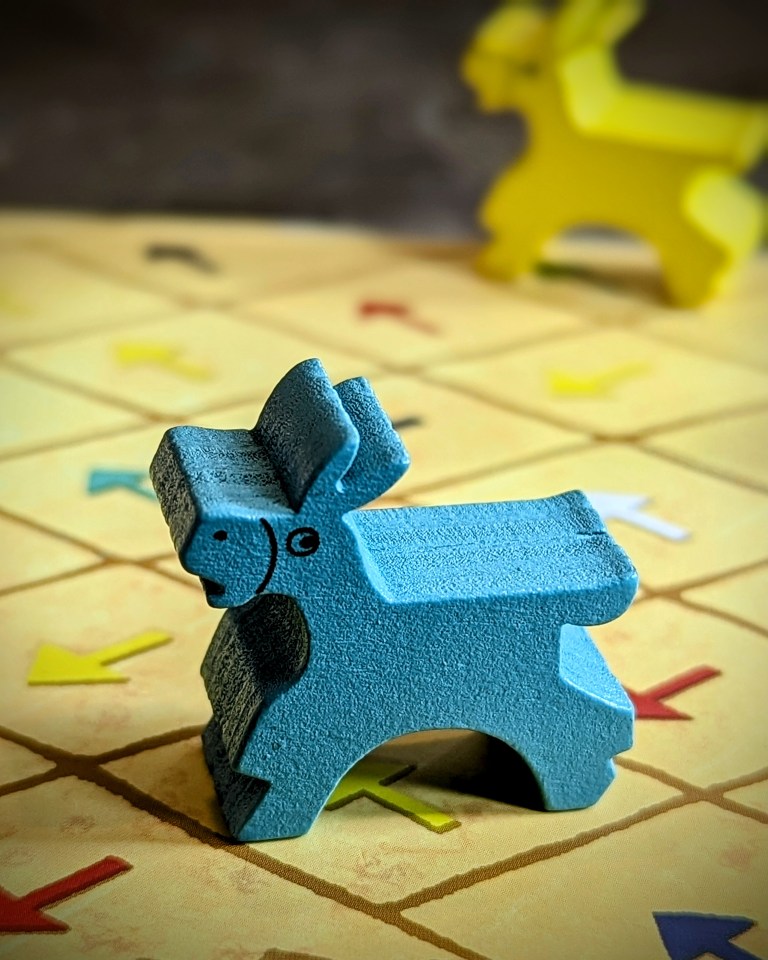
Our first impression of Run, Mule, Run! was the petite portable box that folded out to make the game board – apparently a unique feature for many Playte games! And for Run, Mule, Run! the board was double sided, so you have 2 racing tracks to choose from! The components in the box are minimal, but feel good quality – particularly the cute coloured mule meeples!
The game itself exceeded our expectations. I liked that the different coloured mules didn’t belong to a specific player, and that you could choose to move whichever you wanted – following the downstream consequences of course – to try and get the mules on your betting card across the finish line first. And you can strategise your routes if you want to, trying to map out the possible routes to victory – BUT in our opinion it’s much more fun to be a little bit silly and not think too far ahead. Getting a turn with a long chain of movements felt very satisfying – there are occasions where all 4 mules clog together and block each other, but we didn’t find it detracted from the game because of the lighthearted vibe.
You can strategise your routes if you want to, trying to map out the possible routes to victory – BUT in our opinion it’s much more fun to be a little bit silly and not think too far ahead.
The hidden betting cards add to the fun – you’re all working towards something slightly different and you don’t know if you and it can often be hard to figure out what other people’s goals are because of the randomness of the movement. Sometimes you’ll have similar objectives (like the same colour for 1st place) and not realise!
The number of betting cards you have in your hand depends on the player count – in a 2 player game you have the most, 4 cards. We found 4 cards too many, because there was a good chance you’d have enough variety in your hand to score well; in one of our games Matt had a betting card with each colour in 1st place, so winning was pretty much guaranteed. We tried playing with just 2 betting cards in hand (which is what would happen in a 5-6 player game) and we thought it worked better. Alternatively, if players wanted more control you could dealt out X number of cards, and players choose 2 to keep.
The rules book was clear enough with some minor translation quirks. The only thing that was missing was clarity on what happens if a mule was supposed to move off the board – when this happened in our games we decided it meant the current player’s movement ends.
What we like:
- Cute small box that folds out into the game board (a distinctive feature of many of Playte’s games).
- Controlling all the mules with a hidden winning order rather than having your own player token was the twist on the racing theme that made this game and a little chaotic.
- You CAN strategise to choose the best moves if you want to BUT it’s more fun to play a bit randomly.
- Chaining multiple moves in one turn is very satisfying.
- The hidden betting cards mean you don’t easily know which mules people want to win – it could be the same mule as you!
- It has a track on both sides of the board so you can mix it up.
Kids and adults alike will be entertained by the silly and ever-so-slightly chaotic nature of Run, Mule, Run!
Considerations:
- The number of betting cards in a 2-player game – 4 cards each – felt like too many with a high likelihood of getting a winning combo. We preferred to houserule 2 cards instead.
- The rules don’t specify what happens if an arrow would mean a mule moved off the board (we played it that it ends your movement/turn).
Final verdict:
Kids and adults alike will be entertained by the silly and ever-so-slightly chaotic nature of Run, Mule, Run! Overall it’s a lighthearted game – but you can put more brain into your moves if you like. This makes it a versatile game that could be played at many occasions and with a range of different people. We think this’ll be a good game to introduce to our toddler when he’s a bit older!
Playte Games will be at UKGE on the Revelation Games stand 3-745. You can preorder their games at revelation-games.sumupstore.com/products

 Our Board Game Life