

Did you ever wonder why the world has seasons? If you think it’s to do with the angle of the Earth as it rotates around the Sun then you would be WRONG! That’s fake news! If you weren’t blinded by science, you’d know that in Gnomic lore it’s actually because the Ice God and Fire God are perpetually playing OrthoGnomes, and whoever is winning affects the temperature of the world. Well, if it’s good enough for the Gods then it’s good enough for us… let’s play OrthoGnomes by PhantomLab Games.
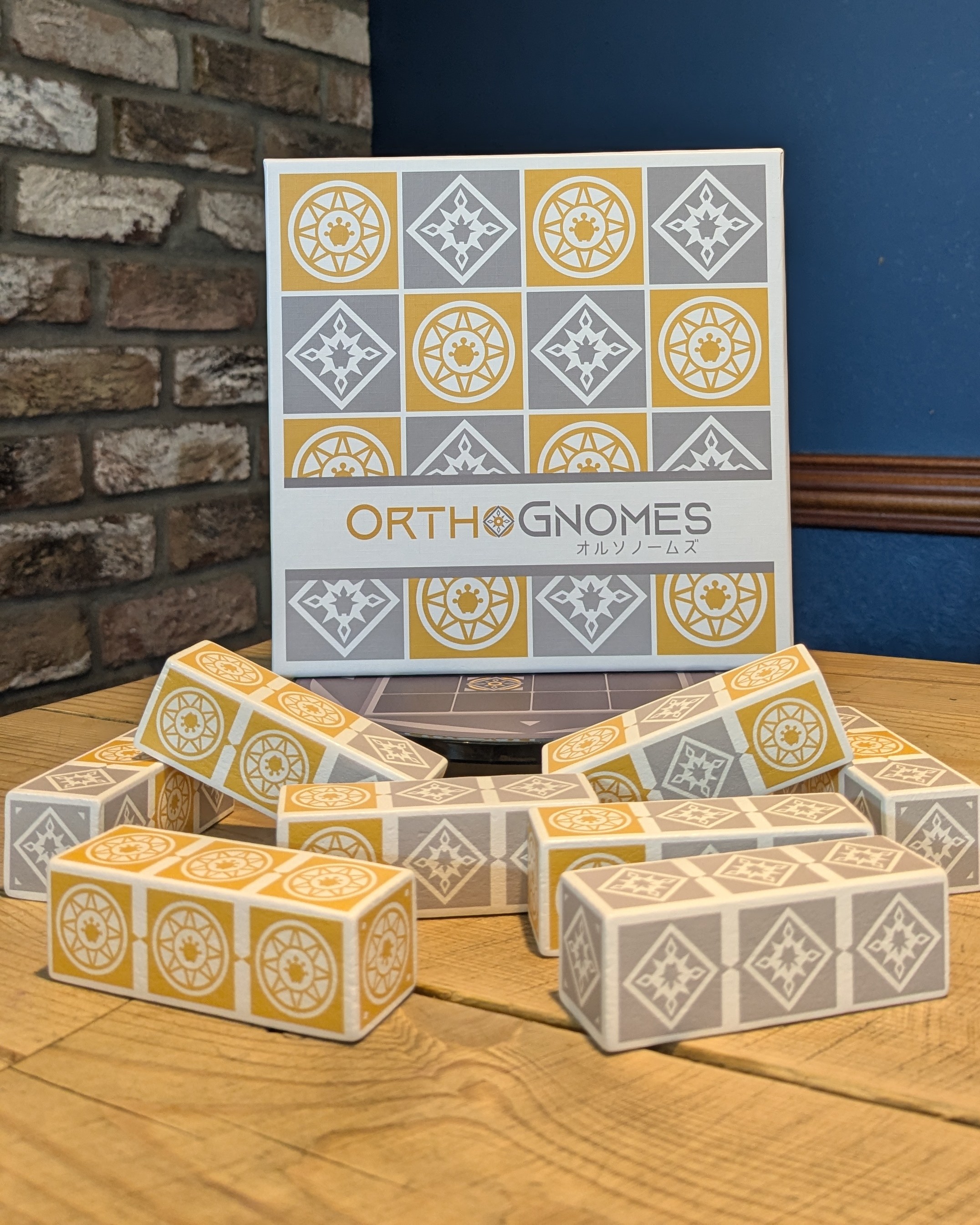
Gameplay overview:
👥 1-2 players
⌛ 15 minutes
🧠 8 years+
In OrthoGnomes you take the role of either the Fire God or Ice God and take turns to play blocks onto the board. The blocks have a mix of two symbols (orange for the Fire God and grey for the Ice God) and your aim is to create lines of 4 of your own symbols. Lines can be orthogonal and diagonal. You play over two rounds so both Gods get a turn at being first. Simples, am I right?
Not quite! A God’s Job would never be that easy:
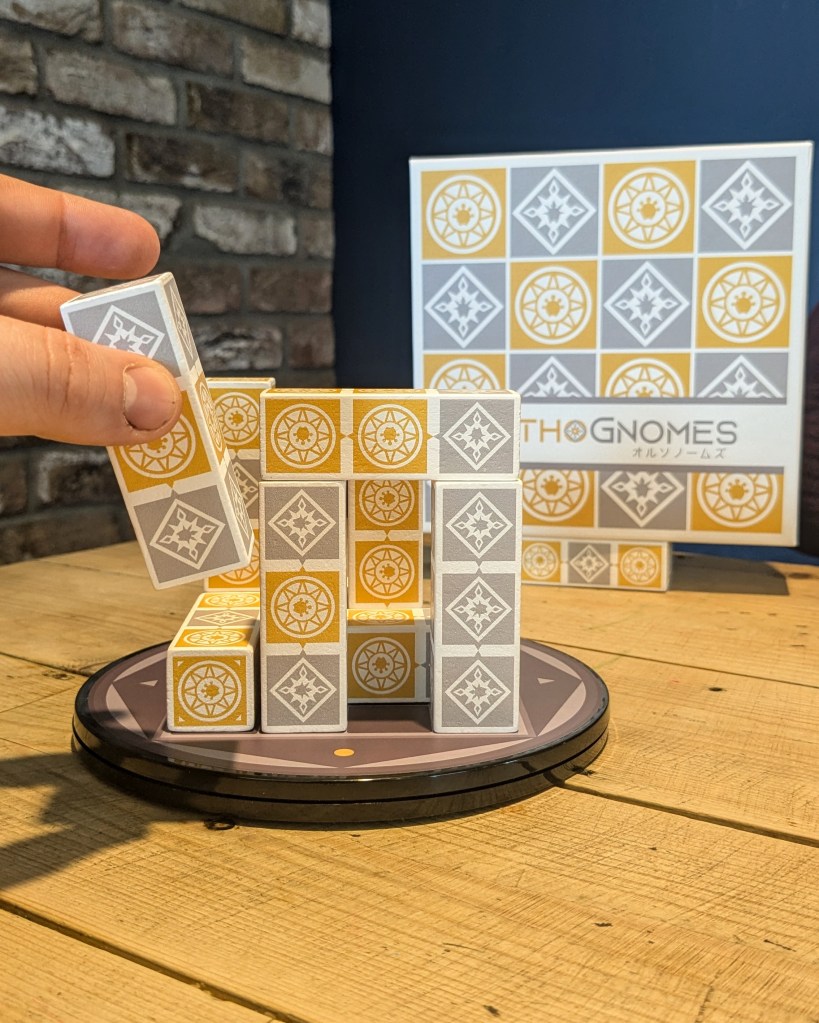
- You must play your blocks within the boundaries of a 4 by 4 grid, but there;s no upper boundary so blocks can stack as high as you want.
- Every block must be placed onto the board at a 90 degree angle from one of the previously placed blocks. Parallel placement is not allowed.
- If the tower of blocks falls then the player who caused it to collapse loses the round.
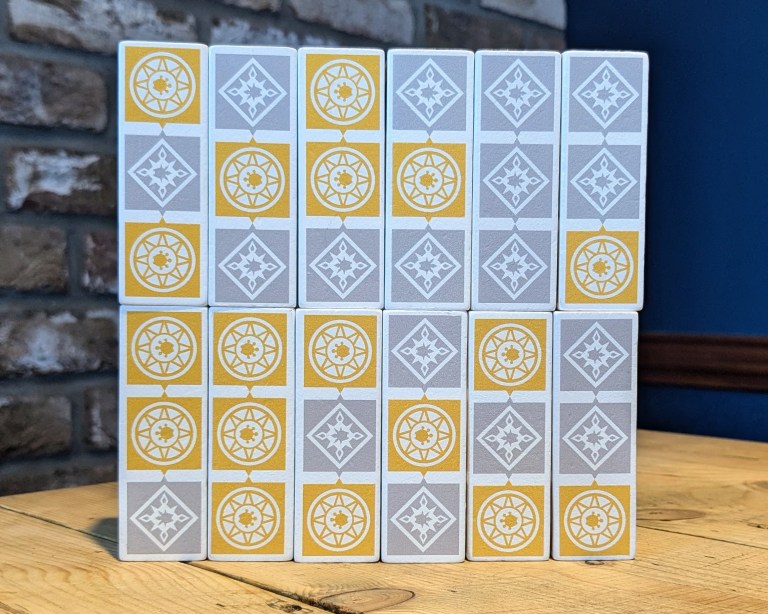
When both players have played all their blocks it’s time to score up. For scoring, you consider each visible side of the board separately and look for lines of 4 connected symbols. When looking for lines you ignore depth, and just look at each side head on and score what you see. Each line of 4 is worth 1 point.
Solo mode:
In the solo mode, you pick a player colour. Then you draw 1 of the 12 blocks at random (e.g. from a bag or the box) and place it on the board. You repeat this until all 12 blocks have been placed. You only score for the sets of 4 for the colour you chose at the start. The aim of the solo game is for you to beat your highscore.

Our Thoughts
When the game arrived I was immediately attracted to the clean, sleek, and simple design on the box. This simple aesthetic is carried through to the tactile blocks. The rotating ‘Lazy Susan’ style game board is a brilliant addition, it’s really useful as you need to see all slides of the board to plan the best placements.
OrthoGnomes is one of those truly abstract games which takes a few moments to learn but lifetimes to master. It will take time to learn the best strategies and tactics to be truly competent at the game. The gameplay is a real brain burner because you have to visualise the board in 3 dimensions and decide the best way to play your blocks to benefit yourself and hinder (or block!) your opponent. Being dyslexic, I’m a 3D thinker so didn’t find the visualisation of the board overly challenging but others who are not 3D thinkers (such as Lauren) may have an innate disadvantage in this game. That’s not to say I found the game easy, I didn’t.
OrthoGnomes is one of those truly abstract games which takes a few moments to learn but lifetimes to master.
Whilst I really enjoyed this game Lauren found it tough to visualise the 3D multi-depth placements and think about the long game (you do need to plan multiple moves ahead). This isn’t something she finds easy or particularly enjoys (it’s why she doesn’t like Chess or Hive). It’s a shame that my mum wasn’t visiting when OrthoGnomes arrived at our house for review when it did, because I truly would have loved to get this to the table with her – like me she loves these sort of games and I think we would have some really good brain battles!
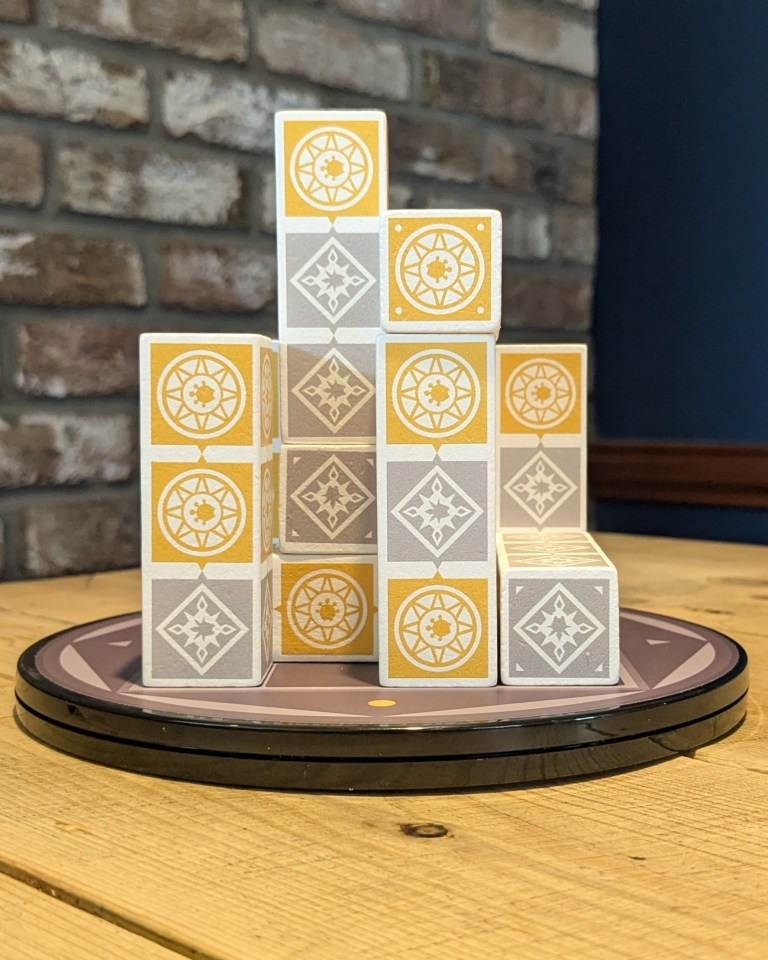
We say this quite a lot in our reviews, but we do a significant proportion of our gaming sessions out in the wild (at our local coffee shop) so we like portable games. OrthoGnomes is a very portable game, with a relatively small box (similar-ish to 7 Wonders Duel) and limited game components which are of a size that you are unlikely to lose them!
One challenge we found with this one when playing it out in the wild was when playing it on a low table it can be hard to line things up properly and you need to bring your head down to truly see if you have properly lined up sets.
The rotating game board is essential to play this game effectively and a really great design choice but there are some aspects I would have liked to see improved. You have to rotate it very carefully or the blocks can move. I know toppling is part of the gameplay, but I don’t think that was the intention. I would have also liked each side to have been numbered or named (1,2,3,4 or North, East, South and West) which would help keep track during final scoring. The version we played had a yellow spot to indicate a ‘starting’ side for scoring, but I would have preferred a unique indicator for each side.
OrthoGnomes is a sleekly designed tactile abstract game that feels like 3 dimensional Connect 4.
Finally, the solo mode provides a slightly different puzzle because you need to place all the blocks yourself in a way to benefit just your chosen colour. But it felt a little bit like an afterthought. It would have been nice for the designer to include some achievements, or something for you to compare your score against (that isn’t just your own highscore). It was definitely more enjoyable as a two player game.
What we like:
- Sleek, simple aesthetic with tactile blocks.
- We loved the ‘lazy Susan’ game board.
- Portable and a small table footprint, making it easy to play out in the wild at coffee shops or pubs
- I loved that it was a real brainburner, but with a tactile edge as you are stacking blocks.
Considerations:
- The solo mode is a bit basic.
- It’s truly abstract, and that brain-burny feeling may not be ideal for some – especially those who struggle with spatial 3D thinking.
- I would have liked to see each face of the game board to be labelled to help with final scoring.
Final verdict:
OrthoGnomes is a sleekly designed tactile abstract game that feels like 3 dimensional Connect 4. If you like a brain-burny abstract game then this one could be for you, especially if you welcome the challenge of trying to visualise 3D shapes. OrthoGnomes might not have been for Lauren, but I loved the balance of building something up on the table whilst also trying to create scoring lines.
——————————————————————————————————————–
This game was kindly loaned by Phantom Lab Games via the UK Board Game Review Circle. All opinions are ours and our reviews are always honest. Our version was a prototype which did not include all the components, for example scoresheets and the block bag, so we weren’t able to comment or show those.

 Our Board Game Life
One thought on “OrthoGnomes – Review”