
I’m seeing stars, and spots, and diamonds, and…plus signs? I guess it’s because we’re reviewing the matchy matchy game Bloxo today!
Gameplay overview:
👥 2 to 4 players
⌛ 10-20 minutes
🧠 4 years+
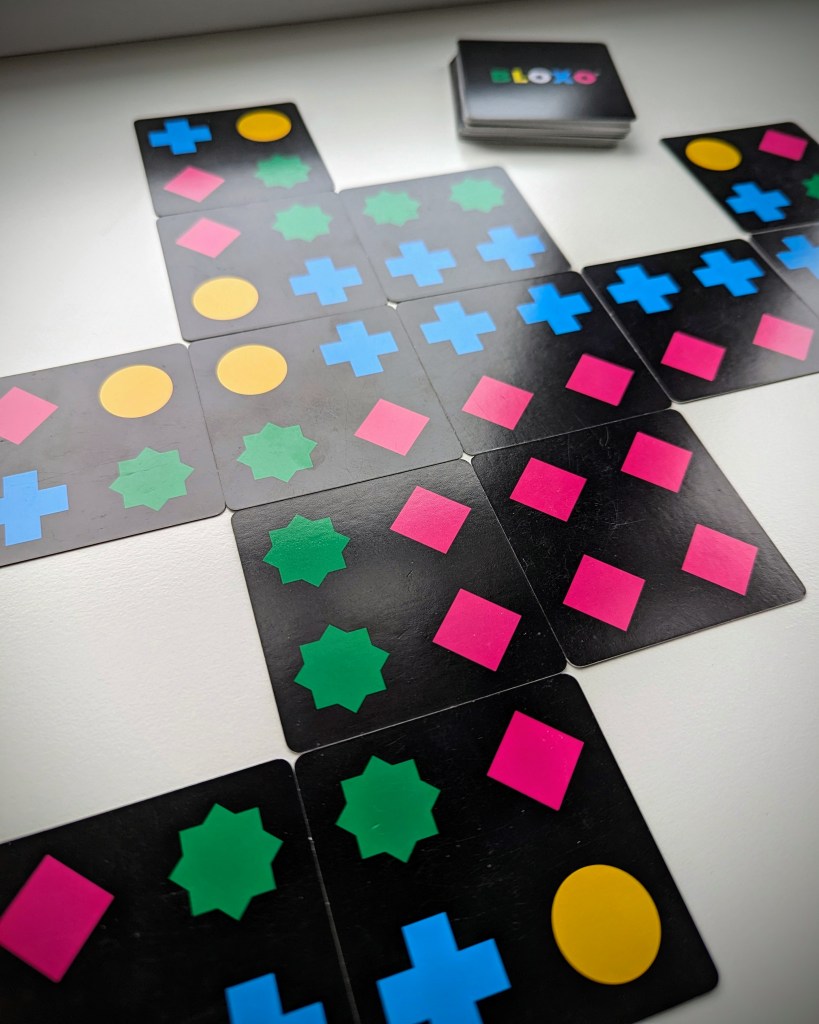
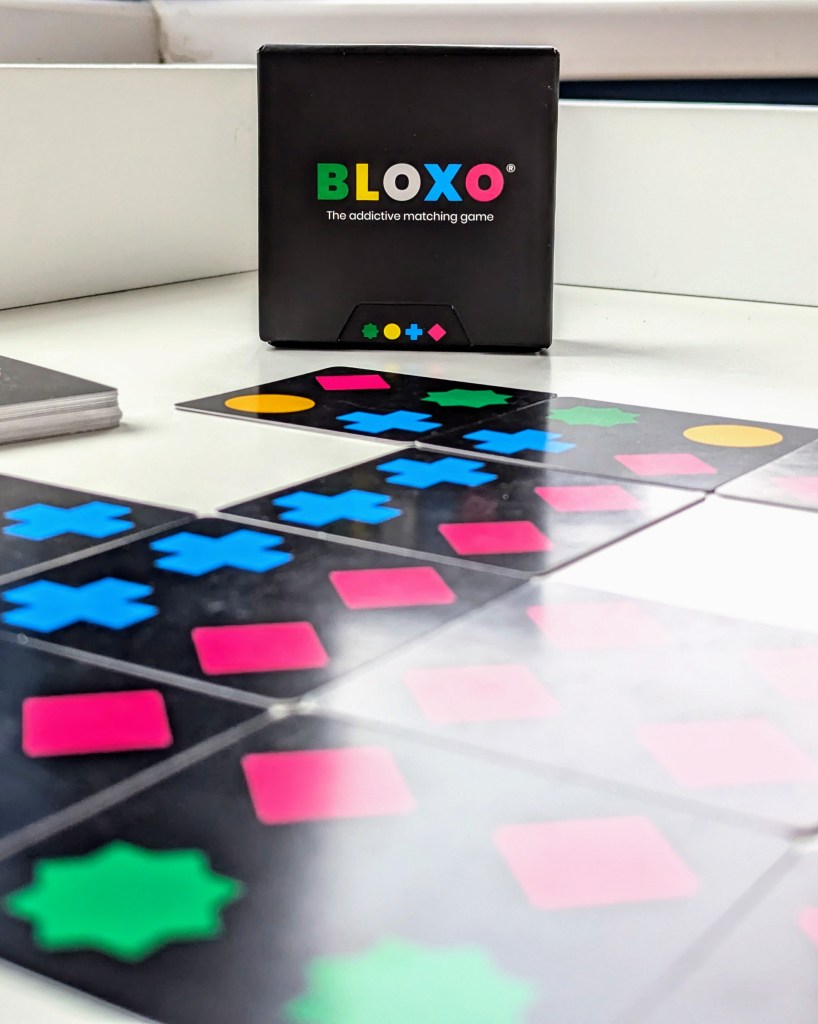
Bloxo is a super simple game – players take turns playing cards from their hand (of 6) to the central play area. When placing a card, it has to be placed directly adjacent to at least one other card, and the symbols on the touching sides have to match. And that’s it!
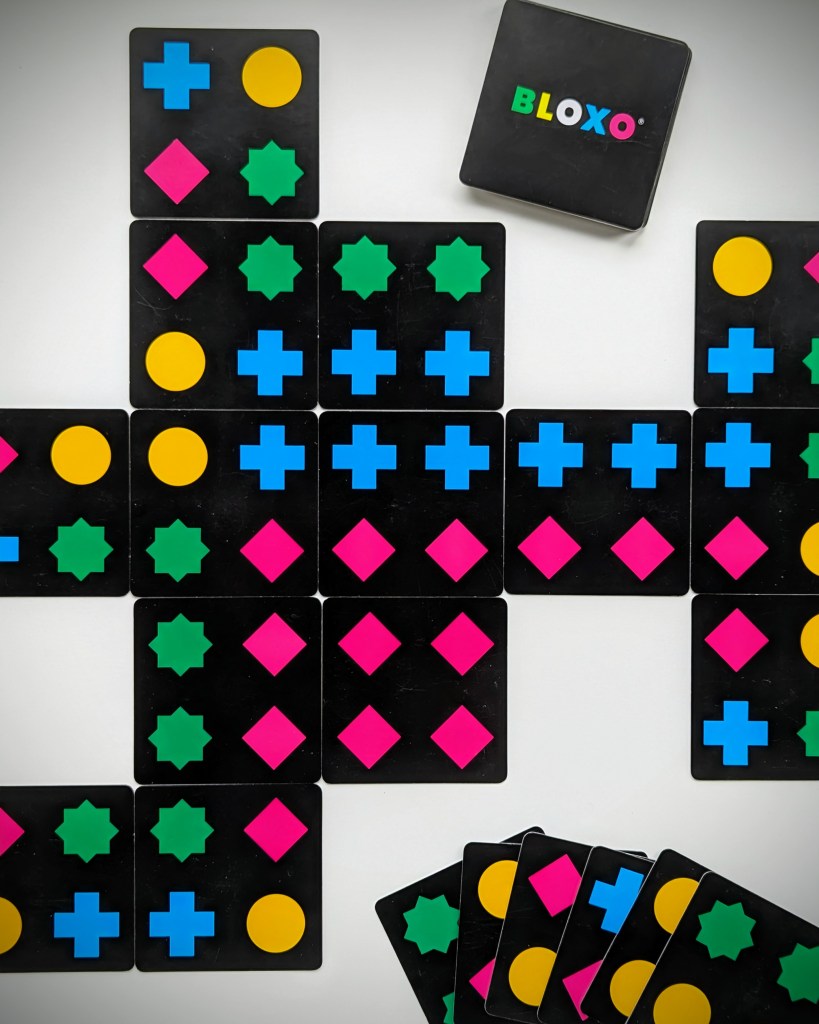
You score points for all the symbols in the ‘blocks’ you match to, and each symbol is worth 1 point. For example, if there’s already a block of 6 circles together, and you place a matching side of your card with 2 more circles with your card, you score 8 points! Wahoo!
So, the best ways to score big are by playing a card that matches against a big block of symbols, and/or matching multiple sides to other cards to score as many different ‘blocks’ as possible.
Alternatively, if you can’t (or don’t want to) play a card, you can choose to discard a card instead – but you lose 4 points if you do!
The game ends when the deck runs out and all players have played their last card, or no one can play a card. Whoever has the most points wins!
Our thoughts:
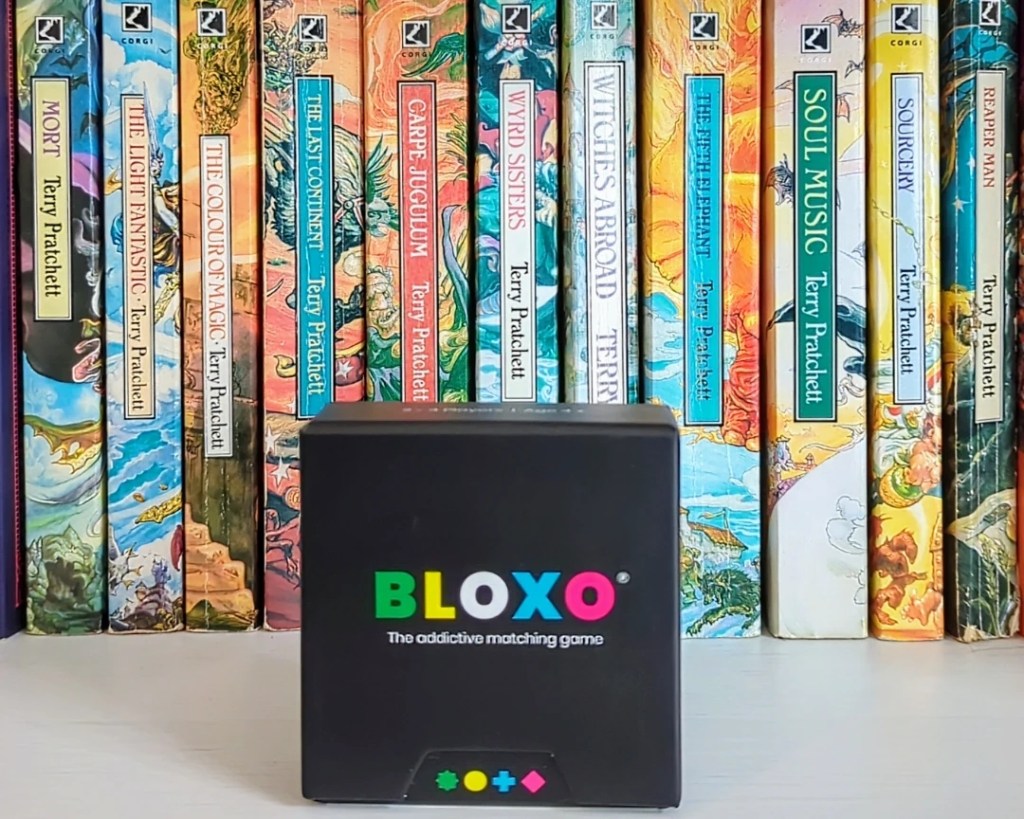
Great things come in small packages, and Bloxo is the smallest, cutest game we’ve come across yet! It’s super portable and would fit in the smallest of handbags. The game itself can spread out a bit though, so you still need decent table space (we managed to squeeze onto the tables of our local Nero, but it was a push!).
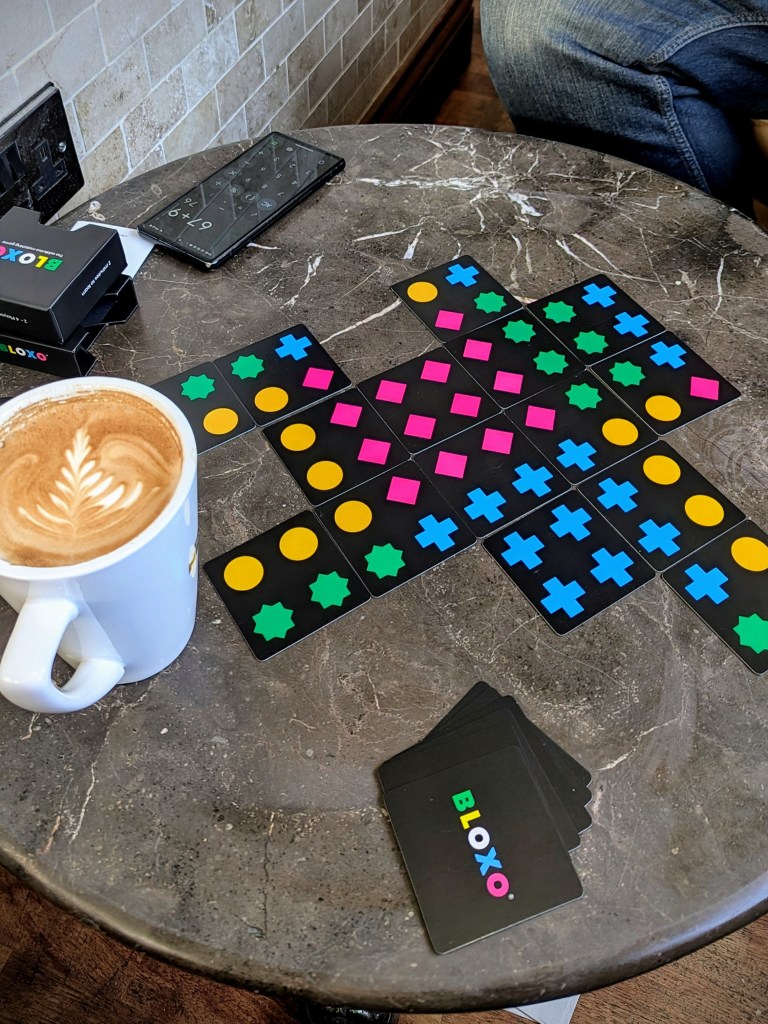

The bright symbols on black background and shape matching gameplay makes it feel like Qwirkle’s much simpler sibling (another game we enjoy). We really liked the spatial puzzle of finding the best placement for our cards to score the most points (or stop other players from scoring points). We’ve also played a lot of Bloxo with Matt’s mum, who has a preference for lighter abstract games – and she absolutely LOVED it.
Learning, teaching and playing Bloxo is super simple, making it a really accessible game for younger gamers or casual gamers. Although it’s not specifically advertised as a children’s game, we can see it working really well for families with young children. And there’s still enough there as an adult to make the game enjoyable. For example, we particularly enjoyed the decision of whether to block off big scoring opportunities now to stop other players using it, or to keep it open in case you draw the right card to score big later on. Or whether it’s better to risk holding on to cards with multiple of the same symbol until there’s a big scoring opportunity, when leaving it too late might mean you can’t place it at all. My only criticism with learning the game was that the otherwise simple and clear rulebook didn’t actually say that players should draw back up to 6 cards at the end of their turn – maybe it’s obvious that you would, but I’m a silly billy who got a bit confused by it.
We particularly enjoyed the decision of whether to block off big scoring opportunities now to stop other players using it, or to keep it open in case you draw the right card to score big later on.
Lady luck is obviously a factor in this game, but it’s such a quick lighthearted game that we didn’t feel put out if the luck wasn’t in our favour – and again, identifying the best moves for your cards can make a difference in how well you score. BUT we did seem to notice a trend that once one person gained a bit of a lead, it was very very unlikely that the other players were able to catch up or overtake. It also feels a bit unfair to lose 4 points if you can’t place a card – not only do you lose a turn, an opportunity to score anything, but you get extra punishment on top. Some people might find these aspects frustrating, especially when the cards you have to work with are out of your control.
Finally, we want to touch on scoring. In similar games there is somewhat of a cap on the points you score – like in Qwirkle where you usually score a max 12 points in one turn. In Bloxo points can accumulate quickly, so pen & paper scoring can be a bit faffy and having a tool to track player scores is helpful. Bloxo does have an app, but at the moment it’s Apple only, so as Android users we weren’t able to test it out (apparently they are planning on it being available on Android but have hit some issues with getting it onto Google Play). In our games, each player tallied their own scores in their phone calculators, which worked fine…it just wasn’t ideal having all the phones out, and this wouldn’t work if you were playing with young children who didn’t have their own calculator.
Bloxo is a light, quick, pocket game that is super easy to learn, super simple to teach, and super fun to play!
Bloxo is available on BGA, and after playing it on both BGA and in real life, we wouldn’t really recommend it on BGA unless you were using it to learn the game. A big part of Bloxo is trying to figure out the best placement for a card, and BGA does that work for you, which we felt took a bit of the fun out of it (and may make people feel more meh about it than if they played Bloxo in person). Use it to get an idea of the game if you need to, but if you already think the game sounds good then we do recommend trying it in person.
What we like:
- Cute, portable packaging. It’s a great option for out and about (but needs a bit of table space).
- Nice design with the bright shapes on black background.
- The speed of games and abstract spatial card placement was fun and very moreish – it was very easy to have more than one game in a row.
- Accessible game – simple to learn and play, easy for new/younger/older players.
- Particularly good for kids (or adults that don’t like a lot of rules). There are some light tactical choices that make it a game adults can also enjoy.
What we don’t like:
- The rulebook is missing a key rule – it doesn’t specify to draw back up.
- In our experience, once a player had the lead it was hard for other players to do anything about it. Some players may find this frustrating when your hand is down to luck.
- Losing 4 points if you can’t play feels unnecessarily punishing when you’re already missing a turn (and therefore missing scoring opportunities), especially when it’s hard to catch up if you’re already behind.
- Scoring without the app is faffy (but not the end of the world).
- The BGA implementation isn’t as fun, but could be useful to learn the game.
Final verdict:
We love abstract games, puzzly games and tile placement games, and Bloxo ticks all those bloxes.
Bloxo is a light, quick, pocket game that is super easy to learn, super simple to teach, and super fun to play! If you aren’t a fan of luck limiting your tactical options, this one isn’t for you. But we enjoyed it, it was nice to play something that Matt’s mum really enjoys too, and I can imagine playing Bloxo with our toddler when he’s a few years older (it reminds me of another game I’ve played with my niece: Shuffle My Little Pony card game). We love abstract games, puzzly games and tile placement games, and Bloxo ticks all those bloxes.
This game was kindly loaned by Bloxo via the UK Board Game Review Circle. All opinions are ours and our reviews are always honest.

 Our Board Game Life