
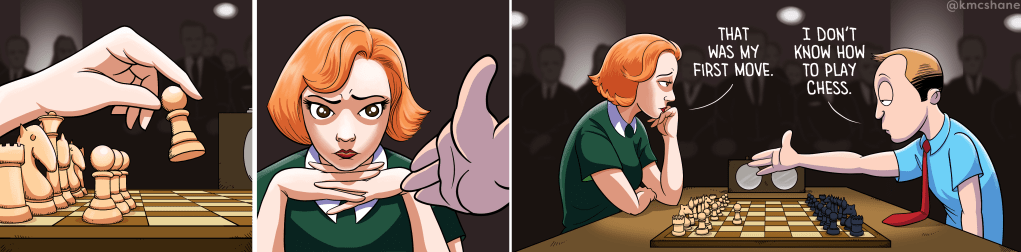
(credit: Kevin Comics)
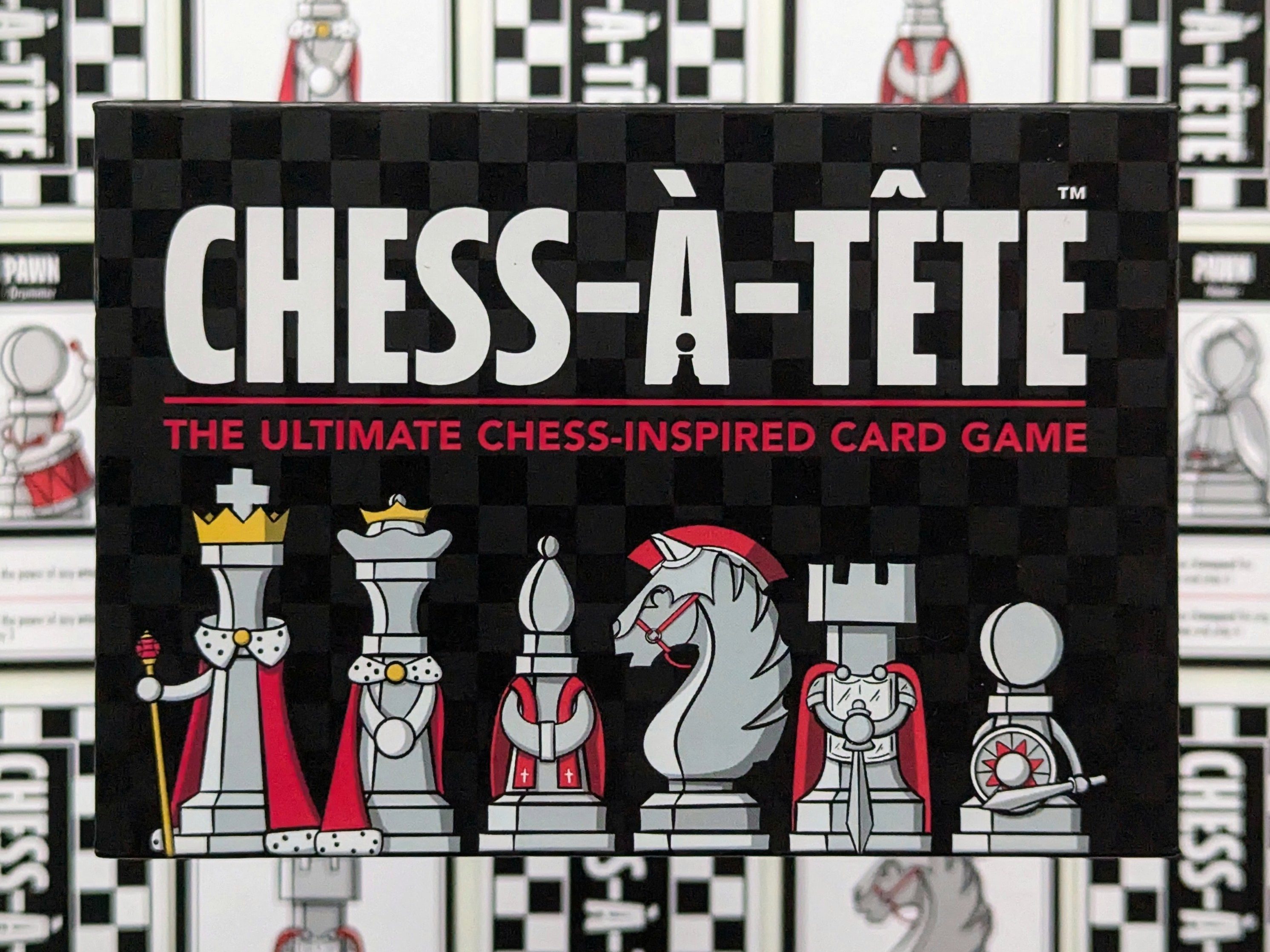
It’s not groundhog day, you’ve seen us review Chess-à-Tête before. This second edition, also called the ‘classic edition’, is the shiny successor to the original and coming to Kickstarter very soon! (next week in fact!).
👥 2 players
⌛ 15 to 45 minutes
🧠 14 years+
Gameplay:
If you’ve played the first edition of Chess-à-Tête, gameplay is pretty similar. Each player starts with a deck of identical cards (one white, one black), a King card already in play in their ‘Board’ area in front of them, and 7 cards in their hand. On your turn, you can play up to 3 cards, which could be:
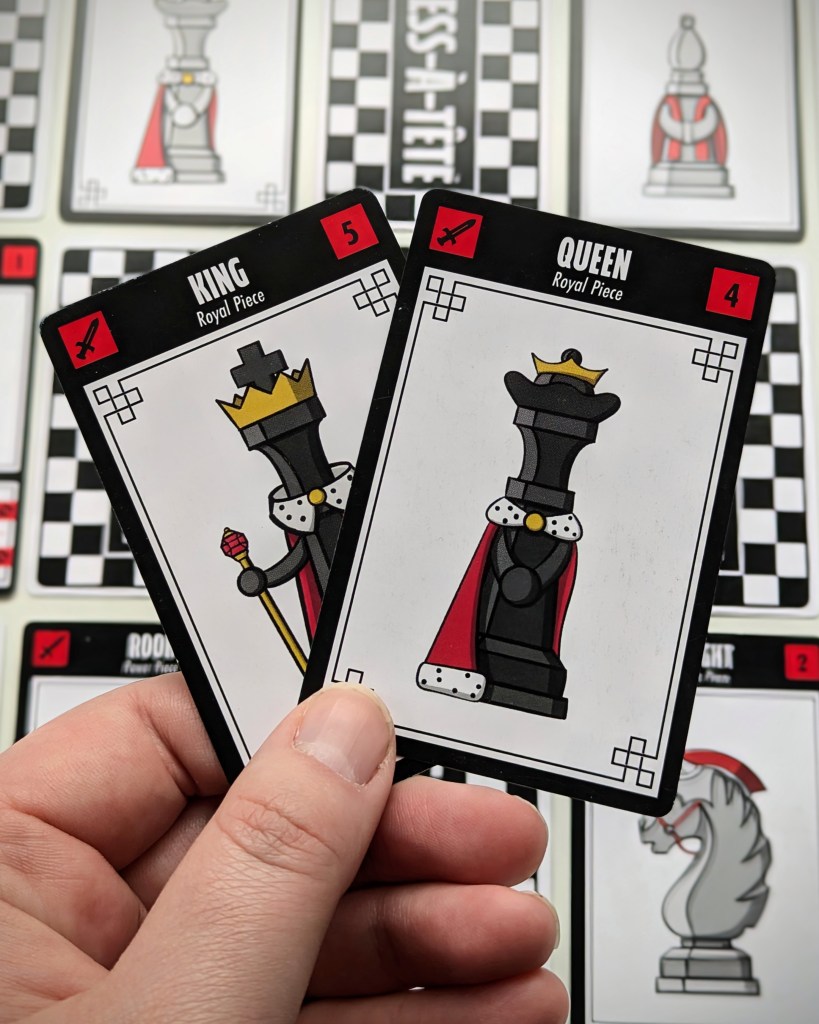
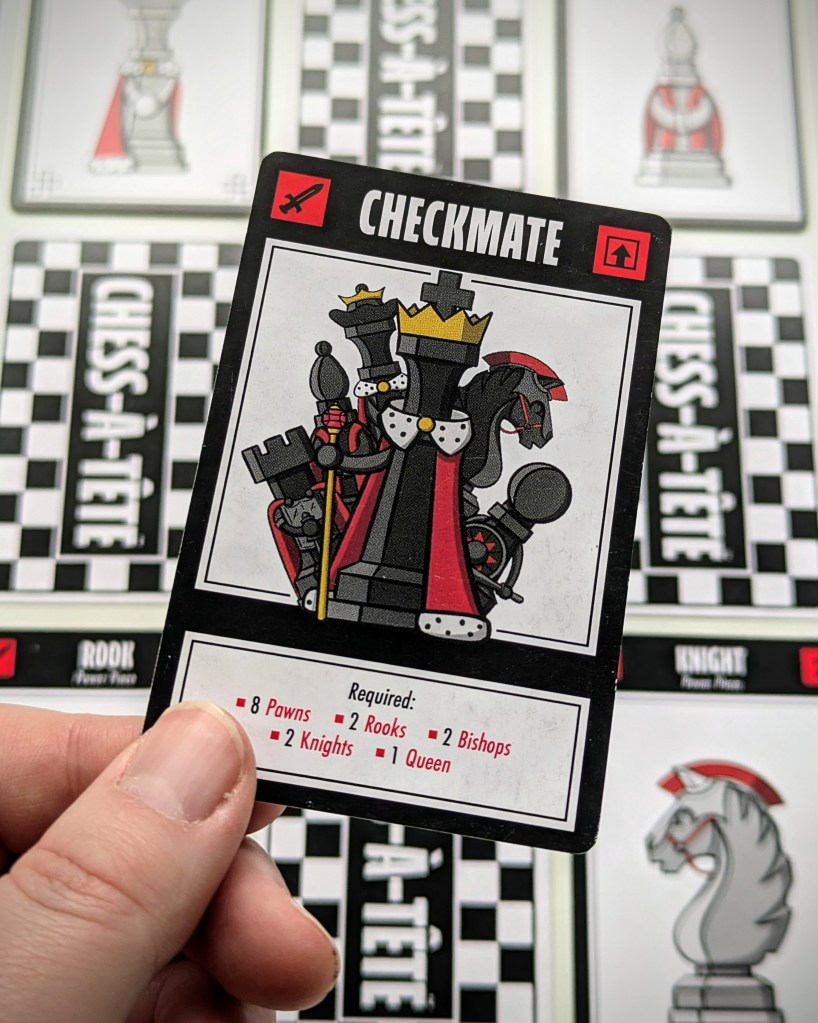
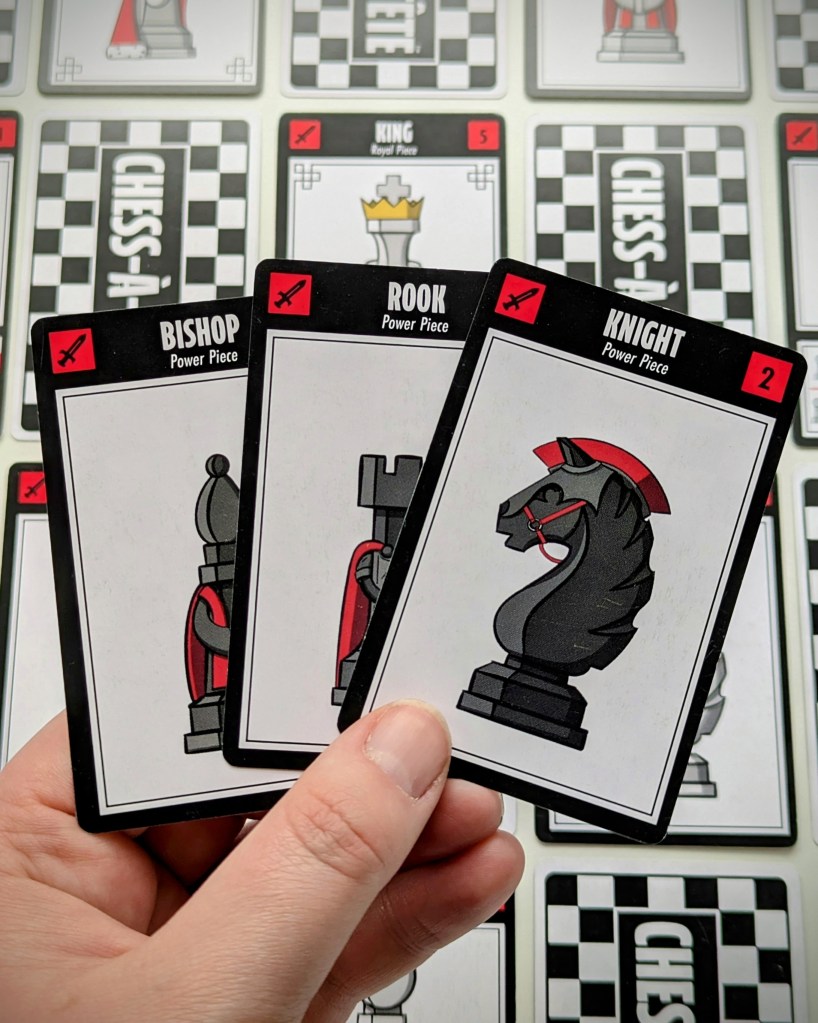
- More chess pieces that get added to your Board (Pawns, Power Pieces, Royal Pieces). Each chess piece has its own health (hit points). The maximum number of pieces you can have in your Board area is the same as in chess (so, 8 pawns, 2 knights, 2 rooks, 2 bishops, a queen and a king).
- A Combat card to attack your opponent (you can only do this once per turn). Each Combat card has a combat value (from 2 to 12) and lists the chess pieces you need for that attack – if you don’t have those pieces on your Board, you can’t use that Combat card (we’ll get more onto battles in a mo!).
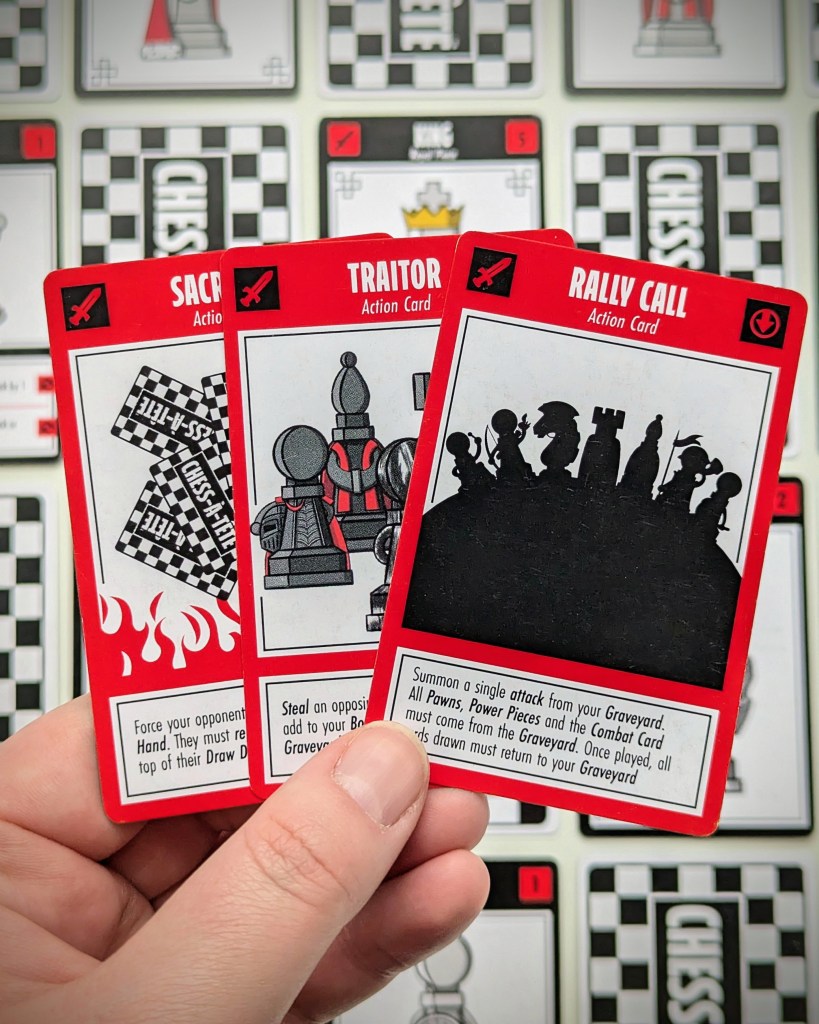
- Action cards. Each action card is different and either helps you, hinders your opponent, or both. Some action cards can also be played outside of your turn (e.g. to block an opponent’s move).
Instead of playing a card, you can choose to burn a card instead – but you can only do this at the end of your turn, i.e. you can’t play any more cards when you choose to do this. At the end of your turn, you draw back up to seven cards.
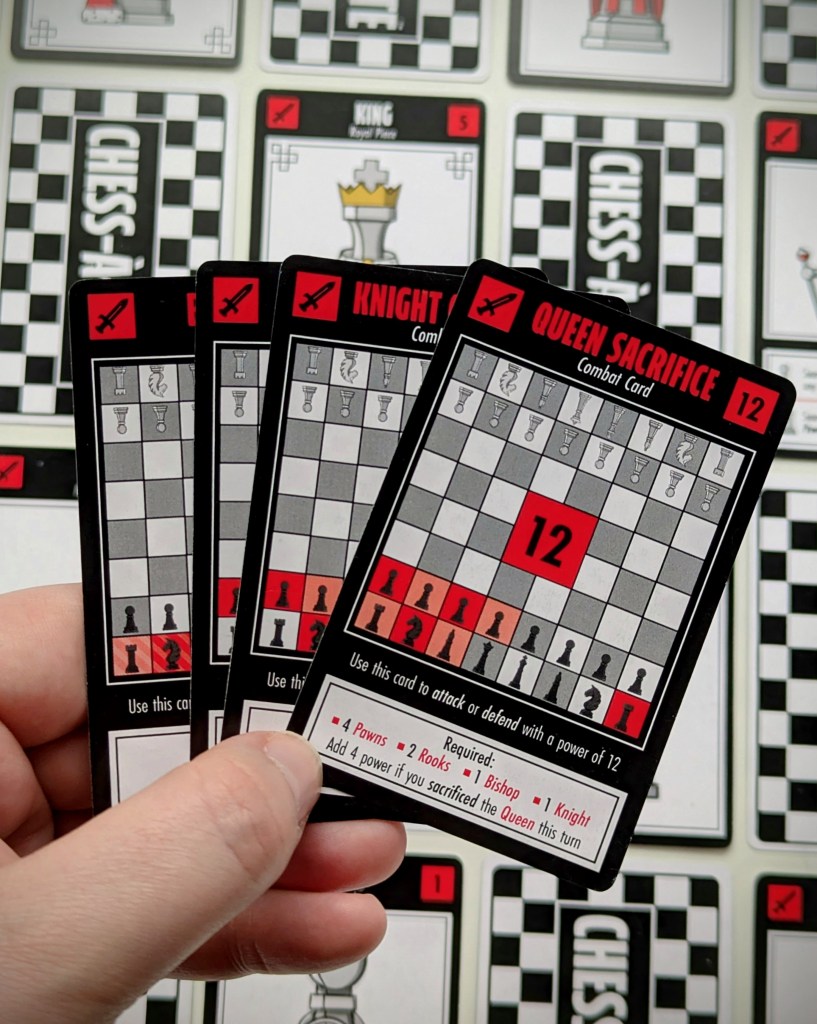
Each pawn has a special ability, and they come in pairs. Play one, and you activate the ‘first pawn ability’. Play one when its buddy is already on your board, and you get to activate the stronger, cooler ‘second pawn ability’. For example, play the En passant pawn and you get to instantly kill an opposing pawn; play the En passant pawn when the other one is already on your board, kill an opposing power piece (knight, bishop or rook).
When you play a Combat card to attack your opponent, then one of three things can happen:
- The opposing player can’t (or chooses not to) defend. The opposing player must then send pieces from their Board to their graveyard (discard pile) with total hit points that equal the Combat value. So if a Combat card has a value of 7, the opponent discards pieces to the total of 7 hit points.
- The opposing player defends by playing a Combat card that has an equal value to the attacking Combat card. This is a ‘stalemate’ and all the chess pieces used in the attack and defence (from both players) get sent to their respective graveyards.
- The opposing player defends by playing a Combat card with a higher value than the attacking Combat card. The attacker loses the battle, and the chess pieces they used in the attack go to their graveyard.
There are three ways to win a game of Chess-à-Tête: Take out your opponent’s King (in our experience the most common way to win), get a full chess board and play the Checkmate action card (a rare but oh so satisfying win), or your opponent runs out of cards to draw before you do.
Our thoughts:
Firstly, let’s talk about the biggest improvement from our last review – the rules. The rules in the updated edition are succinct, clear and well laid out. The terminology and descriptions in the rules and on the cards are logical. Because the rulebook is light, it doesn’t cover every single hypothetical for every card, but there is an FAQ on the website that can help with that (which has also improved a lot from when we last used it). We only had a couple of instances where we were unsure about a card, and the answers were easily found on the FAQs. And I’m sure the designer will continue to update the FAQs if needed. It’s brilliant to see the improvements that have been made and we’re sure that this will make a smoother learning experience for people who pick up the game.
We’ve really enjoyed playing Chess-à-Tête – at home and on the go – and there’ve been a few tense battles between us, where it’s come down to the last few cards.
Moving on to the gameplay: you have the same decks (when playing with the base game), so winning is really all about cards you draw and how you can use that to your advantage and put together a winning strategy. For example, you could purposefully send chess pieces and combat cards to your graveyard with the long-term plan to bring them back with the ‘Rally call’ action card – if you can draw it in time. The randomness of what comes out when might not be for everyone, but it can help balance the game out with younger/newer players. The single and double abilities of the pawns add an extra layer of interest as you decide which ones to put in play – you can’t have every pawn type out, so sometimes you have a choice between playing the different pawns in your hand, or holding out for a matching pawn in the hopes of using a cool power.
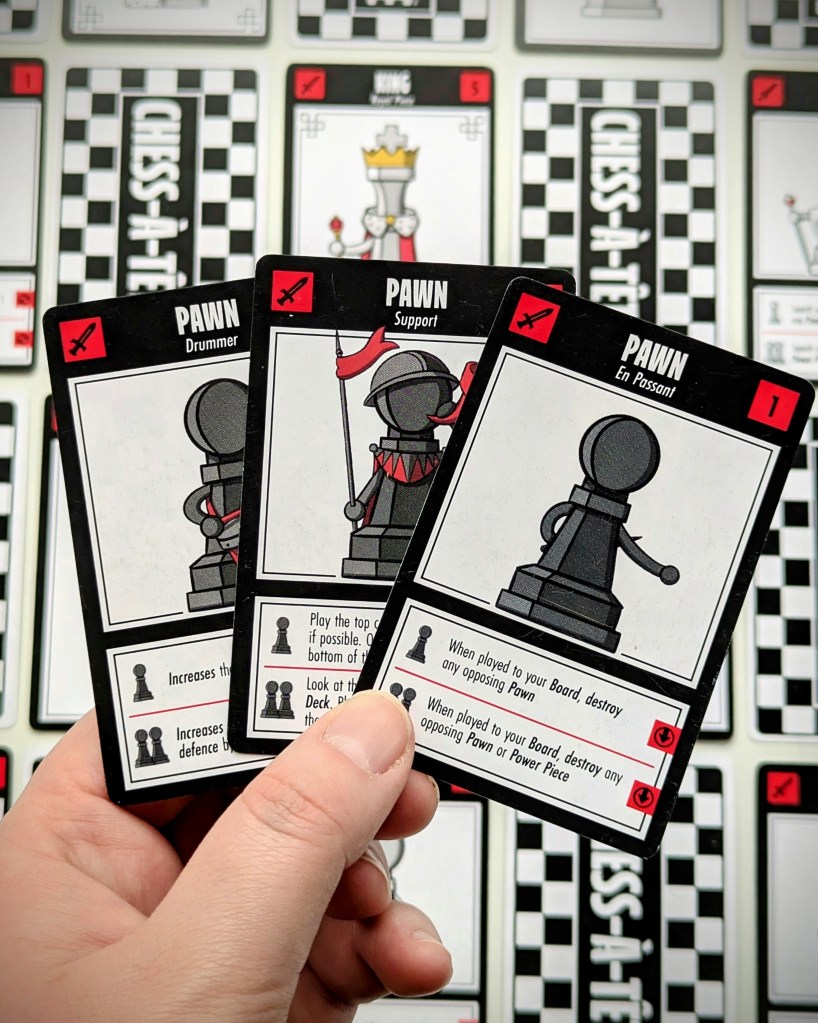
Even though Chess-à-Tête is a quick game, it the tactical choices make it feel a bit more meaty that many other quick card games. We’ve really enjoyed playing it – at home and on the go – and there’ve been a few tense battles between us, where it’s come down to the last few cards.
This is a game where you attack and mess with your opponent regularly, and they do the same to you. If that’s not your thing, this might not be the game for you. But I will say that where I can sometimes get frustrated with ‘take that’ style gameplay, but I didn’t feel that way with Chess-à-Tête; that could have been because it doesn’t outstay its welcome (because the game will end if someone runs out of cards to draw), or it could have been because I never lost!
The presentation and design is simple but feels quality – we particularly liked the sleek magnetic flip box. The mediaeval twist on the pieces and action are a nice touch (Matt was a big fan!) and added a bit more to the theme beyond ‘just chess’. And it’s the perfect size (and length) to take to the pub or cafe for a game or two. It fits easily on smaller tables because you have the option to stack like-for-like pieces to save space.
In our review of the original game we mentioned that we added a house rule: the option to mulligan your starting hand (reshuffle and redraw). We still stand by having this option – it doesn’t happen often but there was at least one game where Matt had a hand of mainly high value Combat cards (that require more Pieces in play) and no actual pieces, so the first few rounds would have been much trickier.
Moving on to the choice of theme. I don’t play chess, I don’t like chess (I’ve tried to like it, honestly I have!). But I can also see the love that has gone into applying chess themes and concepts here, like basing the Combat cards on actual chess moves. It does work. I just don’t think you can avoid the fact that chess will put some people off, where having the exact same game with a different theme pasted on would have broader appeal. Which is a real shame because it is honestly a fun 2-player card game and I don’t want people to miss out on that just because chess is a bit of a turn off for them.
Chess-à-Tête is a smart, travel-friendly 2-player game with a nice balance of luck and strategy – luck in what order the cards come out, and strategy in how you react and use those cards to get to the endgame.
Now, we’ve heard that there’s going to be some mini-expansions for Chess-à-Tête that enable you to customise your deck. Each is themed around a different play style; the Rook pack adds defensive cards whilst the Knight pack adds more offensive cards which you can swap into your deck the customisation will be minimal but it’s definitely something that has piqued our interest.

What works well:
- The rules are clear, well laid out and logical, with an additional FAQ for more card specific questions.
- It’s a great 2 player game: light but with some fun strategic choices, like working towards a final move.
- The first/second pawn abilities were a great addition to the game.
- The chess theme is implemented well and the designer’s love of chess shines through.
- Potential for light, introductory deckbuilding (we haven’t tested this aspect though!).
What doesn’t work as well:
- The theme will inevitably put some people off.
- Sometimes your starting hand can be a disadvantage – a mulligan house rule helps with this.
How does the second edition of Chess-à-Tête compare to the first edition?
If you’ve played the original Chess-à-Tête, you may be wondering how this version differs, so here’s a quick summary:
- As I’ve already mentioned, the rules are much clearer.
- There have been some changes to the card powers, e.g. there are different action card abilities, different pawn abilities, and the single/double pawn ability is new.
- Overall the gameplay felt smoother and a bit more tactical than its predecessor, the games felt ‘fuller’ and went on for longer (in our experience we found games were more on the 30-45 minute end).
- There are some other minor but appreciated quality-of-life updates, e.g. changing the box shape, changing Combat cards from landscape to portrait, clearer terminology for different cards/player pieces.
- The deckbuilding option is new.

Final verdict:
Chess-à-Tête is a smart, travel-friendly 2-player game with a nice balance of luck and strategy – luck in what order the cards come out, and strategy in how you react and use those cards to get to the endgame. It’s been a pleasure to see the game evolve, and all the changes in this new version have been for the positive. We’re keen to see how the mini expansions affect the gameplay, because they have the potential to add even more replayability and strategy to the game (as well as serve as introductory deck-building for newer players).
Chess-à-Tête goes live on Kickstarter next week (March 2025), so be sure to sign-up for the launch.
This game was kindly loaned by Chess-à-Tête via the UK Board Game Review Circle. All opinions are ours and our reviews are always honest.

 Our Board Game Life
Very interesting! I’ll have to check this out…
LikeLike