
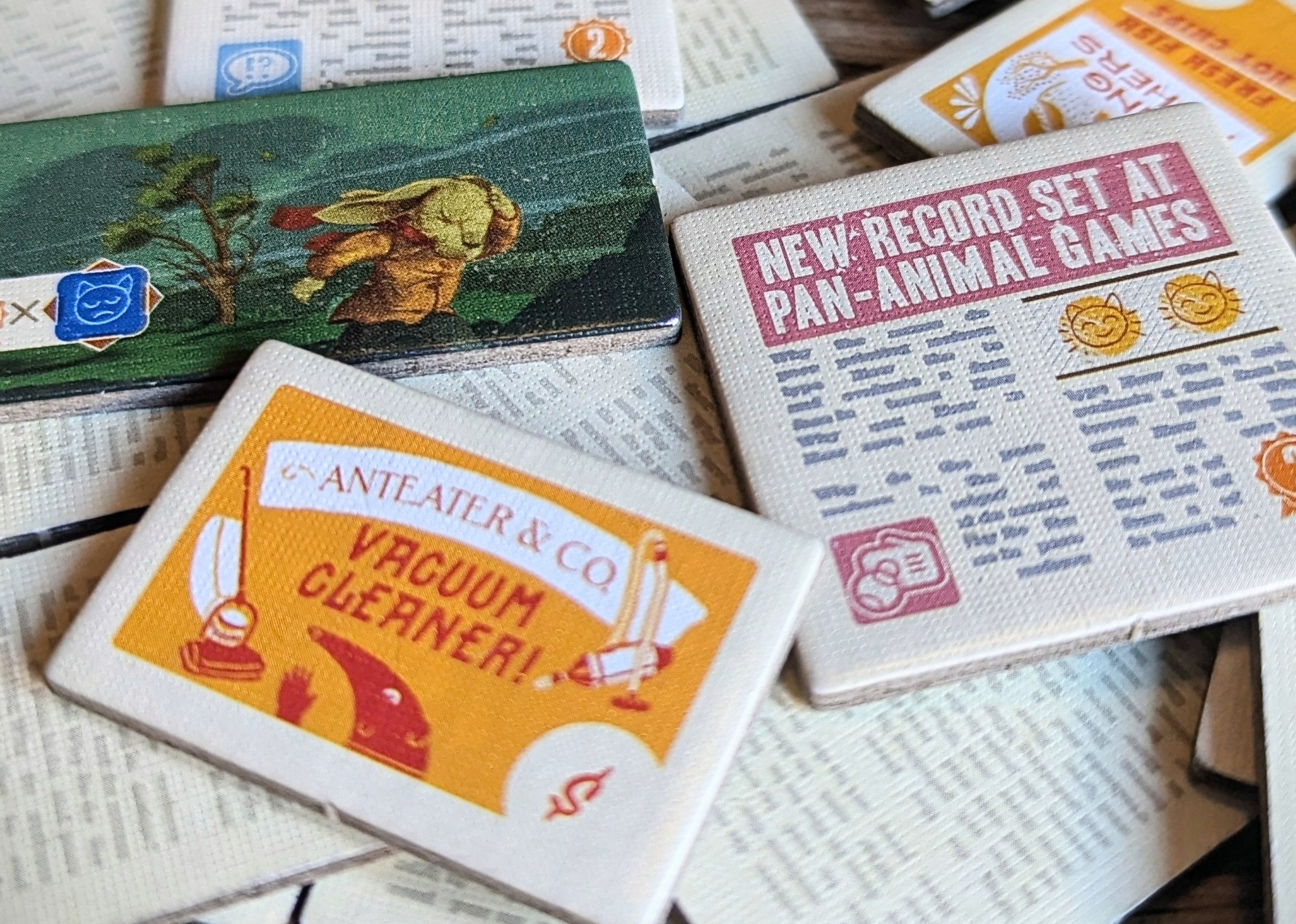
As busy animal editors for the hectic local newspapers of Thistleville, it’s your job to make sure your paper is covering all the best stories of all the latest happenings. And the paper needs to go to print RIGHT NOW!
Here’s our initial thoughts on the fast-paced tile-laying Fit to Print from Flatout Games and AEG.
👥 1 to 6 players
⌛ 15 to 30 minutes
🧠 10 years+
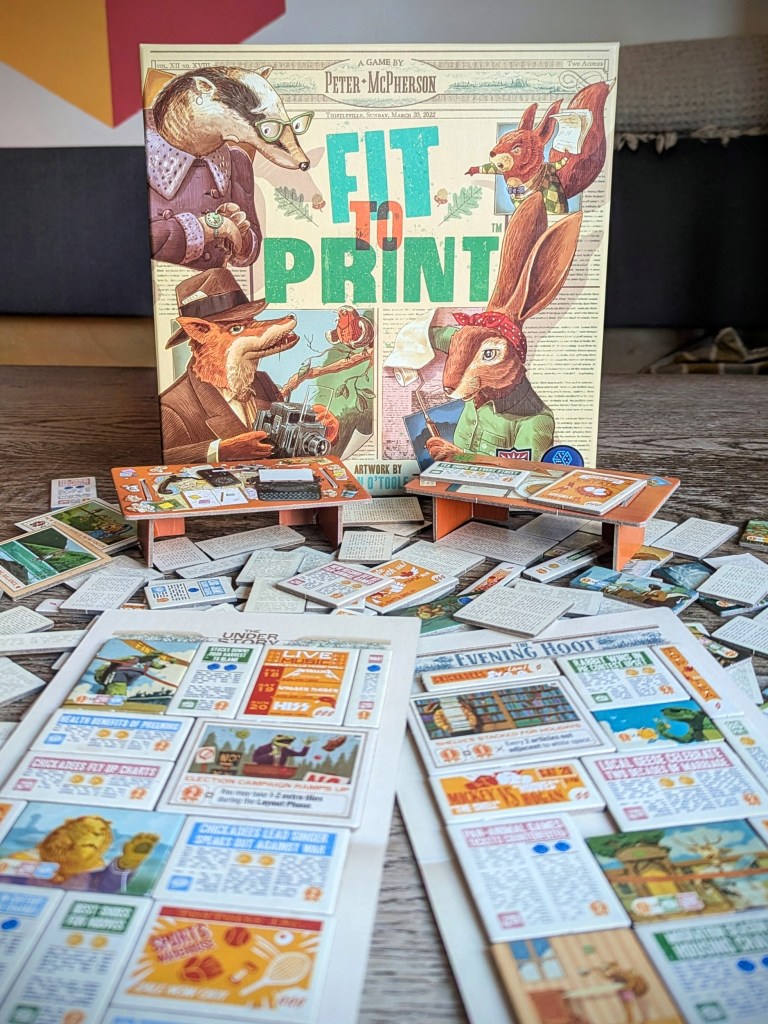
Gameplay overview:
In real time, players race to pick out news stories, photos and ads (gotta get that dough!), before laying them into a glorious news spread to send to print. After 3 rounds (planning the Fri–Sat-Sun papers), the player with the least ad revenue goes out of business, and the player with the most points wins! (Note: in a 2-player game the player with the lowest ad revenue gets a point penalty rather than going out of business).
Each day (round) has two distinct phases: Reporting and Layout. During the Reporting Phase, players grab newspaper tiles from the centre of the table and put them on their desks. Newspaper tiles start face down, it’s only when you bring them to your desk that you can flip them over to see what types and/or scoring conditions they have. Then you have a choice: keep them on your desk for good (no backsies!), or put them back into the tile pile face up (so other players can see what they are and grab the tile for themselves).
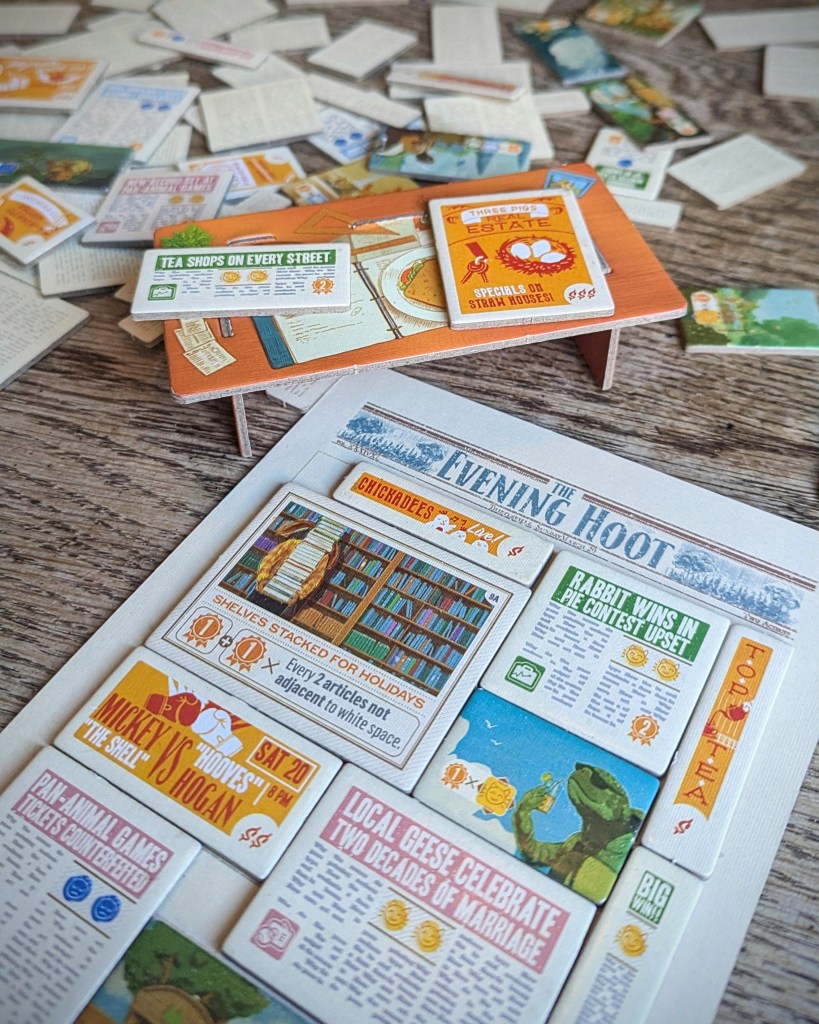
When a player thinks they have the tiles they need, they shout “LAYOUT!” and move on to the next phase (funnily enough called the Layout phase)m arranging the tiles from their desk onto their paper board. There are some placement rules: tiles can’t overlap with the edge of the page, they have to be placed the right way up, and like-for-like posts can’t touch one another (so, article of the same colour can’t touch, photos can’t touch another photo, adverts can’t touch another advert…). Aside from that, it’s a mad dash to place your chosen tiles in a way that will get you the most points and ad revenue possible! Oh, and you always start each round with a large centrepiece tile on your board, which can give you additional bonuses/powers for that round – but you have to fit all your newspaper tiles around it!
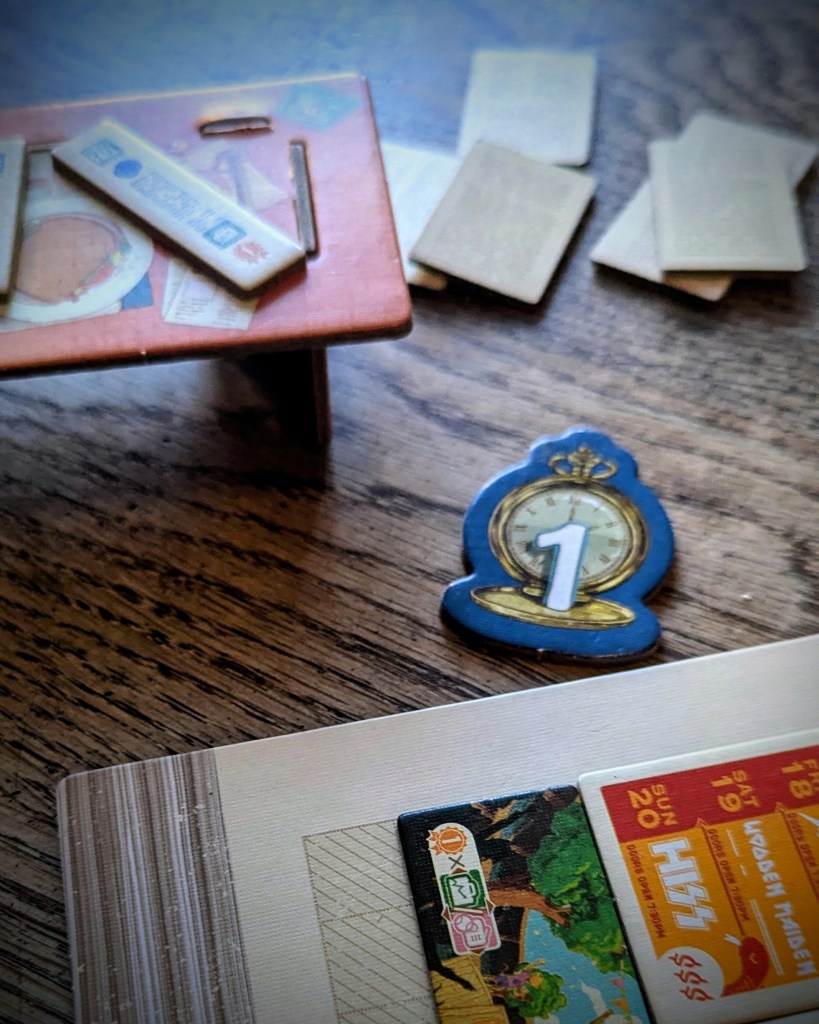
As soon as a player has finished their layout, they shout “PRINT!” and take a Finishing token – that’s the end of the round for them. The quicker you finish, the higher the value of the Finishing token you take. If you’re still going when the timer ends, you have to stop and take the highest Finishing token that’s left.
Then it’s time to score! After checking for incorrect placements (tiles get flipped until there’s no longer a conflict), players score as follows:
- Articles: score points equal to the numbers shown on the tile.
- Photos: score points based on their own specific rule for adjacent tiles (e.g. 1 point for each neighboring green tile).
- Centerpiece tiles: can score points (and can have additional scoring bonuses).
- Empty areas: the player with the smallest total empty area not filled by articles gets 3 points, the player with the largest empty area gets -1 point, everyone else gets 1 point.
- Mood balance: some tiles will have happy or frowny faces. A perfectly balanced paper has an even number of both, and receives no penalty. Any difference in the number of smiles and frowns gives the equivalent negative points (e.g. if I had 5 smiley faces and 3 frowny faces, I’d get -2 points. It doesn’t matter which one you have more of).
- Unplaced tiles: tiles that are left on your desk are -1 point each.
Ads don’t earn points – you earn ad revenue equal to the number of $ signs on the tiles. These count towards your final ad revenue at the end of the game (when the player with the least is eliminated!).
We played the simplest set-up, but there are more elements that add more layers (and I’m guessing more hijinks!). For example, we didn’t play with the asymmetric player powers, or the Breaking News deck that adds more in-game events (like restrictions and bonuses).
There are also 2 different solo modes: a standard one like the original setup, and a puzzle mode that makes you work with specific tiles (I like the sounds of this one!).
Our first impressions:
- Fit to Print is great fun! We haven’t come across a real-time game that uses puzzly tile-laying, so it felt like a unique experience.
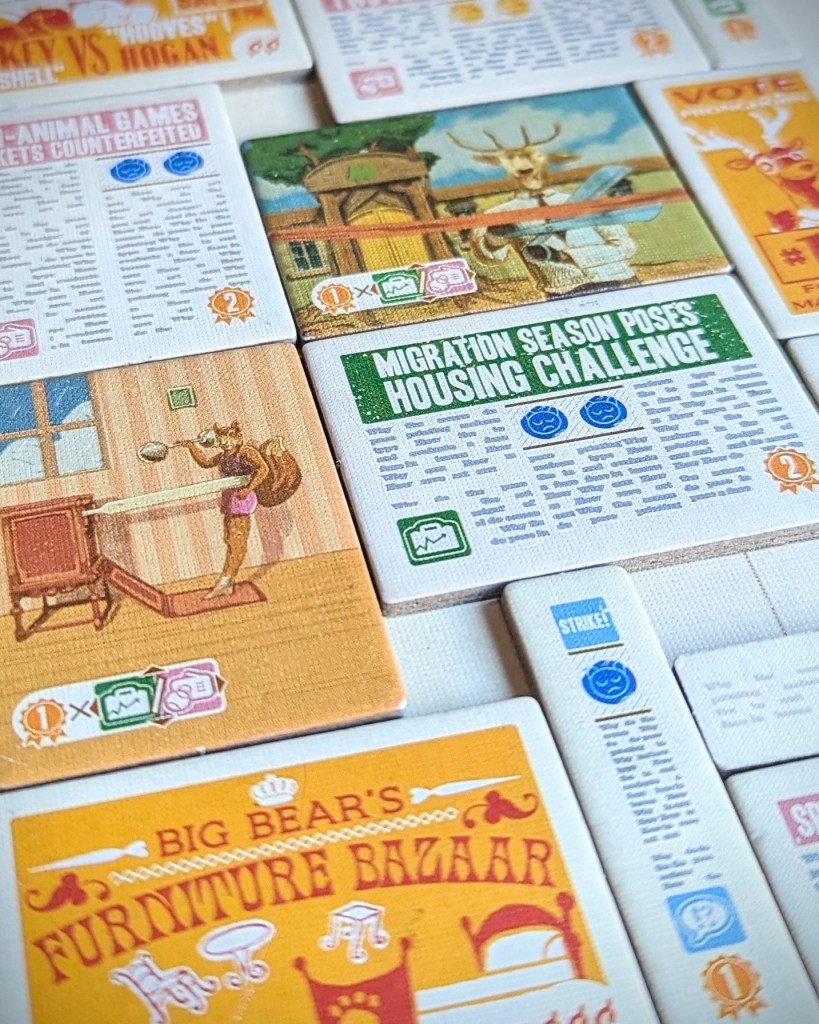
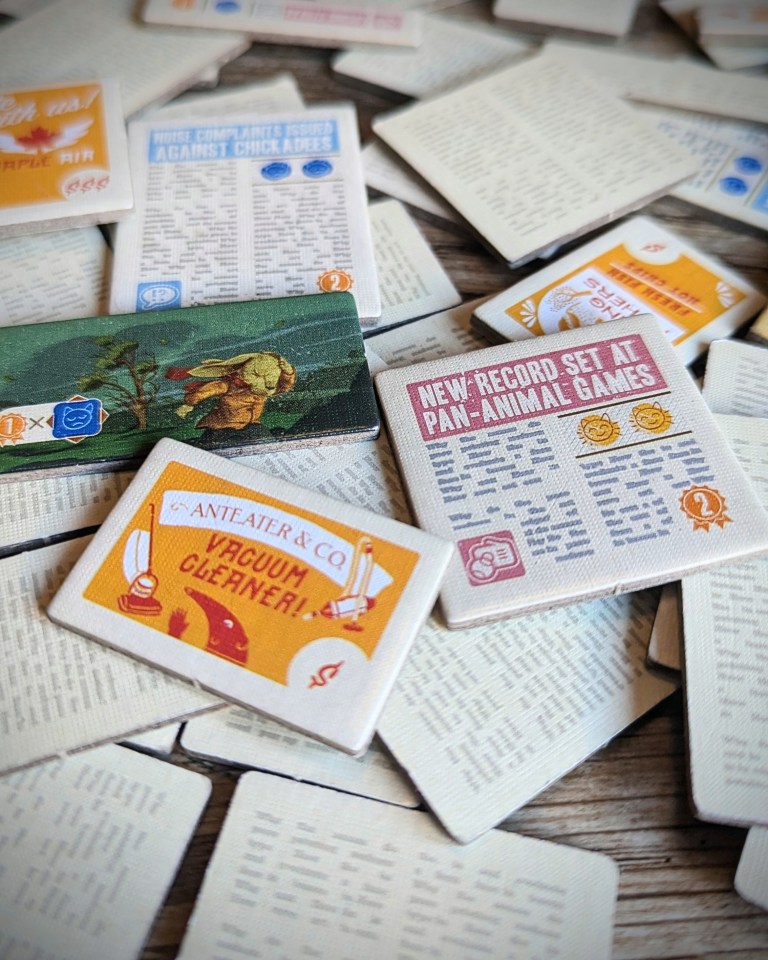
- So much effort has gone into the theme! There’s so much detail and subtle lore included – from the individual character bios to the different article titles. And we LOVED the art (by Ian O’Toole).
- Fit to Print is one of the best implementations of real time play that we’ve seen. Often the pressure and frantic simultaneous play of real-time games causes carnage and ‘accidental cheating’, but in Fit to Print it felt more like organised chaos.
- When I first pulled this off the shelf, I had no idea it was a real-time game! Real time is more Matt’s thing, so he thought it was brilliant. I enjoyed the game, but I do feel a bit stressed when I’m under the pressure of real time, even though it’s ‘just a game’. I did like that the rules say you can modify the time limit (and I suppose you could choose not to have a time limit at all and just race!).
- As this was our first game it was very tricky to know how many tiles we needed each day. The more you play the more likely you’d get attuned to how many tiles you would need – but I don’t think this matters much because the main challenge will always be fitting it all on the page in the optimum way.
Final verdict:
We’re so glad I picked out Fit to Print at Chance & Counters – our first game left us wanting more! From the gameplay, to the art, to little easter eggs in the articles – the production and design is clever and well thought out. The real time element was a big hit with Matt, and manageable for me (when real time isn’t my strong suit), because it’s been implemented in a way that feels a nice balance between order and chaos. I’ll still be perfecting my spread to the last second though!

 Our Board Game Life