
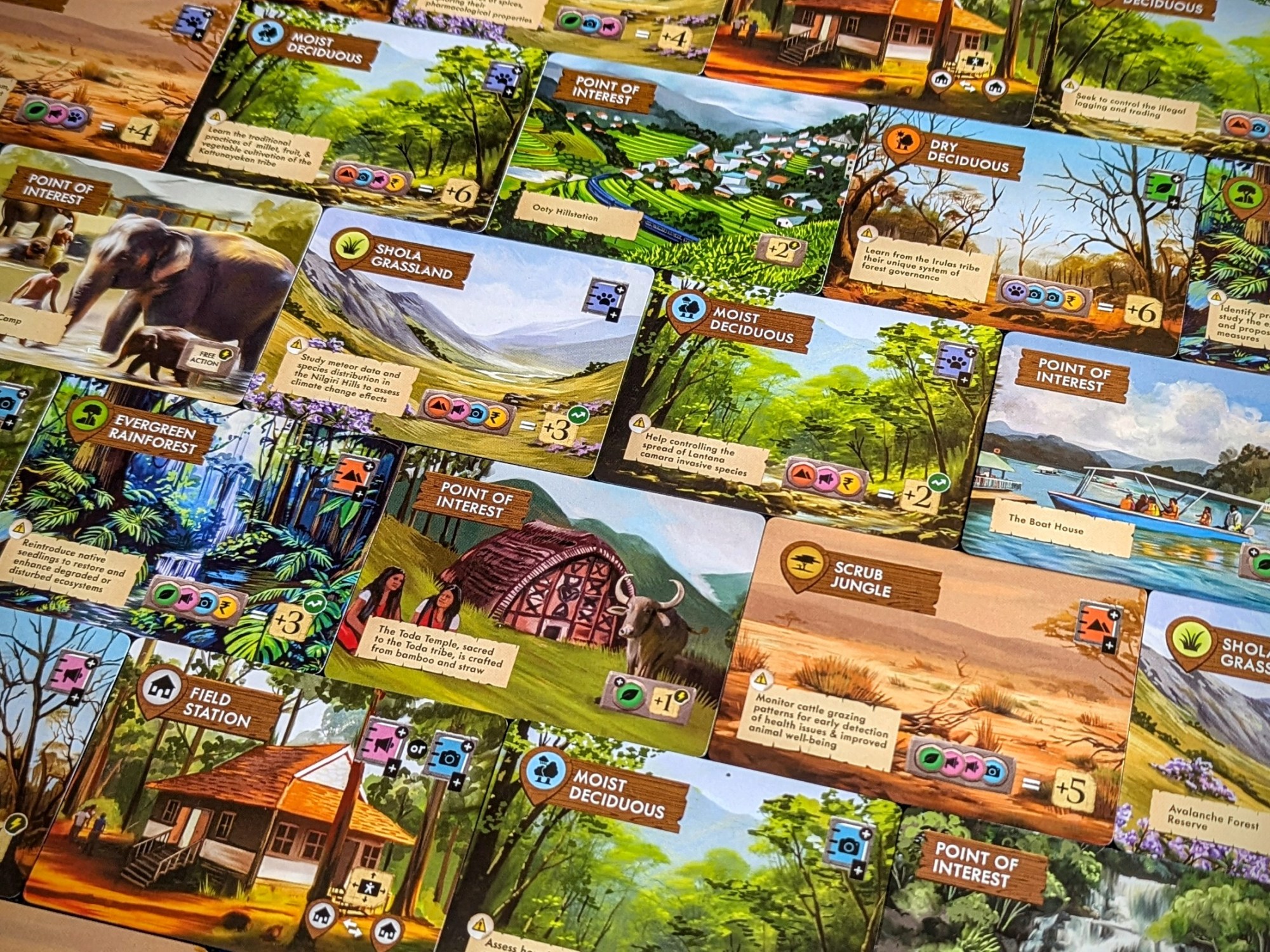
Happy Friday! And have we got a treat for you. Coming to Kickstarter next week (Tuesday 11th February) is Biomes of Nilgiris, and we’ve been lucky enough to preview the prototype!
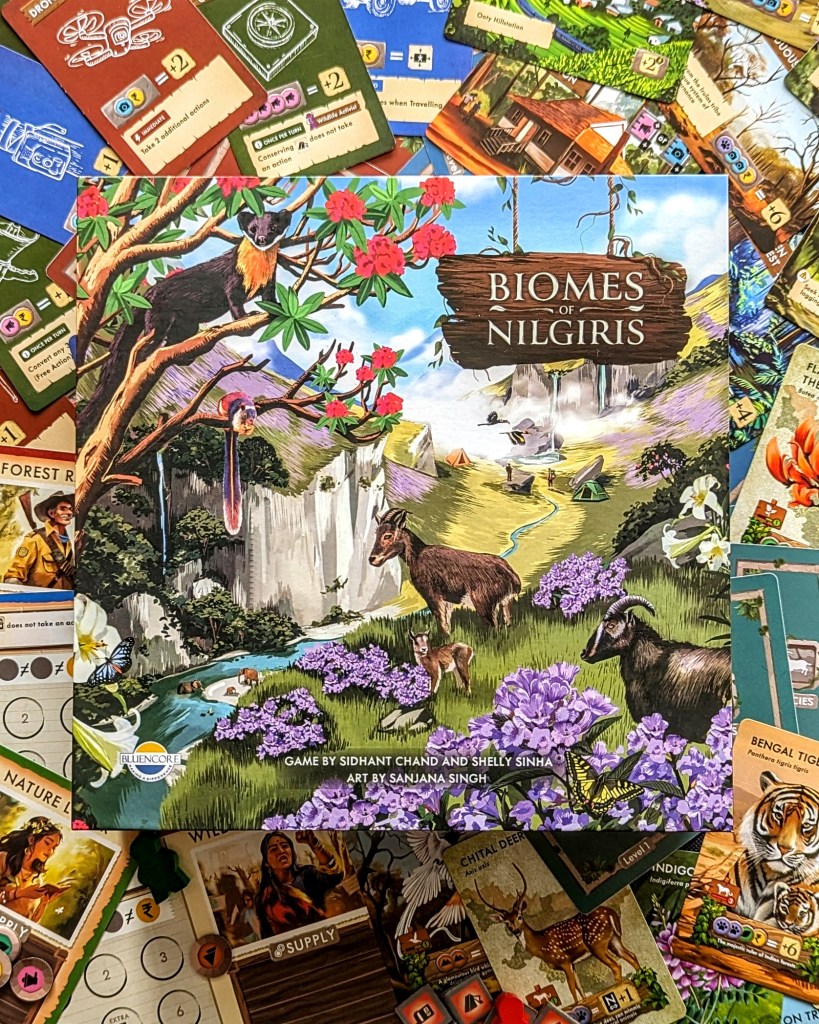
👥 2 to 4 players
⌛ 60 to 90 minutes
🧠 14 years+
Gameplay overview:
Welcome to the beautiful Nilgiris region, a very real location in India. As different conservationists – from scientists to forest rangers, birdwatchers to nature lovers – players explore the Nilgiri biosphere. Travel to new biomes, journal findings, discover new species, and complete conservation goals. Earn ecology points (EcoP) through biome and species conservation, achieving end-game objectives and travelling up the sustainability track – the player with the most EcoP at the end of the game has proven themselves to be the most skilled and dedicated conservationist and wins!
Each turn a player has to take 3 actions, choosing from:
- Explore – place a new biome card face down adjacent to at least 2 other biomes.
- Travel – move between adjacent biome cards (if this involves moving onto a face down biome card, that card is revealed), or between field stations (they don’t need to be adjacent!).
- Journal – study the biome you’re in and gain experience (represented by an XP token you add to your player journal). The experience you get depends on the biome you’re in, and includes botany, zoology, fieldwork, communication, and photography. When you journal you also gain an item or species card from the main board.
- Study – back at a field station study your journal to move the XP tokens in your personal supply.
- Equip – play an item from your hand, paying the cost (XP tokens) and gaining any EcoP listed on the card. Some items are single immediate use, some can be used once per turn, and some are ongoing.
- Discover – play a species card from your hand and get its bonus (XP tokens or EcoP).
- Conserve – pay the XP tokens required listed on a biome or discovered species card to conserve it.
It’s vital to remember that your location is key! You have to travel to specific biomes to get the XP you need, then you can only convert that XP to your supply when you’re on a field station to study. And you can only discover/conserve species if you’re on the biome that matches their card! There’s also a benefit to travel around and reveal face down biomes, as some have instant perks like EcoP or moving up a sustainability bonus track (which gives bonus benefits, like XP tokens or actions).
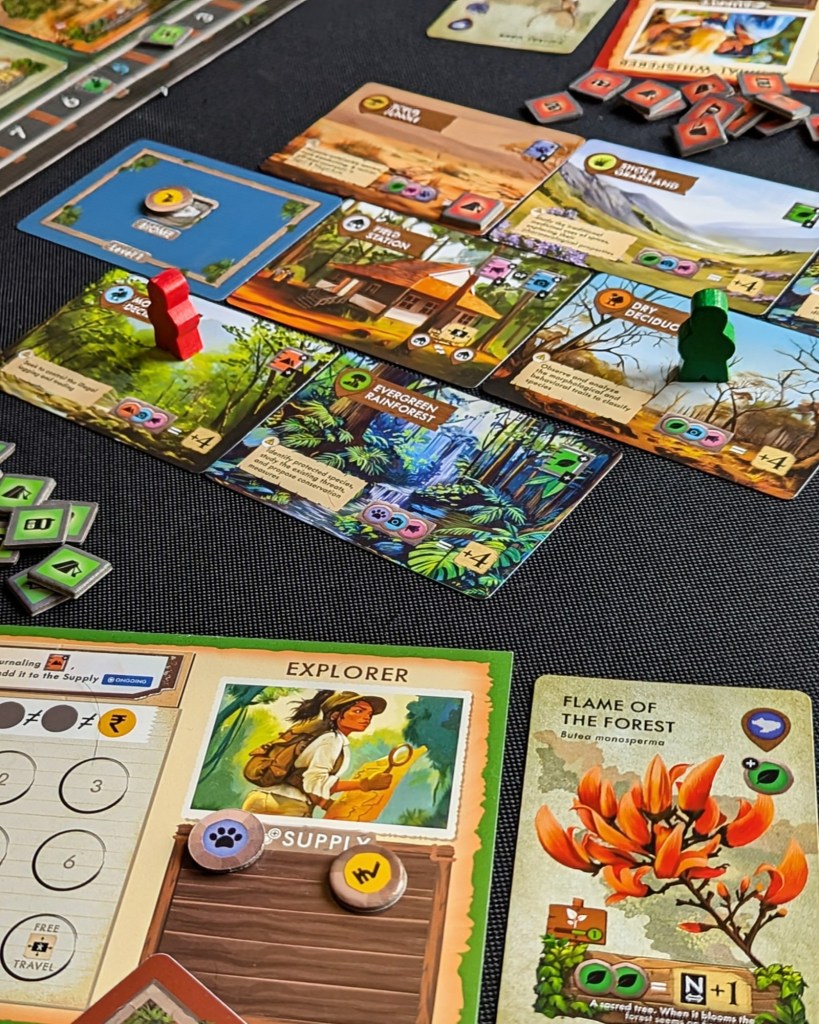
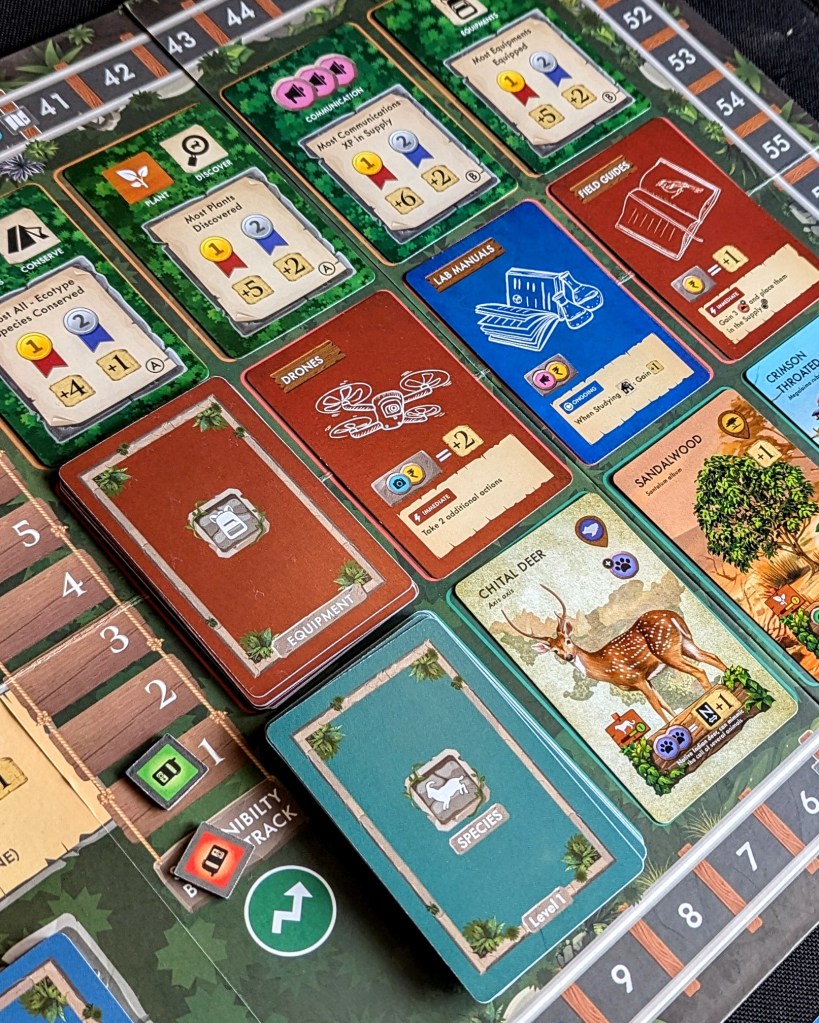
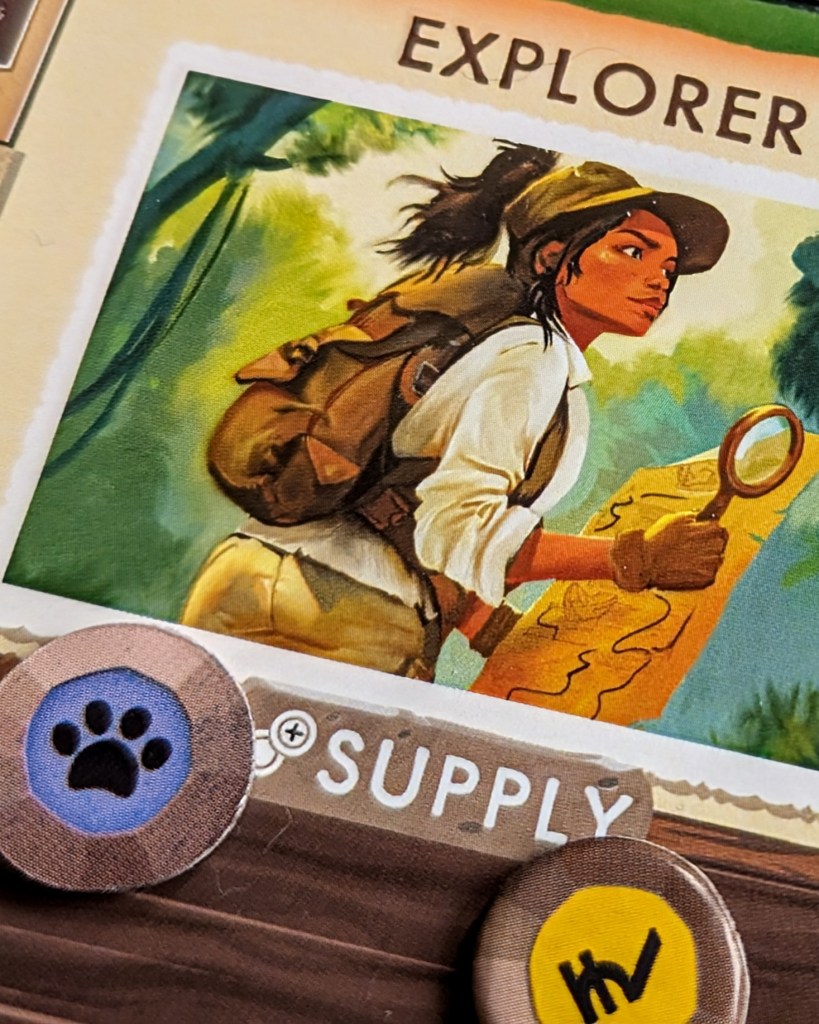
At the start of the game, players pick from different character cards that each have a unique ability, e.g. when the photographer journals photography XP, you can put photography XP tokens straight into your supply. Each character also has unique items that go in your starting hand.
As you travel round the EcoP track you’ll pass certain bonus actions (like taking a free study action). And the first player to pass 18 EcoP triggers a mid-game switch-up, where the ‘level 1’ biomes and species decks are swapped out for ‘level 2’ cards that are slightly more challenging. The first player to pass 49 EcoP triggers the endgame, and once the round is finished players final score based on the end-game objectives in play (e.g. most animals conserved, most items played) and bonus points if you are the highest player on a sustainability bonus track.
We only played the base game (hence the first impressions!), but Biomes also has some mini expansions that add additional ‘missions’ to the game, building on the challenge and giving more strategic options. There were lots to choose from, and you could mix and match which missions to use in a game.
Our first impressions:
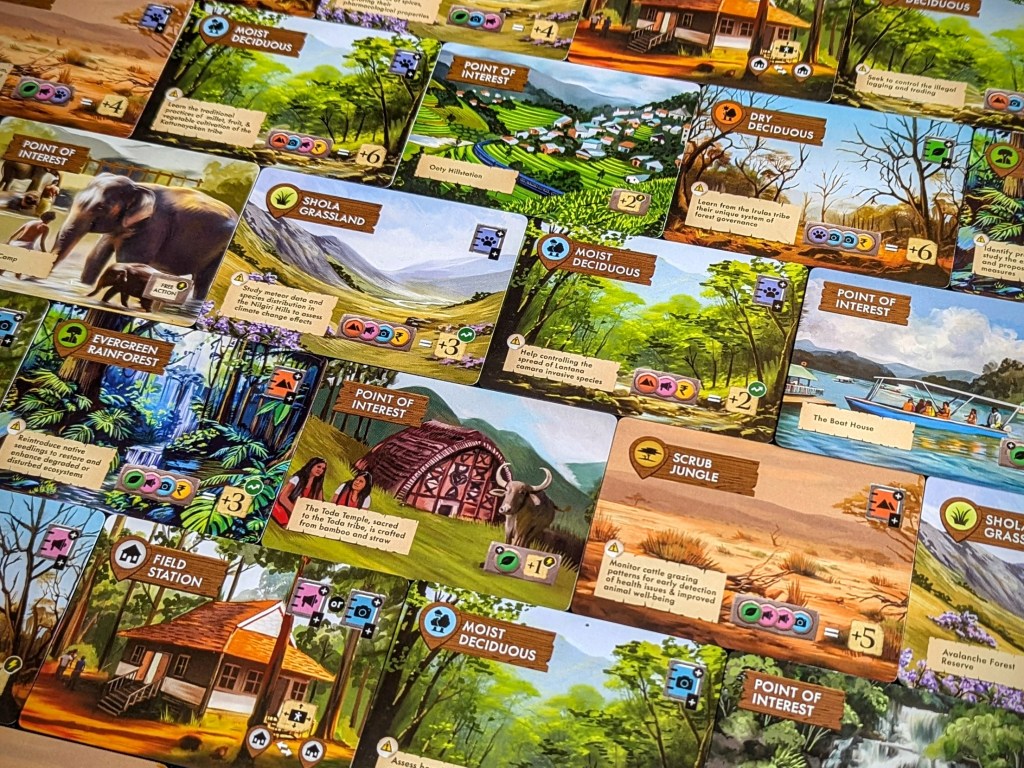
From the gorgeous artwork to the thoughtful gameplay, Biomes of Nilgiris has excelled in its immersive implementation of the conservation theme. The designers have used real life inspiration and expertise (e.g. consulting an ecologist) to capture the true nature of Nilgiris and conservation efforts. It was an absolute pleasure to explore the biodiversity of Nilgiris and learn more about the flora and fauna there.

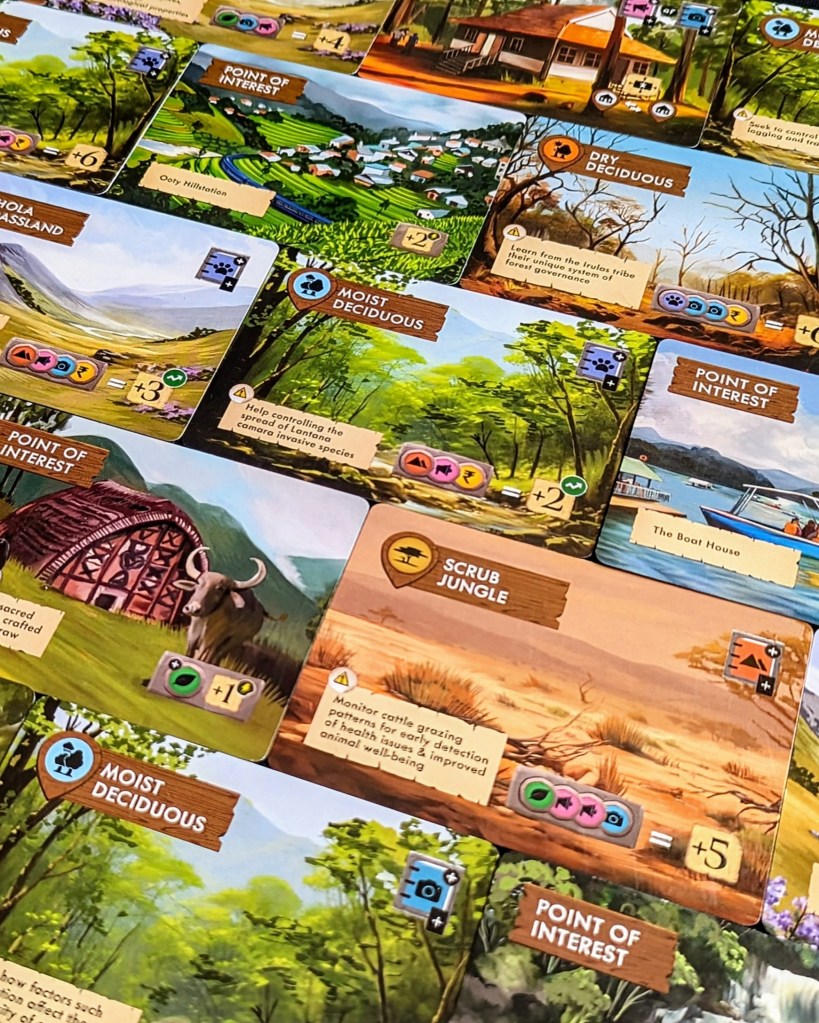
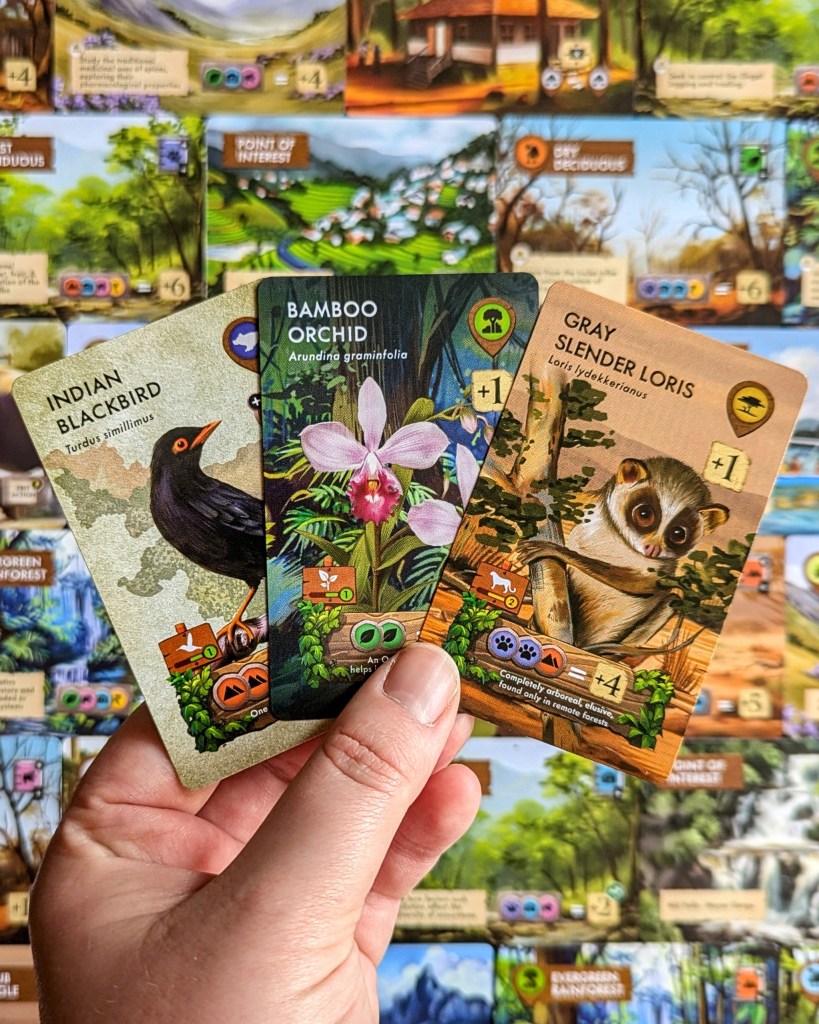
Although the gameplay can seem like a lot – having 7 different actions to choose from – the gameplay itself feels straightforward and easy to get your head around. I think the logical way the theme has been applied to the gameplay helps a lot with this, as well as a clear and well laid out rulebook. The trickiest bit for us was keeping track of how many actions we’d taken in a turn; actions often had additional steps or triggered other things so it was easy to forget where we were action-wise. So having an action tracker of some sorts would be helpful.
From the gorgeous artwork to the thoughtful gameplay, Biomes of Nilgiris has excelled in its immersive implementation of the conservation theme.
We’ve said the game is straightforward, but that doesn’t mean simple! The game is quite crunchy as you try and optimise those three actions each turn, balancing choices that work towards immediate scoring, endgame objectives or moving up the bonus sustainability track. Changing the biome/species deck midgame builds on this. Ideally you’ll be using your character’s special ability, equipped items and cleverly planned actions to make the best move combinations. If you like games that give you analysis paralysis, this certainly has the potential.
There’s also a lot of opportunity to add variability in the game, like the different character abilities you can play with. There’s also the additional mini-expansion mission cards which add additional goals and/or rules. Unfortunately we didn’t have time to play with these but they looked great and will add to the longevity of the game.

What we liked:
- An immersive game with gorgeous artwork capturing a unique (for board games) location.
- Gameplay is easy to learn, helped by a clear rulebook and logical implementation of a theme we love.
- A good amount of strategic choice an opportunity to make satisfying actions combining with player/equipment abilities
- Variability in gameplay, from the asymmetric character cards to the optional mission cards.
- Inspired by real conservation efforts.
What we didn’t like (really scraping the barrel here!):
- Potential unfair ‘knock on’ advantage by giving the leading player on the points track the benefit of placing the field stations (which they will place to give them more advantage).
- We generally aren’t fans of unnecessary (in our opinion) abbreviations like EcoP, SusP. SusP in particular was unnecessary (to describe the levels on the sustainability track) as it was barely used in the rulebook, making it confusing when it cropped up.
Final verdict:
Wow wow wow, what a game! It’s crunchy, but not too complicated and probably sits well between the lighter Nice to Know! Animals (a game we reviewed and backed last year!) and heavier games like Ark Nova.
Biomes of Nilgiris is a well-crafted board game that is set to be one of our top games of 2025!
As an animal lover with a biology background (I even chose a conservation module in my undergrad!), I’m an easy target for the conservation theme. It’s one of my favourite board game themes, and I love that there’s a growing number of games in this area – the most recent examples include the aforementioned Nice to Know! Animals and Kavango (which we’ve yet to try!). Matt’s a big fan of the theme too.
Biomes of Nilgiris is a well-crafted board game that is set to be one of our top games of 2025! (Yes, already!) For us, it’s an instant back – so, if it sounds like your cup of tea make sure to register for the Kickstarter launch!
This was a prototype so there may be some changes in the final game. It was kindly loaned by Bluencore via the UK Board Game Review Circle. All opinions are ours and our reviews are always honest.

 Our Board Game Life