
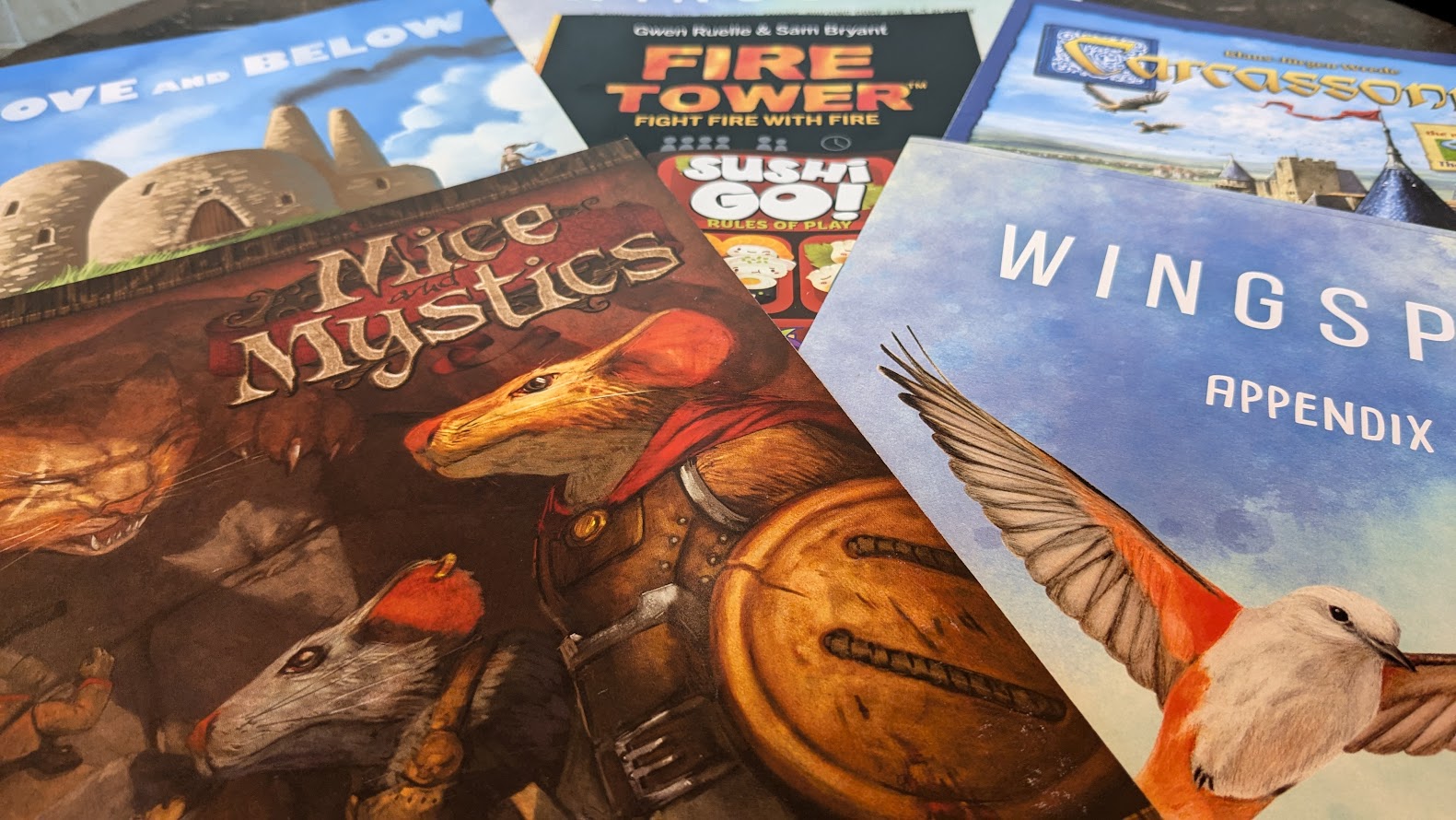
In case you didn’t know, I’m dyslexic. This month is Dyslexia Awareness Month with last week being Dyslexia Awareness Week (7th to 13th October). This year, the British Dyslexia Association has set the theme of “What’s your story?” I thought it would be a great time to take an introspective look at how I think my dyslexia affects my approach to board games. Hopefully this is an interesting way to mark Dyslexia Awareness Week and clear up some misconceptions about dyslexia.
My diagnosis
I remember when a University Lecturer arranged a meeting with me to discuss an essay I had written. He asked me a few questions about my schooling and then went on to say something like “Have you ever been told you might be dyslexic? I’m not able to diagnose dyslexia, but I believe there are some aspects of your writing that might indicate you are dyslexic.” He went on to discuss how supportive the university is and how they would arrange for me to see a psychologist for a formal assessment.
My immediate thought was to shrug it off… “No! I don’t think so…anyway I just did my essay in a rush!” I left the office, closed the door, and was immediately hit by embarrassment, shame and I felt I was being branded as different, something I struggled with during my school days. I now know I shouldn’t have felt this way but it was how I felt at the time.
After my formal diagnosis of dyslexia, I quickly realised that it made sense. The more I read the more obvious it was that I was dyslexic. But, I couldn’t really come to terms with BEING dyslexic. The embarrassment and shame didn’t leave. I told myself that my dyslexia wouldn’t hold me back, and I hid it. I never talked about it, I never told my employers. I just got on with life.
When I first started my board game Instagram account and blog Mattimus Primed (that later became Our Board Game Life), part of my motivation for it was to give myself a challenge and to practice a different style of writing. I never opened up about my dyslexia in any of my content.
I’ve made some progress over the last couple of years and I’m much more comfortable with being dyslexic, and talking about it more openly. It might have taken 10 years or so to get here, but I no longer see it as a bad thing. I’m now open about it in both my home and work life. Dyslexia is part of what makes me, me, and I generally like who I am so it can’t be all bad. Whilst my employer knows I’m dyslexic, I haven’t felt the need to request any reasonable adjustments but if I did I would happily request them. I also know that whilst I might struggle with some aspects of my job due to my dyslexia, it also makes me excel at others aspects.
As I hope you come to understand through this blog post, dyslexia doesn’t just impact someone’s ability to read and write but can also impact someone’s ability to process information, text and language that they see or hear. Whilst I struggle with reading and writing, I’m more impacted by difficulty in processing and remembering information which gets worse if I’m tired, busy, or distracted.
While dyslexia doesn’t impact the enjoyment I get out of board gaming, it does mean that I tend to approach board gaming in a way that might be different to others.
Learning new games through rulebooks is a grind
My biggest challenge when I learn new games is digesting a rulebook. The challenge isn’t in reading the literal words, it’s retaining the information I just read. My dyslexia affects the amount of information I can absorb and recall from any passage of text I read. It also impacts my ability to hold on to information in my brain – for example, if I was given a sequence and asked to repeat them I would struggle. So it’ll be no surprise that I can struggle to remember rules and actions from a read of the rulebook alone. Therefore, rulebooks aren’t always a good starting point for me, no matter how well they’re written.
I’m also a ‘big picture’ thinker, a common dyslexic trait. This means understanding a high-level overview of a game and what the aim and win conditions are is essential before I can absorb the more specific rules. I need that wider context to anchor the details to. Without it, I won’t remember those details, or I’ll struggle to link the snippets of rules someone explains to me. That’s why when I’m learning a new game I often look at how-to-play youtube videos like ‘Watch It Played’ first, and then start diving into the nitty gritty of rulebooks afterwards.
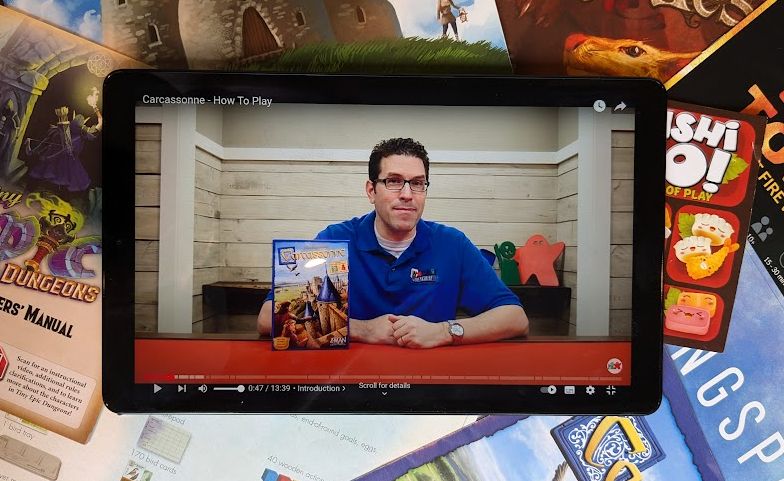
Something that I’ve found helpful is when a board game includes ‘player aid’ cards or turn action reminders on the board as it really helps me remember what actions I can take or what to do and when.
Lauren and I both prefer learning through doing, so we usually make our first play of any new game a ‘learning game’. After a high level overview of the game we just get started addressing the specific rules as they come up, or as we raise questions. This helps me to anchor the rule with actual gameplay at relevant points, and I learn better this way.
We learn most new games together as 2-player games, so this doesn’t normally impact other people. I’d be interested to see how this might work with a bigger social group where others may be more interested in having a competitive first game. I reckon I’d be happy treating the first game as a learning game even if others are playing ‘properly’… I’ll be in it to win the next time we play!
Text heavy cards don’t sink in…
I initially struggle with games that have text heavy cards for the same reasons that I struggle with rulebooks. For example, games like Keyforge, Disney Lorcana, and even Wingspan where the cards have different abilities. It can take me a few plays of a specific card before I fully appreciate what the ability means in a wider strategic sense, e.g. as part of an engine or combination. I can also struggle to remember what the different keywords mean or confuse the different keywords with one and other.
That’s not to say I avoid text-heavy games with lots of reading involved. Some of my favorite games are narrative games like Mice and Mystics by Plaid Hat Games, and Above and Below by Red Raven Games which have lots of written story passages to read. I’m not confident at reading allowed and can often trip over the words so I wouldn’t want to read long passages of text in front of a group I didn’t know… and to be fair they are unlikely to want me to either!
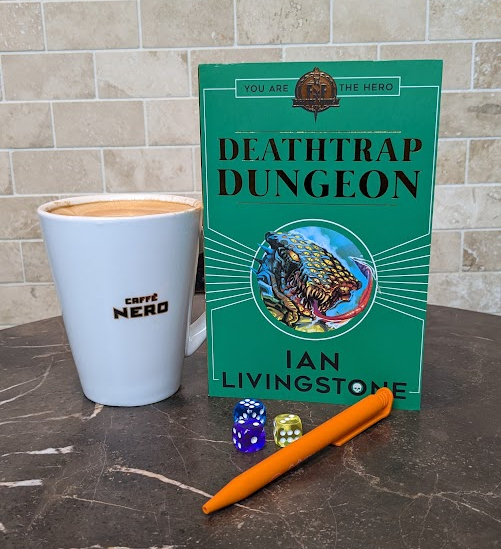
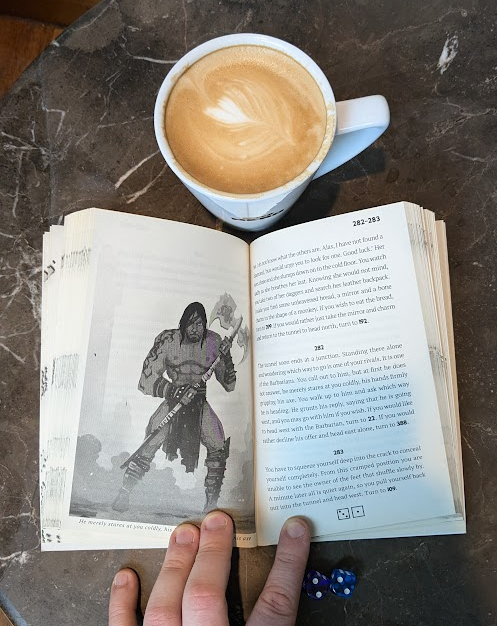
I’m currently playing/reading The Fighting Fantasy Books by Ian Livingstone and thoroughly enjoying it! I will be exploring other gamified choose your own adventure style books in the future. Playing these solo allows me to take it at my own pace and reading snippets is easier then full pages and chapters.
I’m boss at shapes, spatial reasoning and pattern recognition
Dyslexia is not all bad though. My dyslexia means that I’m pretty good at creative problem solving. Something that can come in handy with our love of escape room-style or detective puzzle games like EXIT by Ravensburger, Unlock! by Space Cowboys or Escape Tales by Board and Dice. We have regularly enjoyed this type of game which we play as a kind of date night, now we have a baby it is harder for us to go out out.
These games have a lot of spatial reasoning, and pattern recognition puzzles within them which plays to my strengths. As with a lot of dyslexics I am quite good at manipulating shapes in my mind.
For the same reasons, I have a growing appreciation for abstract games. Azul by Next Move, Boop by Smirk and Dagger, and Sagrada by Floodgate Games being amongst my favourites.

In contrast to what you might expect, I also don’t have a massive dislike for word games. I am actually pretty good at anagrams, which I guess make sense as it’s just pattern-recognition in letter form.
So that’s my dyslexia story and how I think my dyslexia has an impact on how I approach board gaming. If you enjoyed this blog you should check out Caroline Black’s blog on Board Game Geek – The Dyslexic Gamer. They also have a blog post discussing their experience being dyslexic, and you’ll find that we have both shared and differing experiences. Everyone experiences dyslexia in a different way, so it’s always interesting to see someone else’s story.
If you feel comfortable I’d love to here your story or your thoughts on mine in the comments.

 Our Board Game Life