
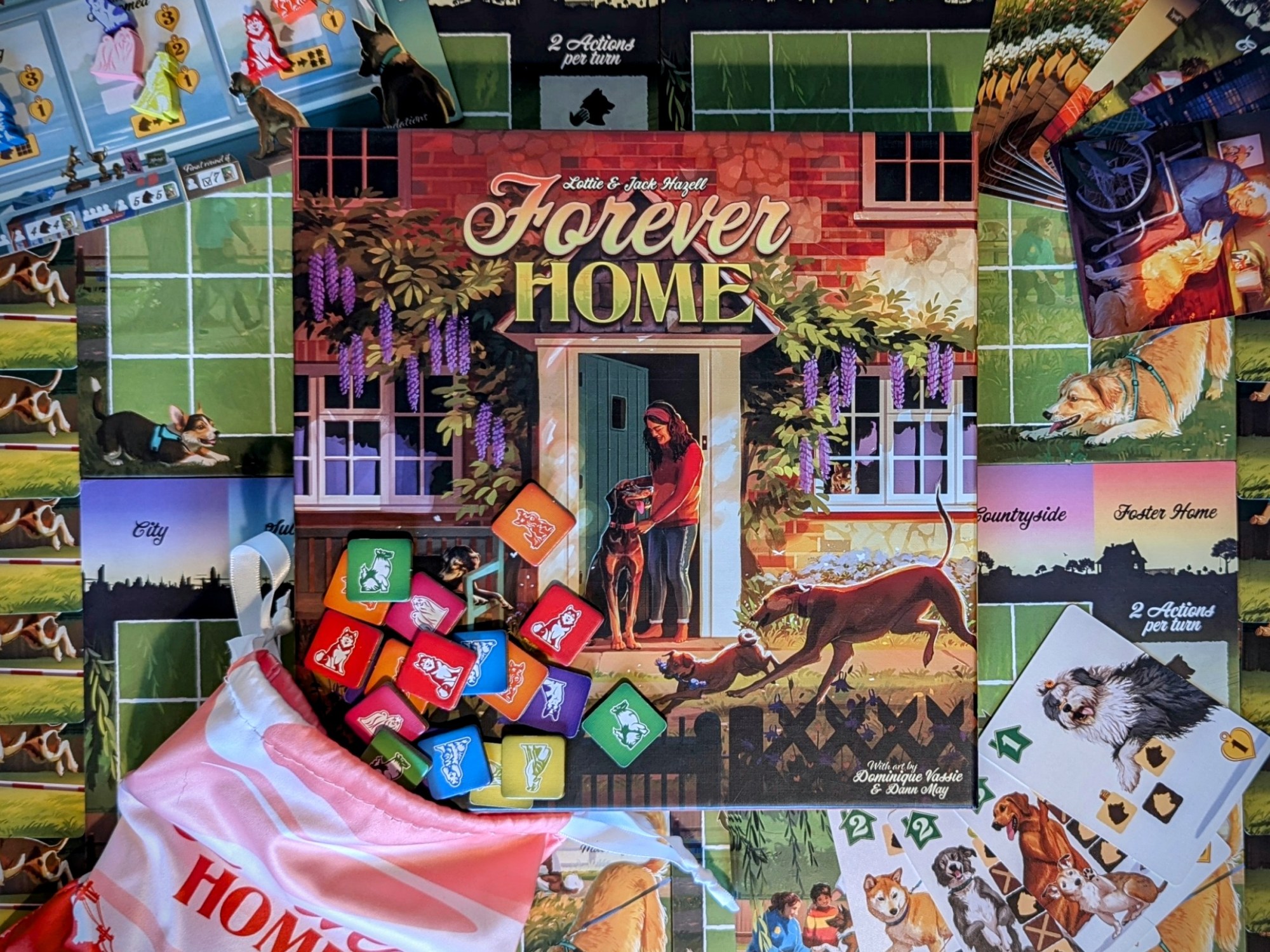
In Forever Home, players take on the role of shelter workers, training and rehoming dogs. It’s a heartwarming theme, but should you get your paws on it?
Game overview:
👥 1-5 players
⌛ 20-45 minutes
🧠 8 years and up
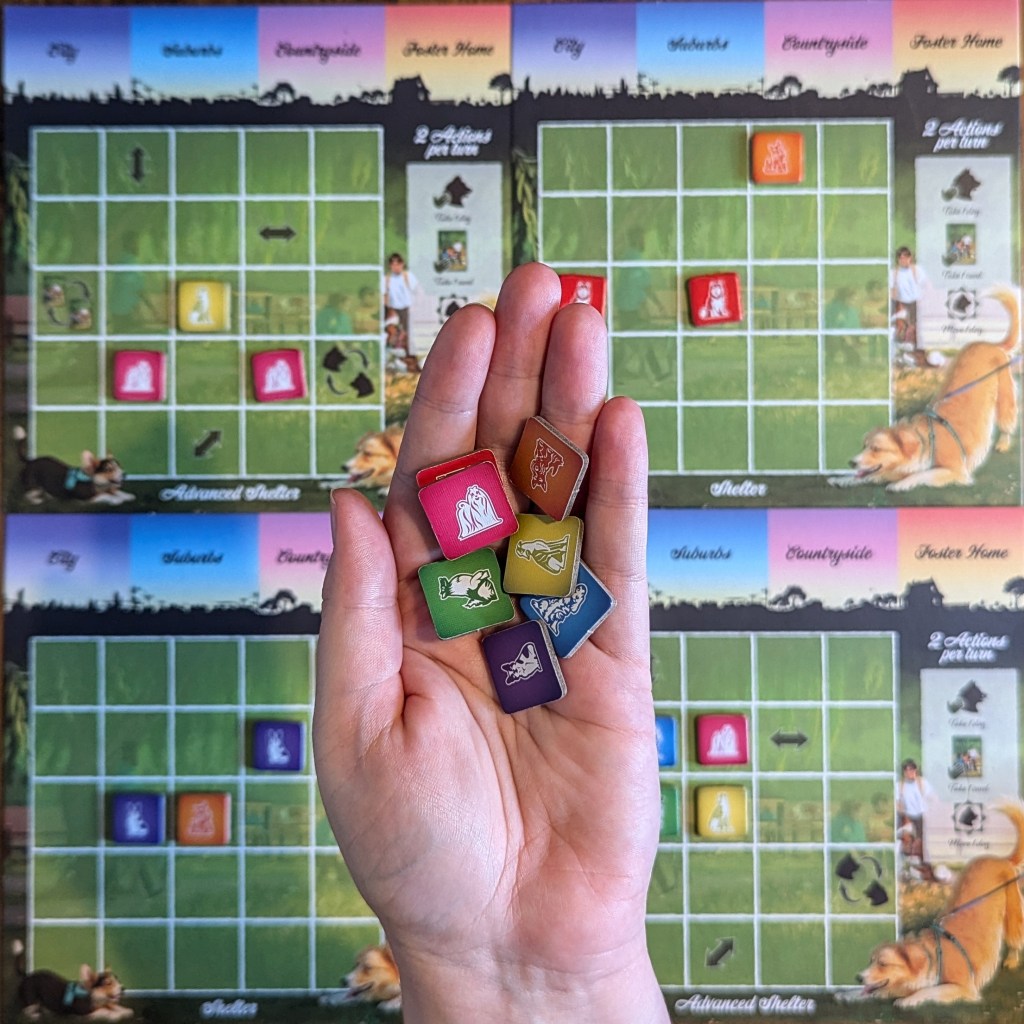
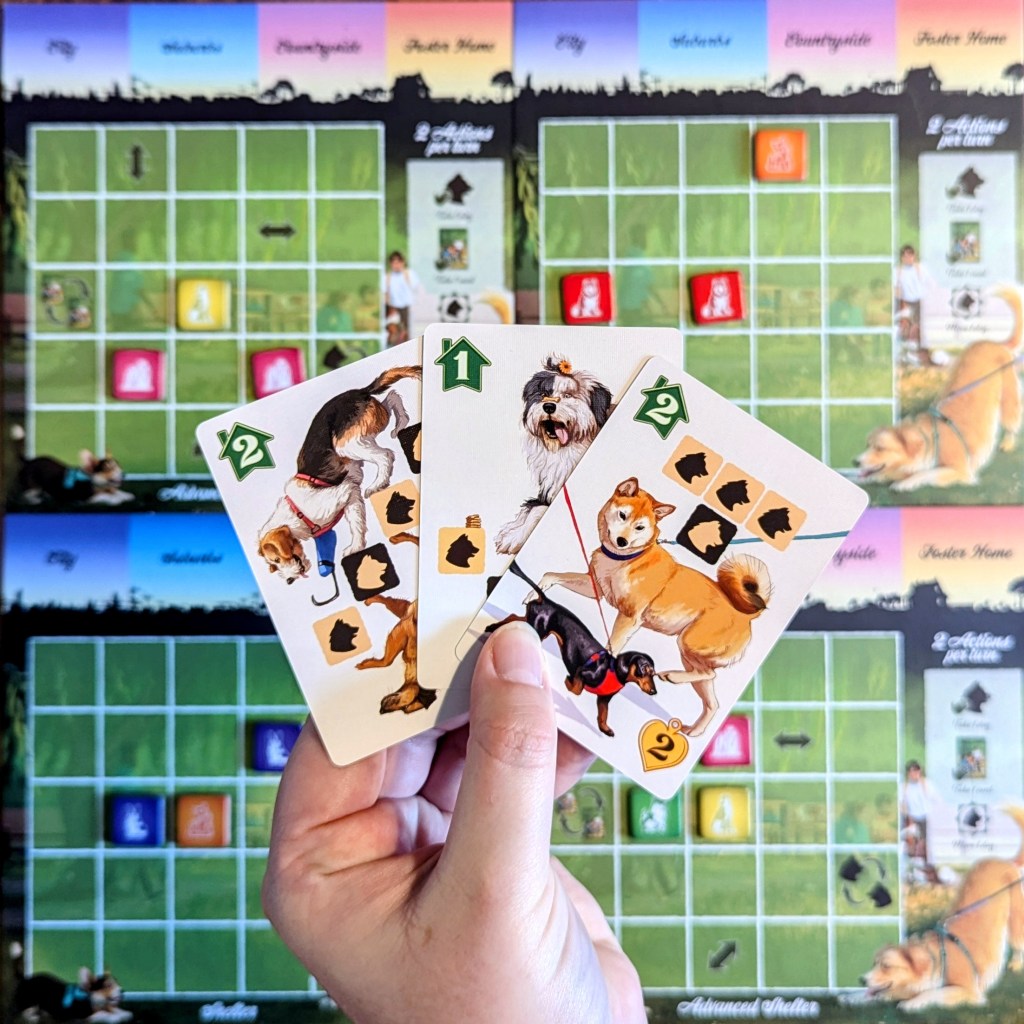
Players collect and place coloured dog tiles on their shelter board to make different patterns that complete trainer cards. Completed trainer cards let the player rehome a number of dogs (0-3) to either the Cities, Suburbs, Countryside, or Foster Home, which all score reputation points in different ways.

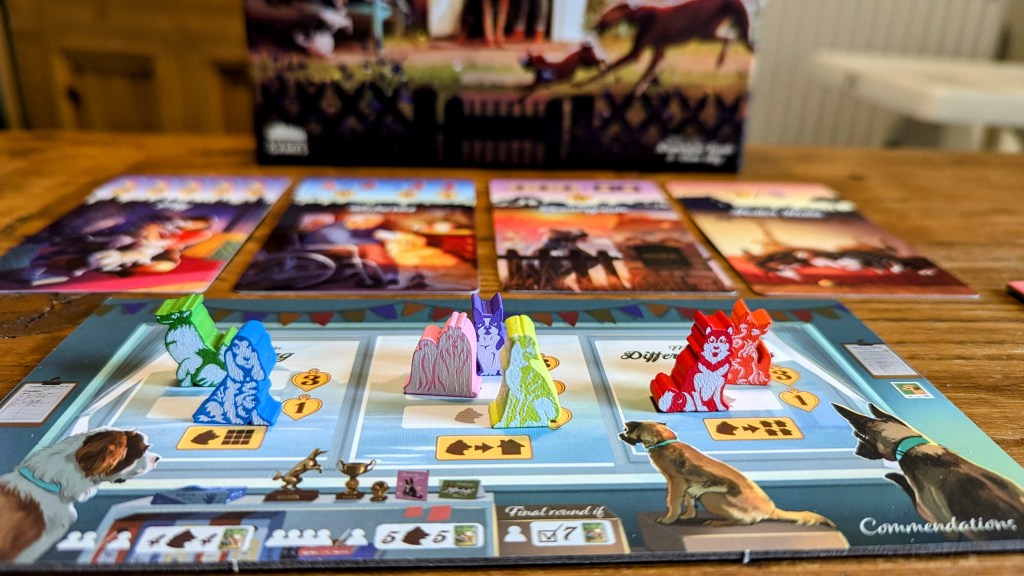
There’s also different shelter commendations for players to compete for, based on:
- Most of a specific dog in shelters
- Most of a specific dog rehomed
- Most homes that have a specific dog
Which specific dogs score for which commendation is randomly assigned at the start of the game using little dog meeples.The player with the most reputation through completed Training cards, Home card scoring and commendations wins!
On a player’s turn they take 2 actions of their choice (repeated action are allows):
- Take a dog tile from the central area and place it in their shelter.
- Take a training card from the central area and add it to their hand
- Move a dog tile that’s already in their shelter, 1 space in any direction.
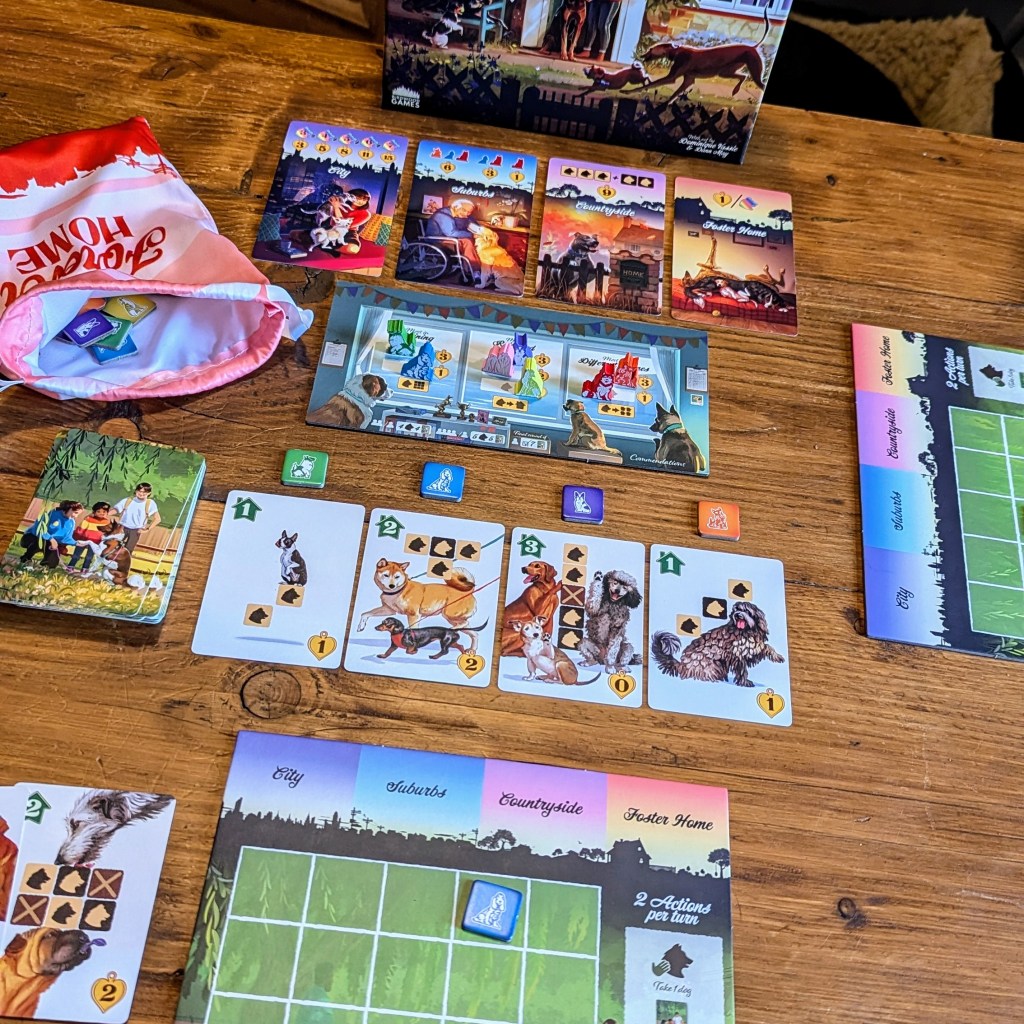
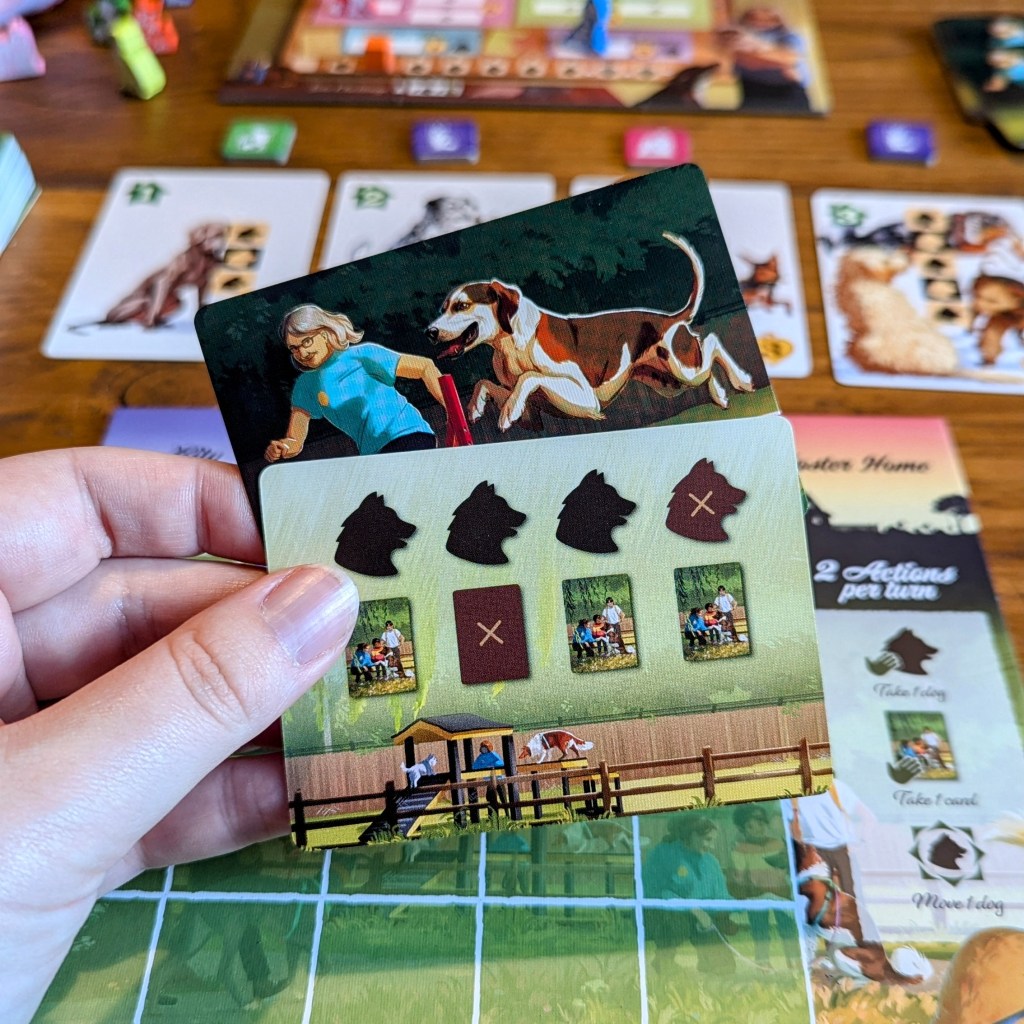
Completing training cards (and rehoming any dogs as a result) is a bonus action and happens as soon as you make the specified pattern on the card. The first player to complete 7 Training cards triggers the final round of the game.
Solo mode
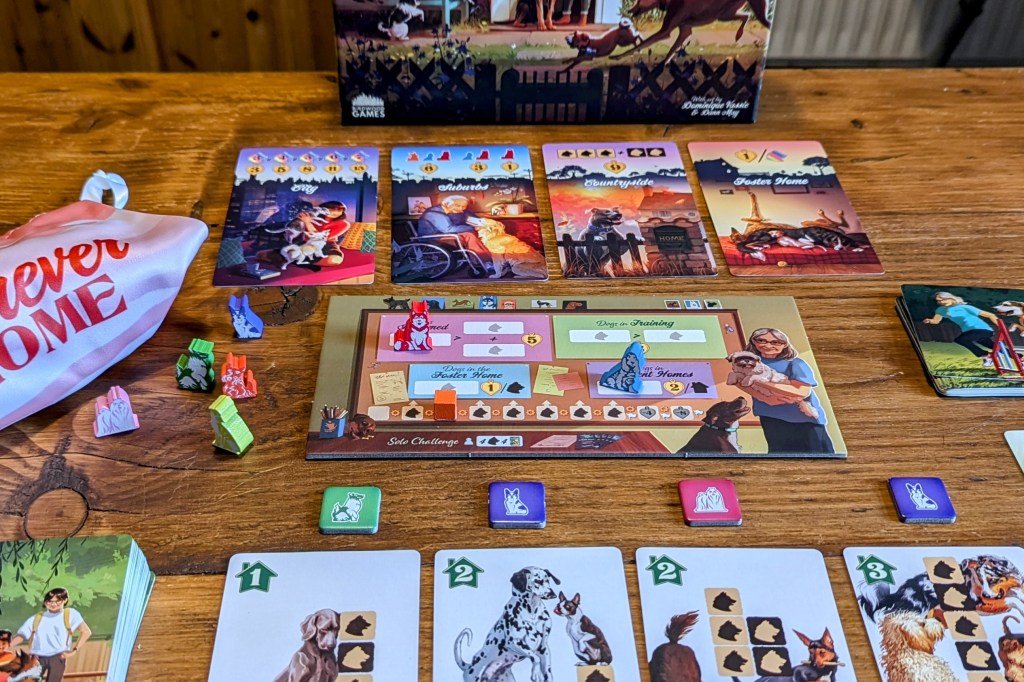
The solo game of Forever Home has some intriguing changes from multiplayer mode. The player turn remains the same, taking two actions of your choice. Afterwards, an Auto-Trainer takes their turn – you reveal a card from the solo deck that shows what dog tile(s) and/or training card(s) the Auto-Trainer will take from the central area. These are removed from the game and the central area is replenished as normal. It could involve taking two tiles, two cards, or one of each; the idea is to emulate another player taking a turn.
The biggest twist to the solo mode is that the commendations are swapped for solo challenges:
- Dogs rehomed
- Dogs in training
- Dogs in foster home
- Dogs in different homes
Rather than setting them at the start, which dogs apply to which challenges are decided throughout the game by the player! Between each player turn (after the Auto-Trainer), the player has to choose a dog meeple and place it on an empty space of the challenge board. Once the dog meeple has been placed, it’s locked in.
A solo game takes place over at least 8 rounds, when the player can choose to stop. If they want to continue (up to 10 rounds max), each extra round costs reputation points.
What we think:
Where to start with Forever Home – we love it! It combines two of our favourite board game elements: animals and abstract. We’ve played with 2-4 players, as well as solo mode, and it works well across all those player counts. It’s both light and puzzly, which makes it easy to get out and play to scratch that itch for spatial pattern building.
The game gives you a lot of ways to score points with the different homes and commendations, and you have to make a choice which ones you want to go for. There’s also a fair bit of variability in the play set up – i.e. the dogs for commendation, and there are a few different Home cards to choose from. This helps the game feel fresh and replayable.
The theme is heart melting, and the artwork is so cute – I was always noticing something new to “‘awww” at! It does suffer a little from that ‘pasted on’ feel that is so common with abstract games. That doesn’t bother us (it’s how I prefer my abstract games, if I’m honest!), but I know it’s not for everyone.
The theme is heart melting, and the artwork is so cute – I was always noticing something new to “‘awww” at!
A lot of people have praised Forever Home as a solo game. I don’t play a lot of solo board games, but I have to agree that playing solo Forever Home was immensely satisfying. The addition of deciding how the dog meeple should score elevated the thinkiness of the game. It definitely didn’t feel like you were missing out or not playing a ‘proper’ game.
The rulebook is mostly clear and well laid out. There are two elements that confused us and I think are worth highlighting:
- It doesn’t say whether your hand of Training cards is private or public, so we assume it’s private (as that’s the norm). As Training cards complete as soon as you make the pattern, it felt strange that you are relying on people to be honest, rather than ignore a completed pattern because they’re working towards a more complicated Trainer card (with a bigger reward).
- One of the commendations is ambiguously called “Most of a specific dog across different homes”. The explanation in the rule book makes it clear that this is NOT the total of the dog, but the total of different homes that dog is in, but we still had to double check what it meant for the first few games. Calling it “Most different homes that have a specific dog” would be clearer.
Our main criticism of the game (multiplayer) is that it feels like it ends too soon. You’re just getting into a rhythm, setting up potential patterns and planning ahead, when suddenly someone has completed their 7th card and it’s the endgame. We got used to it the more games we played, but it still feels a bit abrupt (because we’re enjoying the pattern-building so much!).

What we like:
- Puzzly pattern goodness. Every time you complete a training card it feels like a little win.
- Variation of home cards and commendations make it feel fresh and replayable.
- Solo mode is lush – challenging and satisfying.
- It’s clearly designed with love, and this really comes across in the cute artwork
What we don’t like:
- The game feels over too soon.
- Possible flaw relying on honesty to complete training cards.
- No black labradors – our labrador Rosie was gutted (and says so in her review of Forever Home and Dog Park).
Final thoughts:
I’ve seen a few people suggest Forever Home is a gateway game (I’m not going to get into my view on ‘gateway game’ as a term here!). I disagree. While I can see that argument based on the pattern-building gameplay on its own, the multiple scoring avenues pushes it above a gateway level game in complexity (particularly the commendations, which I’ve found people struggle to get their heads around until they’ve played their first game – even gamers). It is a lighter game, but for us Forever Home strikes a nice balance of simple abstract and puzzly thinking. We loved playing it so much we had to buy our own copy!
…Forever Home strikes a nice balance of simple abstract and puzzly thinking. We loved playing it so much we had to buy our own copy!
While researching for this post, we saw that Birdwood Games has an incredible initiative, “Our Board Games Give Back”. Each of their games have a Charity Partner, and a portion of the game profits go to that charity. For Forever Home, they are fittingly working with a shelter charity called Misfit Mutts Dog Rescue. We want to applaud Birdwood for this.
____
This game was kindly loaned by Birdwood Games via the UK Board Game Review Circle (although we did buy our own copy after this!). All opinions are ours and our reviews are always honest.

 Our Board Game Life
One thought on “Forever Home – Review”